Until about ten years ago, I was familiar with just two types of Chinese lanterns. The first type is the colorful, paper-covered lanterns that people string aloft for nighttime street festivals or to brighten up patio parties. These date back nearly 2,000 years, though the candles once used inside these lanterns have mostly given way to electric lights. The second type I’ve long known about are ornamental Chinese lantern plants. They don’t give off light, but they bear small, berry-like fruits that are encased within papery, red-orange husks shaped much like real Chinese lanterns.
But there is a third sort of Chinese lantern, and it’s an invasive bug native to China. Although it has bright, cheery colors that earned it the name spotted lanternfly, it brings anything but cheer to orchards, vineyards, forests, and backyards.
The spotted lanternfly (SLF) was unknown in North America until 2014 when it turned up in Berks County, Pennsylvania. Apparently, SLF egg masses came here on pallets of landscaping stones from China. I was surprised that Pennsylvania was apparently so short on rocks that they needed to order them from Asia. Had this deficit come to light earlier, I know lots of farmers who would have gladly donated rocks they pulled from their fields, thus saving a lot of grief.
If only it were a laughing matter. Now established in 19 states plus the District of Columbia, spotted lanternflies have become a significant pest of numerous tree species as they feed on sap in great numbers and weaken trees. They are especially fond of grapes vines, and have caused severe damage to vineyards. They also feed on some non-woody plants. In short, just about anything green.
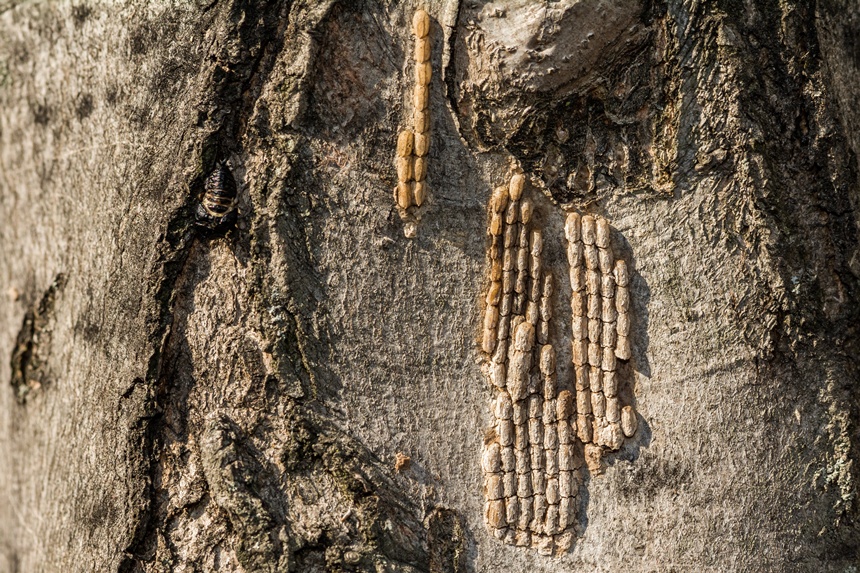
Prolific breeders, spotted lanternfly females plaster their grayish, foam-like egg masses (similar to those of the spongy moth) on all manner of rough surfaces including tree bark, rusty metal, and stones. The juveniles or nymphs look nothing like the adults. Black with white spots, nymphs molt several times before maturing, becoming mostly red in their last “childhood” phase.
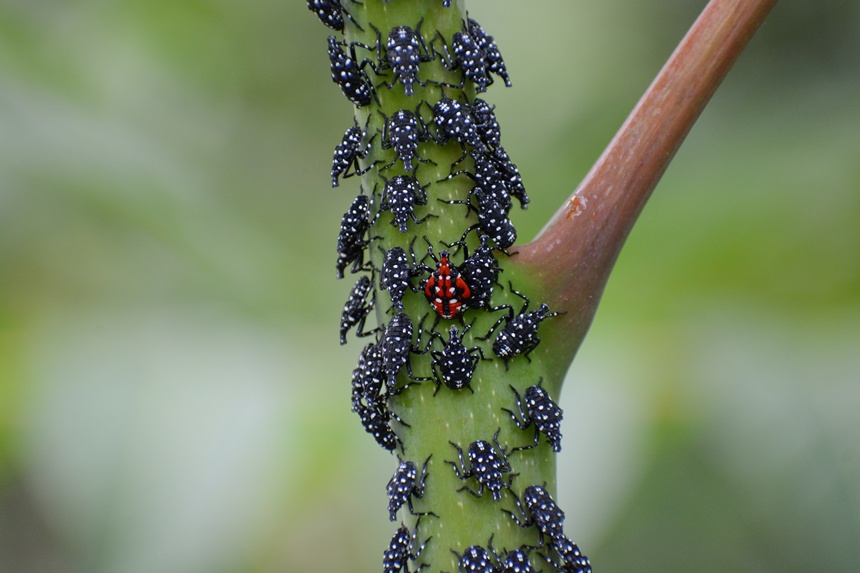
Its name is confusing because it’s not a fly. And it definitely isn’t a lantern, I’m pretty sure. And while the adult closely resembles a moth, it’s not that either. It is a hemiptera, or true bug, related to walking-stick bugs and giant water beetles. Like all hemipteras, spotted lanternflies have piercing mouthparts, and they use these to great effect, draining sap from plant tissues.
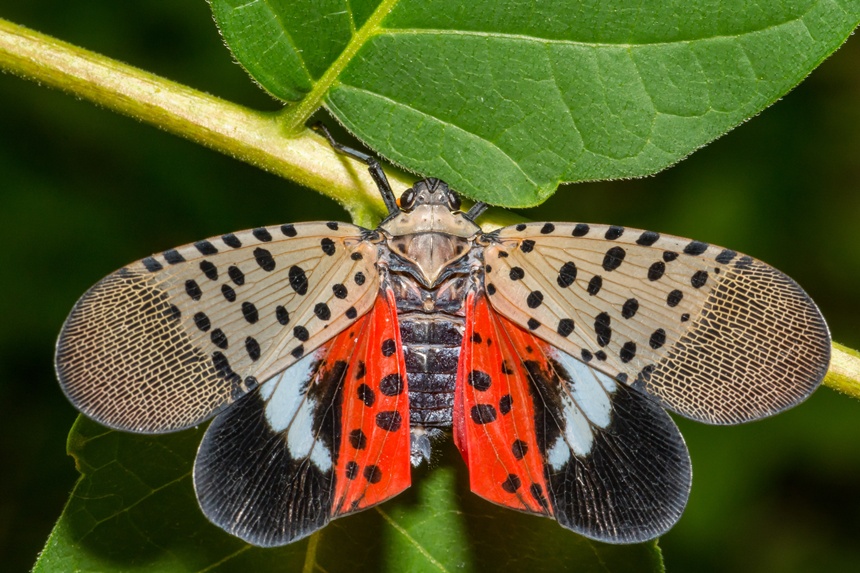
While some of the worst invasive pests such as Asian longhorn beetles and emerald ash borers have harmless native look-alikes, the lanternfly is impossible to confuse with any other insect. Here is a USDA description: “Adults are about an inch long by a half-inch wide, with large, visually striking wings. Forewings are light brown with black spots in front and a speckled band at the rear. Hind wings are scarlet with black spots in front and white and black bars at the rear. Abdomen is yellow with black bars.”
The tree-of-heaven (Ailanthus altissima) is a noxious, invasive weed-tree from Asia that makes boxelders look great by comparison. Lanternflies attack tree-of-heaven before any other species. One would think this is a good thing: An invasive pest takes out an invasive plant – problem solved. The thing is that SLFs will feed on a tremendous range of hosts when it runs out of its favorite food.
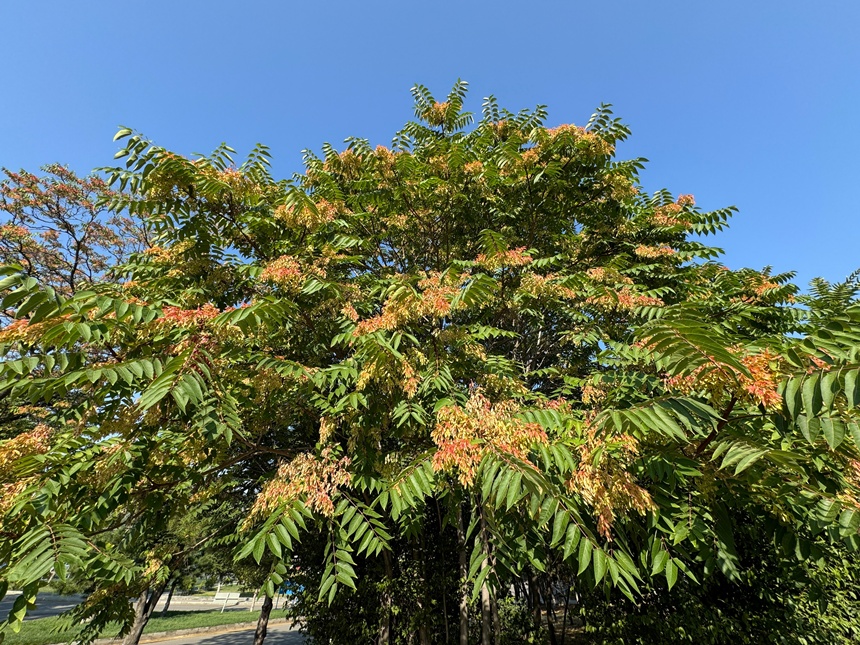
Where tree-of-heaven does occur, it can serve as a sort of early-warning device since it is where SLFs will show up first. In addition, it is possible to use tree-of-heaven to fight spotted lanternfly. Infested trees-of-heaven are being treated with systemic products that kill any lanternfly that feeds on a treated tree.
For obvious reasons, Penn State entomologists have taken the lead in researching SLFs, and are working in conjunction with U.S. and Pennsylvania Departments of Agriculture. Among other things they want to find are its natural enemies, be they predators, parasitoids or diseases. While parasitic wasp species hold promise as natural control agents, they have not yet made a dent in SLF populations. In 2019, researchers at Cornell University discovered two native fungi that attack and kill lanternflies, but success has been limited due to the difficulty in scaling up fungal populations.
If you’re seeing these critters for the first time, the USDA’s National Invasive Species Information Center recommends you report them to your local Extension office or your state’s department of environmental protection. You can also make a report using a phone app like EDDMaps or iNaturalist. They do sometimes find their way indoors, although not a big offender in this regard. Adults do not overwinter, though, and intruders typically die of their own accord within 48 hours. Sweep up any you find, and dump them in a few inches of soapy water, which will kill them.
Given that Christmas is not far off, you should be aware that spotted lanternflies sometimes lay eggs on tree trunks on Christmas tree farms. Although tree farmers are aware of this and actively look for and destroy egg masses they find, on rare occasions a Christmas tree with a lanternfly egg mass gets into the hands of a consumer. If you buy a real tree, inspect it carefully when you get it home. Egg masses are shiny and brownish when fresh, but darken and become duller over time and are harder, though not impossible, to see. Scrape off the egg mass into soapy water, which will destroy the eggs. This holiday season, the only Chinese lanterns in should be the decorative kind.
Become a Saturday Evening Post member and enjoy unlimited access. Subscribe now