Earlier this year, I challenged readers to make 2026 the Year of the Native Plant. After spending the year talking about natives, flowers, lawns, pollinators, and leaves, I intentionally saved one topic for last: invasive plants.
We tend to use invasive rather loosely, sometimes applying it to any plant that grows aggressively, spreads farther than we intended, or simply refuses to stay where we put it. But ecologically, the word has a much narrower meaning. Researchers with the University of Florida’s Institute of Food and Agricultural Sciences recommend reserving invasive for a nonnative species introduced by humans that causes — or is likely to cause — environmental, economic, or human harm. A native plant may be rambunctious; it may become a nuisance. It may, like my jumpseed, even take over a corner of your yard. But a native plant cannot, by definition, be invasive.
So why does that distinction matter? What does it actually mean to have a truly invasive plant growing in your yard?
Invasive plants can crowd out native species, replacing diverse plant communities with dense stands of only one or a few species. As plant diversity declines, so does the variety of resources available to insects and wildlife. And because many invasive plants spread readily by seed, roots, runners, or fragments, a problem that begins in one yard rarely stays there.
Birds carry berries, lawn equipment moves plant material, and some ornamentals simply escape the places where we planted them. Every square foot occupied by an invasive vine, shrub, or groundcover is space that could instead support a diverse community of native plants —and the insects, birds, and other wildlife that depend on them.
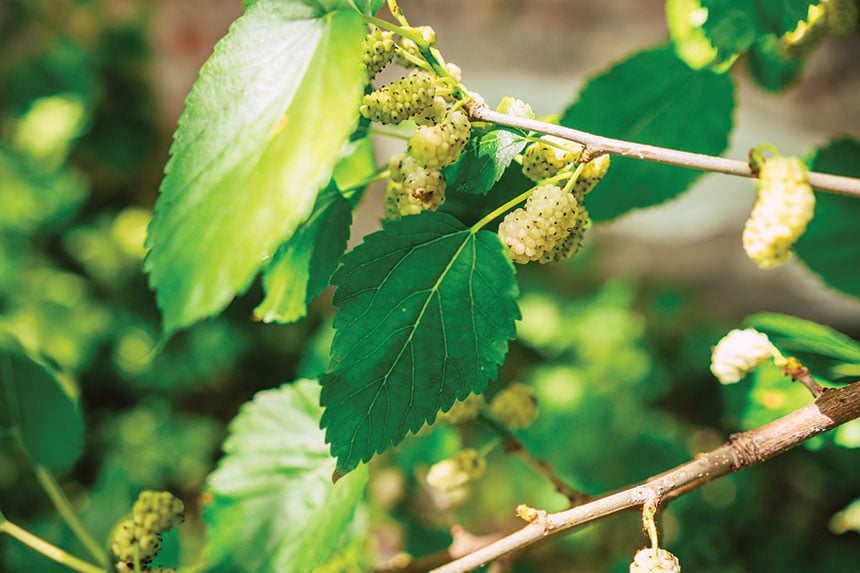
A few years ago, I attended a presentation from Invasives Free USA at a Southern Indiana Cooperative Invasives Management conference. The presenter acknowledged that an invasive-free country is an ambitious goal, so they offered a much smaller challenge: identify one invasive species on your property and commit to removing it. I took them up on it. My target was white mulberry, an invasive relative of our native red mulberry, and during one particularly ambitious week I removed every one I could find in my yard.
I considered targeting wintercreeper, but that would have been another matter entirely. It crept into my backyard from three adjoining properties, appeared in the front yard, and even grew through the lawn. I battled it for years, and even complete removal in my own yard would have required continual follow-up, as plants from the surrounding neighborhood continued to provide new sources for reinvasion.
As tempting as it is to tackle everything at once, trying to eradicate every invasive species can make the task feel Sisyphean — a lesson I have repeatedly insisted on learning the hard way. Choosing just one turns an enormous ecological problem into something you can actually accomplish.
Every landscape reflects thousands of small decisions: what to plant, what to pull, what to leave, and what to replace. If you’ve planted native this year, mowed a little less, left the leaves a little longer, or simply learned to see your yard through a more ecological lens, you have already made some of them. As we head into a new year, consider one more: Identify one invasive plant species, work to remove it, and replace it with something native.
Planting natives is only half the equation. Sometimes ecological restoration in your own backyard begins by deciding what doesn’t belong — and making room for what does.
—Mary Margaret Moffett is an ecologist and Advanced Indiana Master Naturalist
This article is featured in the November/December 2026 issue of The Saturday Evening Post.
Become a Saturday Evening Post member and enjoy unlimited access. Subscribe now