The trek up the mountain was a demanding and unrelenting slog. After more than a week of perfect weather here in Africa, the skies had opened up the night before, making the trails a muddy mess. We hiked for hours up a cut path before guides using machetes hacked into the suffocating jungle vegetation, leading us deeper into the forest.
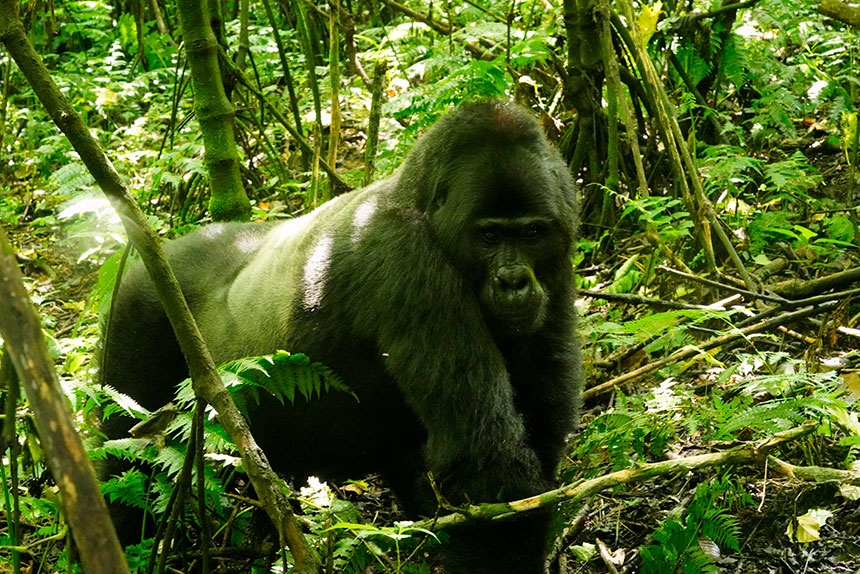
Uganda’s Bwindi Impenetrable National Park — a UNESCO World Heritage Site — is home to about half of the world’s endangered mountain gorilla population, and I traveled halfway around the globe and up this steep and dense mountain forest to see them up close and in person. There are no roads leading to the gorilla habitat, so we hiked up to around 8,500 feet, where many of the estimated 460 gorillas in the park live, feeding on abundant vegetation, such as fruit and tree leaves.
Eight other foreign tourists were hiking with me in a so-called medium-difficulty group. As we struggled upward, I asked myself, “If this is what they consider medium difficulty, what do they consider hard?” The others were mostly older than me, but tackled the trail like fleece-vest-wearing machines. We were joined by our local guide Joshua, two armed guards, and a gaggle of porters carrying bags filled with expensive camera gear. I routinely do hard hikes with a heavy pack, so I was reluctant to hire a porter. But because my driver Joseph strongly encouraged it, I relented. The further up we hiked, the gladder I was.
As we neared the two dozen or so gorillas moving through the forest, we donned simple face masks. Gorillas are highly susceptible to human illnesses; a human-caused respiratory disease could quickly infect a family. I didn’t want to be responsible for inflicting a plague among their species; with so few gorillas left in the wild, losing an extended family could be catastrophic.
Finally, we were overlooking a clearing where the mountain gorillas were moving across the landscape, leisurely eating. I would have been happy there, observing from afar, but the guides motioned for us to get even closer. At the edge of the clearing, the gorillas ambled through our group, seemingly indifferent to the new visitors. I held my breath as a massive silverback strutted past on his way to a tree stump, where one of his offspring sat rolling in the grass. The guide waved me to follow from a respectful distance until I was just feet away from that dominant silverback and his baby. It was so close, I could have reached out and touched its fur.
Here was a wild animal with the strength to rip me limb from limb, but it couldn’t have been more tender with its progeny. I wasn’t scared — these gorilla colonies have been acclimated to human presence, likely seeing us as harmless and hairless interlopers — but rather in immense awe. I came to Uganda too see the gorillas, but took away so much more.
It takes two to three years to habituate gorilla families to human presence, says guide Said Katungi, emphasizing that they’re not making the gorillas dependent on humans. The gorillas are never fed or otherwise bribed for contact; instead, trained guides come back day after day to acclimate the apes and show them humans aren’t a threat. Gorillas can display some aggression at first, but after repeated visits, gorillas learn to basically ignore them. In turn, human visitors are taught basic gorilla etiquette — give them space, never look them in the eye, don’t mimic any sounds they may make, and never, ever touch them.
We spent about an hour with the gorillas, every second of which was magical. Each visitor took turns for the best camera angles, rotating out every few minutes and moving onto another gorilla relaxing, eating a leisurely lunch, or just living their life.
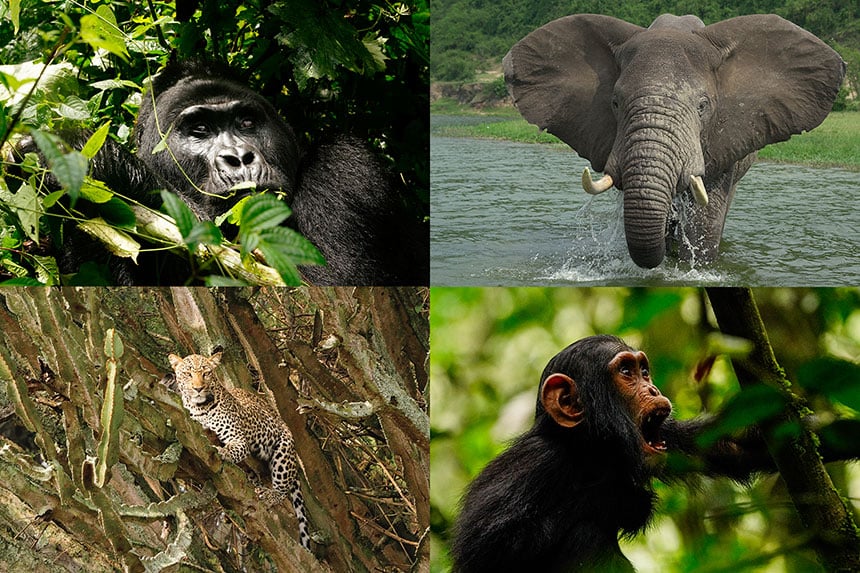
The experience with the mountain gorillas was the culmination of a week of travel throughout Uganda, where I not only got a chance to see great gorillas and chimpanzees up close, but also elephants, lions, leopards, and more. I learned more about the people living in the nearby villages, and how the fates of the animals and humans in those surrounding communities are utterly intertwined.
The trip started inauspiciously, with Brussels Airlines losing my luggage during the trip. So for the first several days in Africa, I was wearing the same clothes and using borrowed toiletries. Luckily all my camera gear was in a carry-on that I refused to let out of my sight. Wearing the same pair of underpants for several days wasn’t ideal, but I’d be damned if I wasn’t getting the photographs I wanted. (Thankfully, the lodge where I was staying was able to launder my clothes most nights until my luggage was returned to me.)
After another flight to a grass airstrip outside the town of Kasese, I headed toward Volcanoes Safari’s Kibale Lodge, which would be my basecamp for the next couple of days. Being my first time to Africa, I had no idea what to expect, but the surrounding landscape was lush and green, a sign that the rainy season had just begun.
Abutting the lodge, Kibali National Park is home to 71 species of mammals, 350 species of trees, and around 375 endemic and migratory birds.
We share more than 98 percent of our DNA with chimpanzees. In many ways, watching them is like standing in front of a mirror. Before hiking into the forest, I talked with primatologist Dr. Emily Otali, field director of the Kibale Chimpanzee Project. I learned that the chimps have their own elaborate vocal and gestural repertoire, essentially their own language. As with the gorillas, I was warned not to mimic anything I heard or saw as I couldn’t speak their language and could risk accidentally saying the wrong thing, like a drunk American tourist stumbling upon a Korean wedding.
“Chimpanzees can be fun and playful, but they can also be vicious bullies as well,” Otali says, “just like us.”
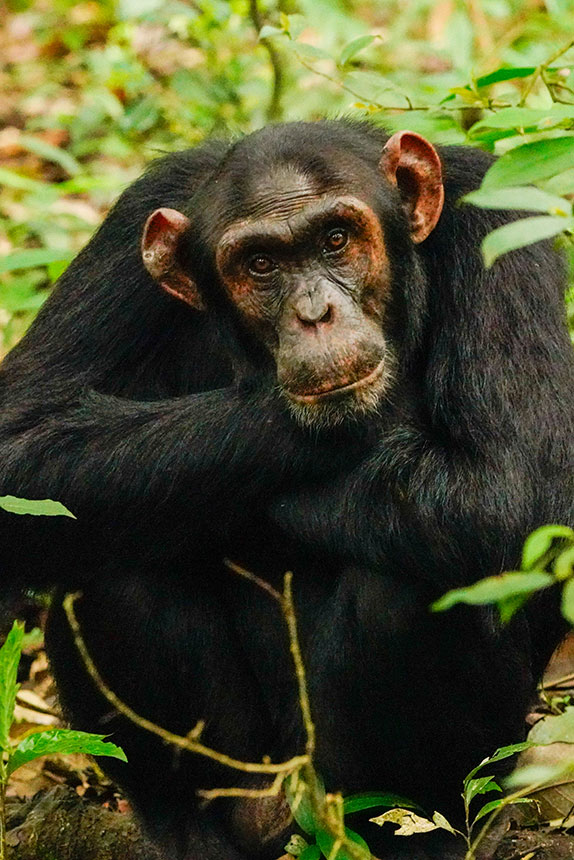
Luckily, I was the only visitor in my group, and so the guide, an armed guard, and I headed into the jungle together. We hiked about three miles, when my guide pointed upward to a chimpanzee above us eating leaves in a tree. A few steps to the left, a seemingly older chimp walked past before sitting down maybe five yards away. He tucked his arms and gave me a world-weary stare that led to one of my favorite photographs of the trip. I would give nearly anything to know what he was thinking as I took shot after shot. Within moments, it felt as if I were surrounded by chimps. Most were eating — about half their day is devoted to eating leaves, fruits, and smaller animals. Bands of chimps do fight each other, and the victors can cannibalize their fallen rivals.
I was thinking about this when the entire jungle canopy exploded into chaos. Chimpanzees were screaming, jumping, and running; one chimp brushed my pant leg as it charged past me. It was a little terrifying, almost like being in the middle of a war zone and you don’t know what to do and all the instructions are being screamed at you in a language you’ve never heard before. This went on for about 30 seconds before the sea of simians calmed in a matter of seconds. No one really knows why they do it.
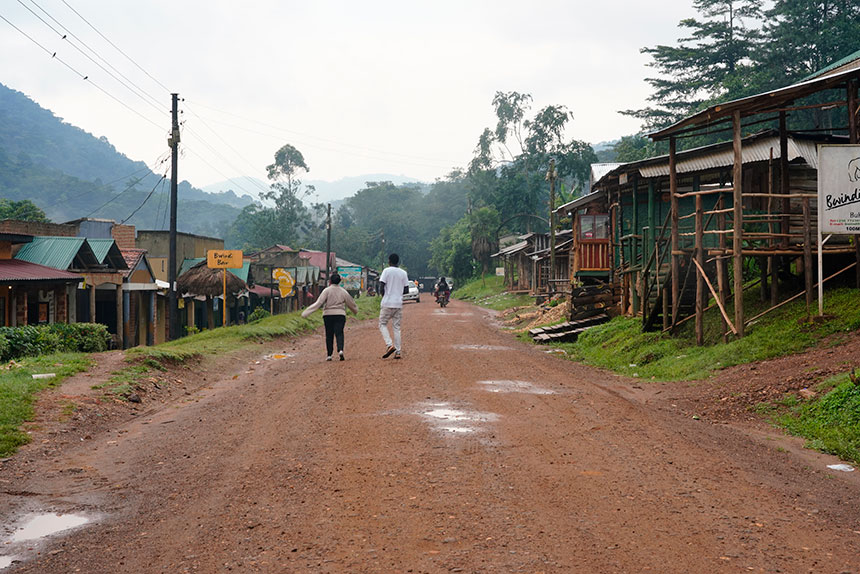
Driving from park to park, it’s impossible not to notice the incredible poverty in the rural villages. It can’t be comprehended without seeing it for yourself. Homes are typically wood-pole shacks with thatched-grass roofs or old shipping containers placed on dirt ground. Young men who can afford a motorcycle typically earn a living as a boda-boda, shuffling people and goods from village to village, as personal vehicles are nearly nonexistent. Most families get by through subsistence farming, but it can be a tough life.
“People work very hard,” Joseph says. “They’re satisfied with their lives.”
Mining is one of the main industries in Uganda, Joseph tells me as we pass through a small city on the outskirts of an extraction site. But most mines are owned by non-Ugandans, and ore is taken outside the country to refine, so both the resources and the bulk of the money leave the country. It’s a pattern of exploitation that’s been going on for centuries. The scars of colonialism run deep.
But the standards of living in the villages are improving, thanks mainly to animal tourism. Wildlife tourism is not only sustainable, but it also allows Ugandans more control and greater say in their future. About 20 percent of park revenues is given directly to the villages, who decide where the money will be allocated, says guide Said Katungi. Near Bwindi, the money has gone to bring clean drinking water into the villages, better roads, small-business grants, and a much-needed hospital.
“Working with the animals has been a childhood passion,” Katungi says. “My uncle was a guide, and when I was young, I got a chance to see monkeys and baboons. I help to habituate these gorilla families, and [in turn] help improve the lives of the people who live here through improved infrastructure and more jobs.”
My Bwindi porter, also named Joseph, was a slight 35-year-old with a wife and four kids. He’d been carrying heavy camera bags up these mountains for more than a decade, typically earning $10 per tourist, plus tips. Villagers’ daily wages average about $3, so this is a good gig. In addition to the pay, the government provides grants to help pay for his children’s education.
While women guides are still fairly rare, the numbers are rising. Marion Ninsiimi led me through the Bigodi Wetland, where we hoped to spot rare red colobus monkeys. She’s proud to be a role model for young women hoping to break into the tourism industry and tries to spread the word about tourism as a way to raise up local communities.
“We’re not taking anything from the land,” Ninsiimi says. “It gives me immense pride to show visitors our country’s gifts. It’s my hope we can boost conservation programming and preserve [wildlife habitat] so that we can have even more tourists 10 years from now.”
The coexistence of humans and gorillas (and other apes) has been built up over the decades. Years ago, when a gorilla traveled down into the valley to eat a farmer’s crop, the ape would often be killed. Bush meat trade was rampant. Now villagers are trained to safely return the ape back to their habitat after they’re found in the villages or fields. Any damage done is reported to the government, which pays for the destroyed crops. Poaching of apes has dwindled; antelopes and bush pigs are still frequent targets of illegal poaching, although gorillas can sometimes get caught in snares meant for other animals.
Local lodges also provide assistance directly to villagers. Volcanoes Safaris buys the bulk of its food from local farmers; during COVID, when the lodges were essentially empty, they redistributed that food to locals. The company has helped buy new farmers seeds, tools, and even goats.
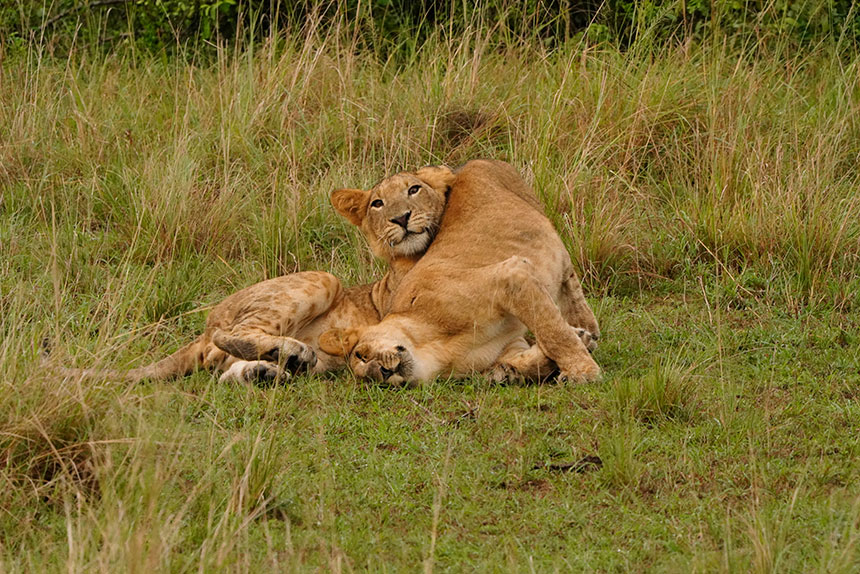
Although Uganda is most well-known for its rare gorillas and other primates, plenty of other charismatic mammals also call it home. The Kyambura Lion Monitoring Project, which started three years ago, keeps tabs on the lions in a section of Queen Elizabeth National Park. More than 400 lions called this section of Uganda home a decade or so ago, but now that number has dwindled to around 60. Researchers with the project use tracking collars and camera traps to keep tabs on the lions, ensuring not only that they’re healthy, but also that they don’t leave park boundaries and hunt local livestock.
The radio collars have another benefit, allowing tourist-towing trackers to find them in the park. Joseph and I arrived to a meeting spot before sunrise, soon following a convoy of classic and brand-new Land Rovers just as the sun was beginning to wash over the savannah. Twenty minutes later, we watched a pack of six lions sneak up on and attack a buffalo, which managed to fight them off. We followed the lions as they regrouped nearby, the two cubs playfully tussling with one another. Later in the morning, we spotted a lone leopard sitting in the branches of a thorny spinosa tree, looking majestic and carefree.
The next day in Queen Elizabeth National Park, another guide and I cruised the Kazinga Channel, looking for even more wildlife. I love elephants, and I hoped we’d see a few on the banks. In fact, we saw dozens, all of whom seemed to be having the time of their lives. They trumpeted, playfully wrestled with one another, and enjoyed the abundant water.
Leaving Bwindi Lodge and heading to another grass airstrip, I tried to put my experiences in perspective before I flew back home. I had come to Uganda to see the endangered mountain gorillas, but came away so much more optimistic than I dreamed possible. Meeting the guides, veterinarians, and staff working so hard to save these great apes while helping their own communities gave me hope for the future.
Robert Annis is an award-winning outdoor-travel journalist (and certified bear guide!) with work appearing in National Geographic, Outside, Sierra, Men’s Journal, and the Chicago Tribune.
This article is featured in the November/December 2026 issue of The Saturday Evening Post.
Become a Saturday Evening Post member and enjoy unlimited access. Subscribe now