Within the last year and a half, America’s three major airlines — Delta Air Lines, United Airlines, and American Airlines — all celebrated their 100th anniversaries. Not all of those years were spent transporting customers, though, and even when passenger service began, air travel took over two decades to become mainstream.
Since then, the commercial air industry has evolved through the Jet Age, taken shape through competition and government deregulation, and survived the mergers and acquisitions that made it what it is today. It has opened the world to the average American and made a trip to Asia almost as easy as one to a city 12 hours away.
From the moment the Wright brothers made their historic first powered flight in 1903, passenger air travel was inevitable. As early as 1914, the St. Petersburg-Tampa Airboat Line began transporting one paying customer at a time between its namesake cities, but the air service only lasted three months. Other small companies followed and failed just as quickly.
After World War I, the U.S. military sold surplus military aircraft, including its Curtiss JN “Jenny” biplanes, for cheap. Mostly ex-military pilots purchased them, and many toured the country performing aerobatics to try to generate interest in aircraft. Part of their efforts included giving inexpensive rides, which inspired a generation of aviation-crazy youth.
“It was the first time these kids and so many adults had ridden in a plane,” says Matthew Burchette, senior curator at The Museum of Flight in Seattle. He adds that youth interest spawned a whole genre of young adult novels featuring teenage pilots who use their “loyal plane” to bring lawbreakers like smugglers to justice.
Despite the public’s growing fascination with airplanes, the infrastructure to support commercial air travel — aircraft fleets, centralized airports, and regularly scheduled flights — didn’t exist. Bob van der Linden, curator for air transportation at the National Air and Space Museum in Washington, D.C., says Congress passing the Contract Air Mail Act in 1925 changed that.
The act allowed the government to contract with companies to transport mail long distances by air. However, the goal was eventually to transport people, too. While entrepreneurs began the bidding process, the government determined routes and rates. In April 1926, the companies that would become United Airlines and American Airlines were among those receiving contracts. Delta Air Lines wouldn’t receive an airmail contract until 1934. Instead, the airline partnered with the USDA in 1925 — one year before the airmail contracts — to crop dust cotton fields plagued by boll weevils, mostly in the Mississippi Delta Region.
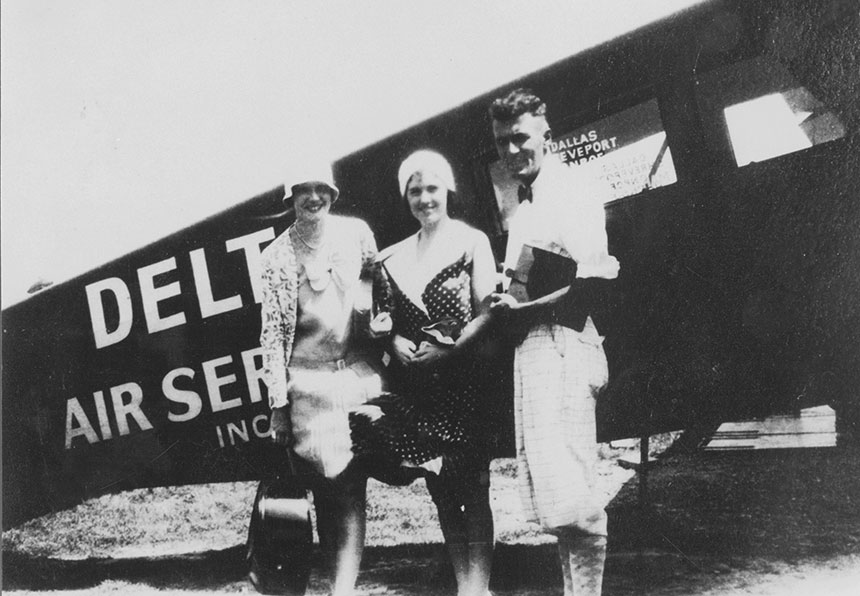
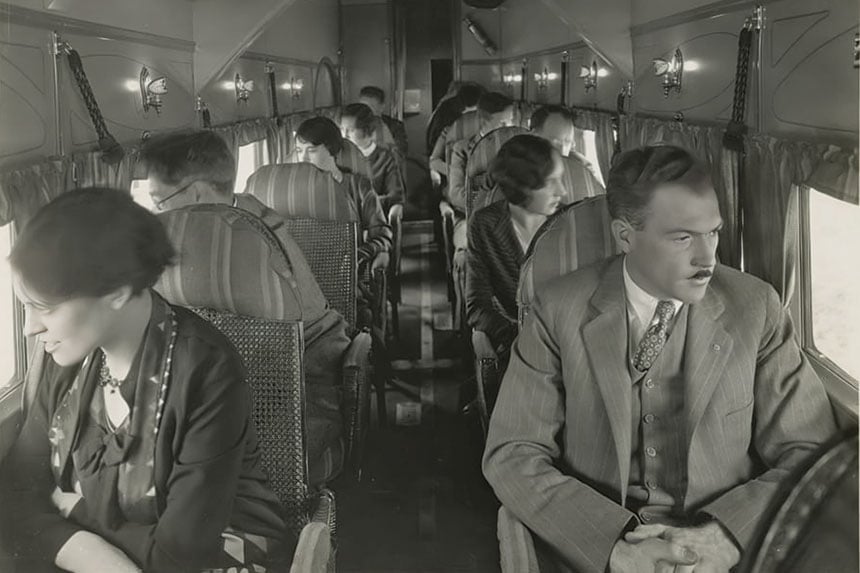
Van der Linden, who wrote Airlines and Air Mail: The Post Office and the Birth of the Commercial Aviation Industry, says the postmaster general at the time, Walter F. Brown, kept focus on the goal of eventually transporting passengers. In 1930, he told the aircraft companies they needed to start carrying passengers in addition to the mail. They agreed, but reluctantly. “Airlines didn’t want to fly passengers because you had to keep them warm and comfortable,” van der Linden explains. “Mail didn’t complain.”
The first passengers had plenty to complain about after boarding their flight. Since aircraft flew by visuals at the time, they had to stay below 10,000 feet, which also meant they couldn’t get above bad weather. (Commercial aircraft today usually fly at 30,000 to 40,000 feet.) Van der Linden says air sickness was so common, especially on Ford Trimotors, that the crew handed out chewing gum to help passengers settle their stomachs and a Dixie-like cup in case they got sick.
Passengers also received cotton wads to stick in their ears because the aircraft were so loud. According to Burchette, the noise from a Ford Trimotor could reach 120 decibels, the equivalent of a rock concert or clap of thunder directly overhead. In fact, it was so loud that the male stewards — and later female stewardesses — would have to yell at passengers through a megaphone to be heard.
Still, people flew because air travel saved time. Only two generations before, it had taken people months to cross the country by wagon. Now, by a combination of plane and train, they could get from New York City to Los Angeles in 48 hours. With the introduction of the Boeing 247 in 1933, the same trip took only 20 hours.
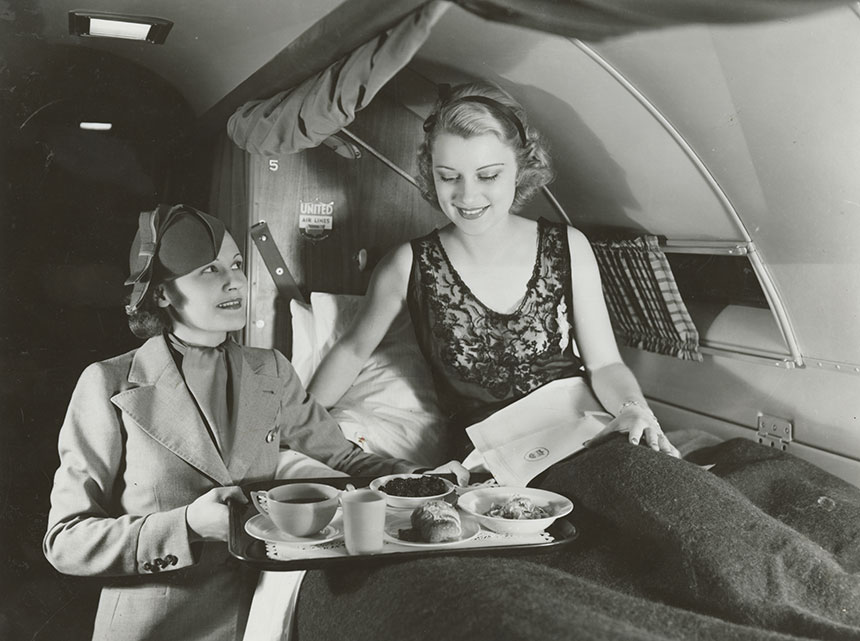
William Turner, vice president of operations for the Hiller Aviation Museum in the Bay Area, points out that passengers also put up with the noise and air sickness because flying was a status symbol. Only the rich could afford it, and it offered the height of luxury, including chef-prepared meals and fine china place settings.
“It was elegant,” he says. “When you arrived, people knew you were someone of status.”
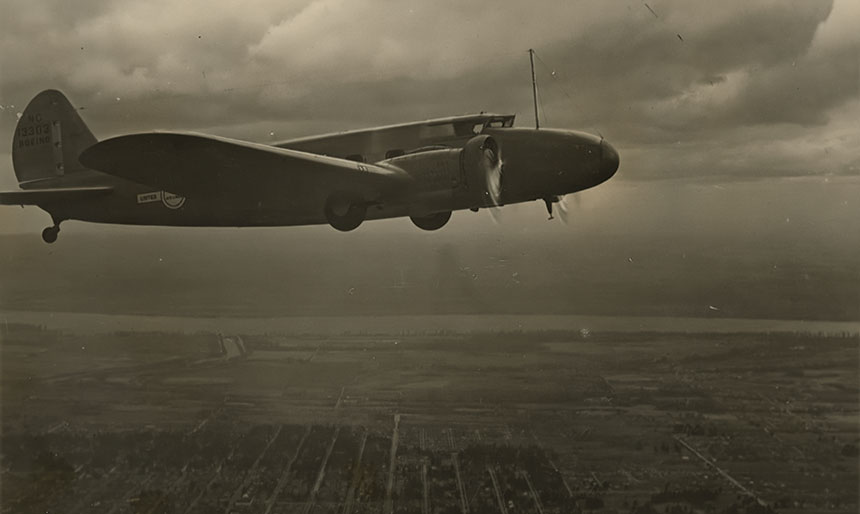
Over the next 20 years, the aircraft improved. The Boeing 247 flew twice as fast as the Ford Trimotor and could carry 10 passengers, two more than its predecessor. Still deafening and unpressurized, the 247’s all-metal design made it safer than the “cloth and stick” Trimotor.
Then, in 1935, the Douglas Aircraft Company introduced the DC-3. What it lacked in new comforts, it made up for in size. The DC-3 could carry up to 28 passengers, and for the first time, airlines could earn a profit. Marie Force, archives director for the Delta Museum in Atlanta, Georgia, calls DC‑3s, like the one on display at the museum, the “workhorse of the airlines.”
Pressurized cabins debuted in 1940 with the Boeing 307 Statoliner, but commercial passengers experienced their first flight above 12,500 feet — and the weather that caused airsickness — on a Lockheed Constellation, or “Connie.” Because it flew at higher altitudes, the Connie provided the fuel efficiency necessary for intercontinental flights and, along with the Boeing 314, opened the world to travel.
In the 1950s, jet airliners brought commercial air travel into the modern era. Although not the first to reach modern cruising speeds, the Boeing 707 was quieter and smoother than its propeller-driven counterparts. It could also accommodate up to 100 passengers, making it even more cost-effective to operate.
The Boeing 747 upped the seat count to over 450 when it first took to the skies in 1969, and it pushed the speed on commercial flights up to 595 miles per hour, about as fast as passenger aircraft can fly and still be cost effective. Although the hypersonic Concorde achieved 1,330 miles per hour when it operated from 1976 to 2003, its high fuel consumption led to high ticket prices and, in turn, empty seats.
Since then, only the Boeing 787 has offered any substantial improvements on the 747, and that was mostly in fuel efficiency. Van der Linden says the industry doesn’t really have anywhere to go without a significant technological breakthrough.
For the first 50 years of passenger service, the federal government regulated the airline industry, dictating both routes and ticket prices. In doing so, the government hoped to create an environment where the fledgling companies could succeed, and the oversight forced airlines to compete on amenities and service to set themselves apart.
As early as the mid-1930s, airlines set up dining rooms with fine china and hired chefs to prepare gourmet meals on board. Some airlines offered sleeping berths similar to those in railroad cars for international flights, and others sometimes showed movies. The 747 offered more space for more luxury: Its upper deck became a candlelight supper club on Pan Am, a piano bar on American Airlines, and a penthouse available for rent on Delta Air Lines.
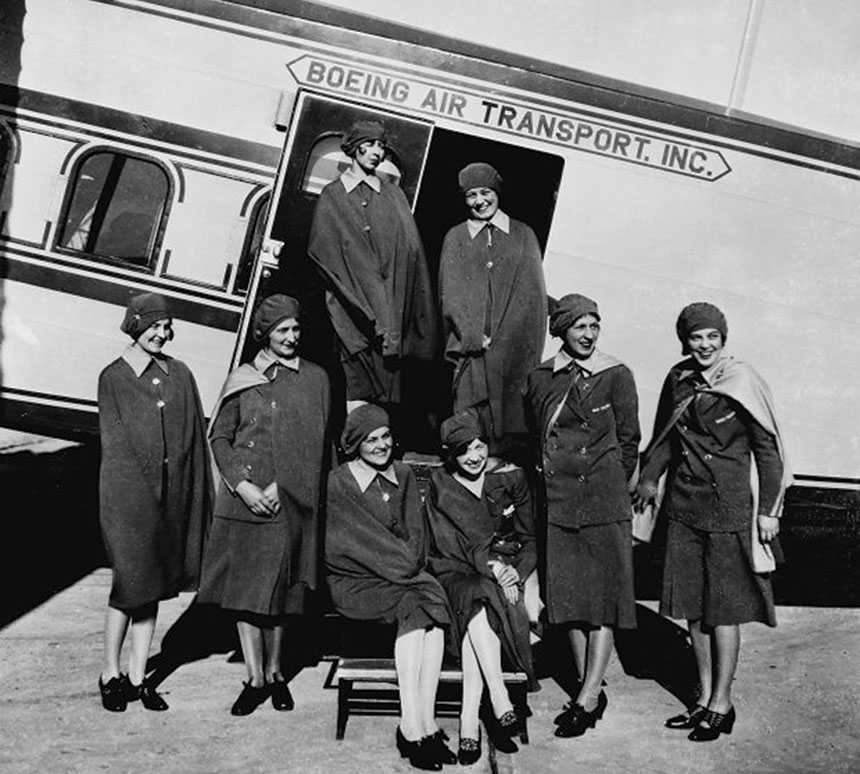
Where an airline could really stand out was its flight attendants and their uniforms. At the time, businessmen filled most seats. To attract more passengers, airlines hired single women under the age of 30 who met strict physical requirements for their crews. Uniforms showcased their beauty, and men weren’t discouraged from inappropriate behavior.
This caused a major problem, van der Linden contends, because the flight attendant’s primary job is ultimately to get passengers off an aircraft in an emergency. If the passengers disrespected flight attendants under normal circumstances, why would they listen to them when things went wrong?
Title IX helped right the situation. Passed in 1972, the law made sex-based discrimination illegal, and flight attendants became among the first to file lawsuits. Airlines could no longer prohibit flight attendants — male or female — from getting married or require them to meet physical beauty standards.
Six years later, President Carter signed the Airline Deregulation Act, ending federal control of the airline industry. Airlines shifted focus from attracting passengers with amenities — including the appearance of their flight attendants — to competing primarily on price.
Deregulation sparked other changes. In 1979, Texas International Airlines — which merged into Continental Airlines in 1982 and was then absorbed into United Airlines in 2010 — introduced the first frequent flyer program. Airline-branded credit cards that earned points passengers could redeem for tickets and perks followed in the 1980s.
Expanding on that, five airlines — United Airlines, Thai Airways International, Air Canada, Scandinavian Airlines, and Lufthansa — formed Star Alliance in 1997. The partnership offered passengers the flexibility to earn and redeem miles within their group and served as another way to create loyalty.
Then, the terrorist attacks on September 11, 2001, devastated the airline industry. In response, Congress approved the creation of the Transportation Security Administration, air marshals provided undercover security on board, and only passengers could continue past security to the boarding areas.
Over the next few years, several airlines merged — American Airlines and Trans World Airlines, America West Airlines and U.S. Airways, Delta Air Lines and Northwest Airlines, Continental Airlines and United Airlines — to increase their fleets and expand their routes. They also found ways to maximize income by charging for things like checked bags, seat selection, and meals.
Van der Linden points out that even though passengers pay for these extras now, ticket prices are low. In the 1930s, an airline ticket would have cost about as much as a new car. Today, we pay a few hundred dollars and can choose the perks to splurge on.
“People love to complain, but they make their decision on ticket price,” he says, adding that when given the choice, they won’t pay extra for more leg room or a meal.
While there isn’t much engineers can do to improve current aircraft design, the way we travel through the air from Point A to Point B could change dramatically in the next 20 years. Electric vertical take-off and landing aircraft (eVTOLs) are already being tested in Dubai, and depending on how long it takes to get FAA approval, these drone-like air taxis could be flying over the freeways of major cities soon.
However, air taxis can only travel the width of a large city, Turner cautions. To go any further, they’d need bigger batteries, and at that point, they’d weigh too much to get off the ground. Commercial airlines face the same hurdle.
Autonomous flights are also on the horizon. Aircraft computers already control much of the flight, while the pilots focus on takeoff, landing, and monitoring the flight. While it’s coming, he admits replacing pilots with computers will be a challenge because of unions and public perception. “It will start with cargo planes because cargo won’t complain,” he says.
Passengers will also likely see supersonic jets return, despite the Concorde’s woes, which went deeper than just high fuel consumption. The aircraft’s engines were so loud that, at least in the U.S., pilots weren’t allowed to take it supersonic until they were over the ocean, away from residential areas. It also required a longer runway to land, limiting the number of airports that could handle a Concorde. Companies like Boom Supersonic hope to address those issues through improved design and make supersonic flights less disruptive and more affordable in the future.
Blake Scholl, founder and CEO of Boom Supersonic, says initially flights will cost the same as a business-class fare but will drop from there. Once supersonic flights become affordable for the average person, people will be able to travel anywhere in a few hours. “This means a day trip to Paris and a weekend jaunt to Tokyo,” he says.
Even without commercial supersonic flights, air travel has transformed society. One hundred years ago, it took days to cross the country by train. Now, you can travel to anywhere in the world by plane in less than 24 hours. Before Delta, United, American, and other airline carriers, only the rich could vacation overseas. Now, almost anyone who budgets and plans can go.
“It’s truly revolutionized society,” van der Linden says. “Distant places are not really so far away anymore.”
Teresa Bitler is an award-winning travel writer whose work has appeared in National Geographic Traveler, Wine Enthusiast, AAA publications, and others.
This article is featured in the September/October 2026 issue of The Saturday Evening Post.
Become a Saturday Evening Post member and enjoy unlimited access. Subscribe now



Comments
A fascinating, jam-packed feature on every aspect of flight over the past century and heading into the future. Thank you Ms. Bitler.