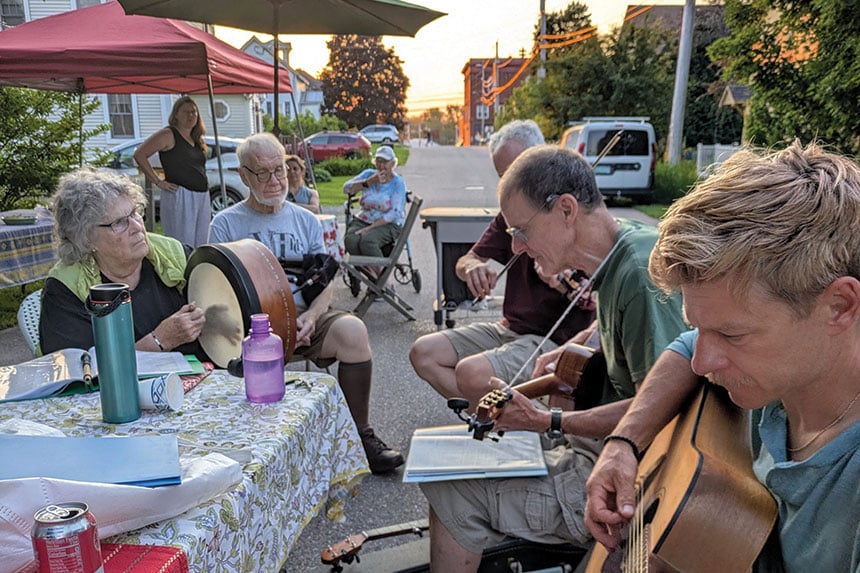
All neighborhoods reveal some things as if by osmosis: Within a month of moving onto a dead-end street in the Vermont village where I live, I had a feel for its morning rhythms, its mowing schedules, the hum or growl of its cars. That was six years ago. On a recent afternoon, the arrhythmic bump-and-drag of plastic wheels on pavement reminded me of the secrets that persist behind its closed doors.
The sound drew all eyes toward a neighbor, an accomplished attorney and a mother of two, wheeling a carnival-style cotton candy machine down the road, a whiff of fruity sugar perfuming the air in her wake. That she owned a cotton candy machine was an exhilarating discovery, I thought, a bit like learning she kept a Ferris wheel in her garden shed. And to universal delight, she’d brought it out to share.
Please come to our first annual block party, I’d written, just a few weeks before, on invitations hand-printed by another neighbor’s talented daughter. We mentioned games and a shared dinner. We’d gather at a toddler- and midlife-friendly 4 p.m. It all felt deliciously old-fashioned. And to me, novel. I’d never been to a block party. With its promise of gatherings to come, “first annual” was an optimistic flourish.
Yet it wasn’t so long ago that block parties were a routine part of American life. Soldiers coming home from the First World War greeted crowds one-stepping to ragtime tunes down closed-off streets streaked with ticker tape. The events were a fixture of mid-century cities from New York to Los Angeles. In the 1980s and 1990s, they helped kindle hip-hop culture at parties in the Bronx.
In recent decades, though, many of our lives have turned more private, even as the neighborhood has been displaced as the heart of American social circles. Just 40 percent of us talk to our neighbors regularly, according to recent findings by the Survey Center on American Life, down from 59 percent in 2012. And across the country, block parties have largely faded away too, ceding American streets once more to the cars.
Where I live, thankfully, most of us still know each other. Kids play in the road; drivers take it slow. It’s the kind of place where neighbors swap spare keys and water each other’s tomatoes. Yet too often, we speak only in passing, missing out on both big news and small updates. When I met a like-minded neighbor at a nearby coffee shop to talk it over, we agreed that a party seemed like just the thing.
It was only after dropping invitations in mailboxes up and down the street that I learned our plans aligned with a nationwide block party revival — or at least the attempt at one. Earlier this year, a Vermont nonprofit launched a series of small grants for neighborhoods planning community gatherings and parties. Similar projects have been launched in cities from Cambridge, Massachusetts, to Lancaster, Pennsylvania. A nationwide nonprofit organization, Block Party USA, is calling for the revival of block parties in response to an epidemic of loneliness and Americans’ growing isolation. Their website offers tips for hosting alongside graphs charting the positive ripple effects they can spark.
And as Block Party USA helpfully notes, you hardly need anything at all to host one. We started by emailing our select board for permission to close the street; we borrowed folding tables from a nearby church; we reserved a handful of lawn games — cornhole, bocce — from the local library’s collection.
We invited neighbors to bring something to eat, something to drink, with musical instruments welcome. We watched the weather forecast, muttering spells against rain and thunder. And then, on a Sunday afternoon, we all spilled out of our homes. Clutching potluck offerings and smiling at our luck, we stepped together into a perfectly sunlit street.
Bowls swiftly filled a food table tucked into the shade of a crabapple tree decked with handmade yellow bunting; I added a pile of peanut butter cookies, still warm from the oven. A cooler swelled with cans and the first arrivals poured pink lemonade into paper cups. We pulled patio chairs up to a pair of long tables running down the middle of the street, bright with mismatched tablecloths and garden bouquets.
A young family, who planned to move in over the summer, introduced their luminously fat-cheeked baby. Our street’s longest-standing resident, an octogenarian raised in Belgium during the Second World War, held court at the end of the table. Over the hum of conversation came the steady thwack thwack of beanbags slapping down on cornhole boards. Children clutching cotton candy — fresh from the machine — grew stickily giddy.
I am fortunate, I know, for the community I inherited here, one enmeshed by relationships that far predate my arrival. My neighbors babysat one another’s children, long since grown; for decades, they’ve swapped perennial flowers and tools. Yet as the party wore on, I also saw faces I’d only glimpsed in passing; I learned of recent bereavements, met new arrivals, and welcomed the friends they’d invited along for the meal.
Sharing food has always seemed to me a kind of alchemy because gathering at a table weaves and reweaves the fabric of social connection. That fabric is prone to fraying when neglected — a fact apparent in a national moment of political discord, when old differences seem newly insurmountable. Such differences tend to fade up close. Peanut butter cookies and lemonade alone aren’t the only foundation of strong communities, but they’re lovely, and they’re a start.
At this latitude, and so close to the solstice, the sun stays high late into the evening; when the party’s planned end came and went, we were all still talking in the lengthening shade, cruising the food table for second helpings of pie and Oreo trifle.
A handful of neighbors brought instruments out from their homes: small pipes, an Irish bodhrán drum, a fiddle, a pair of shiny ukuleles. Settling around the tables, we sang the songs we knew the words to, passing around songbooks for the rest.
As sunset turned nearby brick buildings a deep, rosy red, someone called for a round of “Auld Lang Syne” in honor of a family moving off the block and out of state. It wasn’t in the book, but we all knew the chorus. So at the top of our voices, we hit the familiar lines a few extra times for good measure. Maybe next year, we’ll do the verses.
Jen Rose Smith has written for The Washington Post, CNN Travel, Condé Nast Traveler, AFAR, Rolling Stone, USA Today, and Outside Online and is the author of six travel guidebooks to Vermont and New England. For more, visit jenrosesmith.com.
This article is featured in the September/October 2026 issue of The Saturday Evening Post.
Become a Saturday Evening Post member and enjoy unlimited access. Subscribe now



Comments
People will always seek to be part of a community — it is part of who we are as human beings. These days, we often search for communities online. But there are signs that we are tiring of spending so much time on our computers, and that we instead are gravitating toward connecting face-to-face with others, including our neighbors. I am happy to say that I get together with neighbors in our small town often. Having neighbors you know and trust definitely improves one’s quality of life.
I’ve heard of these but never attended one. My assumption is these are for those close knit neighbours in an urban area, subdivision, or otherwise. In rural areas where neighbours are few and far (sometime not far enough) between we don’t have this sort of thing. That is unless you are counting a get-together where we bring our guns and have target practice. Such as you describe just doesn’t appeal to my interests personally.