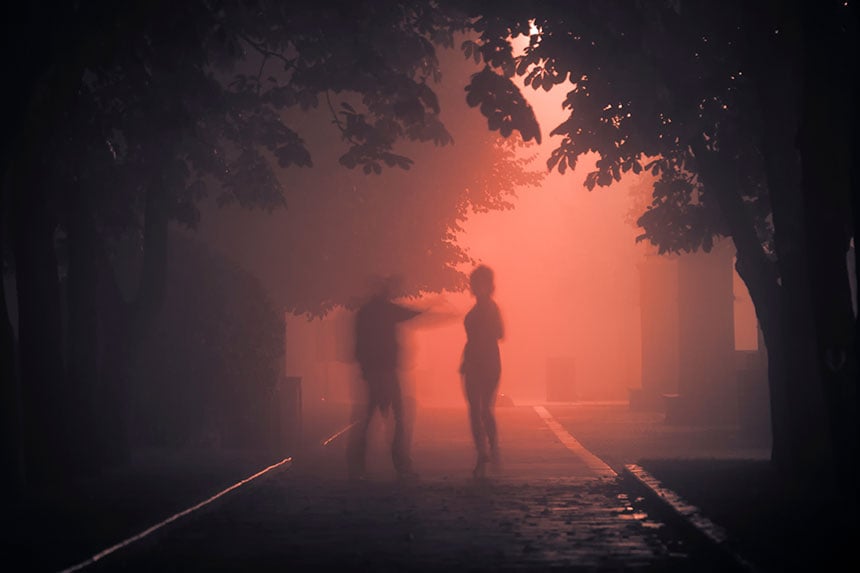
The evening fog tiptoed into town from the countryside as they walked to the train station. Jamie had insisted that they walk — it wasn’t far, and he claimed he wanted more time with her to talk. But Emma noticed he said very little as they made their way down the wet cobblestone streets. She felt the barrier of silence between them, wondering what would break through it.
Same as Jamie, Emma carried a gas mask and helmet in a green canvas bag slung over her shoulder. It seemed to be a fashion necessity for everyone at the moment. She was required to keep it with her at the munitions factory and now took it everywhere. The Germans hadn’t bombed their rather insignificant town yet, if they ever would, but all Emma heard was that she worked at a “prime target.”
Outside the small café attached to the station, Jamie stamped out a Woodbine on the curb, his third of the last half-hour. The windows and doors were all blacked out due to air raid regulations, but people were filtering out, heading for the platform, where the exhalations of the locomotive — burning coal and rusty steam — clashed with the cleanness of the fog, pinning the whole soup to the area around the station. He suggested a cup of tea. After looking through the briefly open door, she declined. His train was leaving in five minutes, and she didn’t want to see him court-martialed.
“Your pass is up at midnight,” she said. “There won’t be another train to Dover until tomorrow.”
Motherly, she adjusted his blue field service cap and brushed some lint off the new sergeant’s stripes on his arm, then stood back to admire him.
“I pass inspection, sir?” he said, another cigarette already between his lips.
“I approve, Sergeant.” She gave him a mock salute which made him grin as he struck a match and lit up. For a second, he might have even looked dashing, film-star-like. Maybe even been an RAF recruiting poster.
But soon Jamie’s face became sullen again, as he looked at his watch and saw the departure time nearing. “Spitfires won’t repair themselves, I suppose. Those lads on my crew don’t know what they’re doin’ without me there screamin’ at ’em.”
He attempted to smile down at her. He was almost a foot taller, but his broad shoulders seemed unnaturally slumped. As the door to the café opened again, the brief flash of light from inside pronounced the dark circles under his eyes.
There were a few people huddled about the platform, idling before boarding the train or saying goodbyes to loved ones. She saw a mix of people in uniforms and civilian dress. Half expected to hear some lonely-sounding woman accompanying the scene, sorrowfully singing, “I’ll be seeing you, in all the old familiar places …”
“I’d better get on board,” Jamie said, exhaling smoke and flicking the cigarette onto the platform, half-smoked. The discarded butt flared briefly and then died on the damp concrete.
He bent down to her, and they kissed — quickly, perfunctory. Jamie’s mouth tasted bitter, almost repelling her.
“I wish you wouldn’t smoke those blasted things,” she said.
His face was expressionless. She could tell he was searching for something to lighten the mood. He used to be so good at making her laugh.
“You pick up some bad habits in the RAF,” he said.
He was trying to sound jocular but failing. His guard going up again, she thought. God knew what was awaiting him back at Dover. The morning BBC wireless report had mentioned another bombing in that area, no specifics on damage or casualties. Jamie tried another smile and pecked her on the cheek. His hands rested on her shoulders, hesitantly, she felt, as if he was afraid he’d break her. It wasn’t the embrace of a parting lover he’d given her when he’d left in September the year before. He pulled away.
“Be safe, Em,” he said, and bolted for the nearest empty compartment.
As the final whistle sounded, she watched him sit and put yet another match to yet another Woodbine. The match seemed to tremble in his fingers. Turning away, she walked toward the doorway of the station café as the train pulled out.
* * *
She found Robert calmly sipping a cup of coffee at the counter. She walked up beside him and ordered tea for herself. They brought their drinks to a table in an empty corner. The café was sparsely populated but she kept her voice low.
“I almost died,” she said. “When he asked if I wanted to come in here, I could see you, plain as day, over his shoulder.”
“Yes, Love, well, I thought you’d want an escort home after seeing your husband off,” Robert said, smiling. “Perhaps a drink or two? My treat.”
Robert was barely 22, almost five years younger than her, but also a nephew of the owner of the munitions plant. He’d shown up just before the war. People said it was because his uncle wanted to keep him out of the army. He was handsome — red hair, slim body but not sickly-looking like some aristocrats she’d seen. And he could afford to dress well. But the good points ended on the surface, as Emma was now finding out.
“Stop grinning,” she said.
A worried look appeared in his eyes.
“You were able to … to welcome him home,” he said, vaguely waving his hand in the air, as if that meant “sex.”
If she was making him nervous, that buoyed her spirits more than a bit. She let him sweat for a minute while she sipped her tea. It tasted bitter, probably brewed hours ago, if not yesterday, and the café was out of milk — rationing and all that — but she kept silent, enjoying his discomfort. Then she informed him:
“Don’t worry. He was more than willing to be welcomed.”
Robert looked relieved. She felt a slight thrill from worrying him, even only a few seconds, but then it didn’t change anything.
He quickly lit one of his American cigarettes. His spinster aunt who lived in New York City was always sending him cartons of the things. They made Emma faintly nauseated as Robert blew smoke indiscriminately.
“It’s odd,” he said. “I feel like it’s the scene in some American gangster film after they’ve just pulled off a rather large robbery.”
“You had very little to do with this,” she said.
“Cheer up, Love,” he said. “Seven months from now your husband will be a proud father. Awfully lucky he was able to get leave.” He chuckled.
“As long as he doesn’t do the maths too closely,” she said. “And what if the child has red hair? Neither me nor Jamie do.”
Robert seemed to consider that. He ran his fingers over his scalp, smoothing out any loose hairs.
“In that case,” he said. “Just tell him you’ve got some Irish in your family — some grandparents or cousins. A part of the family you never speak with. How does that sound?”
The idiocy of the suggestion seemed to tickle him. He stamped out the cigarette in an ashtray, still grinning.
“Anyway,” he continued. “Let’s worry about that when and if it happens. Your husband could be dead by then if the Jerries start bombing again like before.” He calmly sipped more of his coffee. Obviously, he hadn’t heard the BBC that morning. “How is the old boy?”
“Fine,” she replied. “He can’t wait to meet you.”
Her joke didn’t register with him. After hearing the good news, she saw that he was in a mood where none of her jabs could touch him.
“Looked a bit run-down to me,” he said. “I hear from a friend at Biggin Hill they had those mechanics working day and night repairing planes. Sounds terribly stressful.”
“They’re the only thing keeping Hitler from crossing the Channel,” she said.
“Well …” he said. “Mostly the pilots are, really. And who knows for how long, eh? You’ve been listening to too many of old Winston’s speeches.”
Robert finished the last of his coffee and stood up.
“Care for a bit of something stronger to celebrate?” he asked, holding out his hand.
She got up without finishing her tea and followed him out, ignoring the gesture …
… Back in September, the only reason she had accepted his dinner invitation was out of sheer boredom — boredom and stress from worrying about Jamie. It was at the height of the Battle of Britain, and her husband had not had leave for almost four months. A series of ten-hour shifts had drained her resolve. Robert, in those first days, had seemed less of a cad. He would hang around her table in the canteen at work, her in her blue coveralls and head scarf, him in one of his tweed suits, fresh from the offices on the top floor. All compliments and jocularity.
Soon he was bringing her little things — chocolates, a small bottle of wine which she had enjoyed, alone, one evening with her dinner. She reasoned that she wasn’t the first girl she knew to step out on an absent husband or boyfriend. And again, he was rather good-looking. A nice meal of roast beef and potatoes in Robert’s small cottage on the edge of town was more appealing than a night at home, eating her ration of beans and stale bread.
The sirens had gone off while they were having after-dinner brandies and coffee. The sound had made her spill a bit of coffee on her dress. He produced a napkin to help dab at the spot; conveniently it was on her upper thigh. She remembered him putting his arm around her as they sat together on the couch. After that, it had been quick, a blur really, in the way she remembered from her first few encounters with boys in her teenage years. At the moment, though, with the prospect of bombs raining down around them, it was also downright thrilling.
But no German planes had ever made it within 50 miles of them. It was enough to get her to stay until morning, though. The blackout was difficult to navigate on the best of nights. She hated to admit that part of her enjoyed it. But, like a fatty meal, afterward there was no doubting the feeling of overindulgence, regret…
… His smile offended her. She now found that a lot of things he did offended her. They were alone outside, and he was droning on about the inferior brand of scotch that was currently available at the Lady Rose Pub. God’s teeth, but he was a boring twit.
“You were a mistake for me,” she blurted out.
He turned and looked at her. She was just as surprised as him that the words had escaped her mouth. But she continued:
“I’ve come to the conclusion that I’d sleep with anyone during an air raid, even a false alarm. I was a fool, the biggest bloody damn fool, to fall for your schoolboy moves. I shall regret it the rest of my life.”
“Well, Love,” he said. “If you’d taken care of this mistake the way I wanted you to, we wouldn’t be putting on this ridiculous charade for your clod of a husband. I told you there’s this woman in Nottingham who’s an expert at these procedures —”
“You don’t understand,” she said. “You were — you are — the mistake. A walking, human, goddamned mistake. I spit on the day I laid eyes on you in the canteen.”
She was trying with all her might not to break down in front of him. It helped to see that she may have finally registered a blow. The bastard had stopped smiling, at least.
“Then … good luck, I suppose,” he said. “I was going to tell you after a couple of glasses of scotch. I didn’t want to upset you … but I see that you can take it … I’ve put in for a job in the London office. Uncle Roy has assured me I’ll get it.”
“Congratulations,” she said. “I know you’ll do well.”
The words came out of her mouth in an almost-whisper. Emma didn’t turn away, but felt her eyes were on the verge of tearing up. She fought a last stand against the tears. She would not let him think that she feared telling him off. Really, she wanted to lunge at him, pound his face into ground meat. His face didn’t show any pain, but perhaps some bewilderment. She was quite sure nobody, certainly no woman, had ever spoken so bluntly to him.
“Well then, Love” he said. “I’ll be seeing you. Or I suppose, in fact, not.”
With a grim finality, he snapped his blue fedora onto his head and turned down the street in the direction of the Lady Rose Pub.
With nothing more to say, and no one to say it to, she strolled off in the opposite direction, toward her home. It didn’t surprise her that she’d chased Robert off so easily. Her husband would never have been so spineless …
… She had seen how, his first night back, Jamie was rather hesitant, at first, to get into bed with her, as if they had not been together this way a hundred times before. He was distracted but eventually he was able to perform the necessary actions.
What she had not counted on was him being awoken around two in the morning by the backfiring of a truck and hiding, naked, by the side of the bed as if it were an air-raid shelter. Jamie, not realizing the sound wasn’t anti-aircraft fire, that Stukas were not diving, screaming, out of the sky, remained hunkered down, face hidden, until she’d taken his head in her hands and pleaded with him to come back to bed. His eyes, at first, didn’t seem to know her, still wide with a terror she couldn’t comprehend. That was the first time she noticed the twitch in his face, an electric jolt that seemed to go through his entire body.
“You’re home, my dear,” she said. “You’re safe.” She rubbed his temple, ever so gently. Kissed him on the forehead. Anything that came to her mind. Anything to calm him.
Even as he slowly slid back next to her under the covers, she could feel him trembling through the mattress. She lay up for the next couple of hours with her husband cradled in her arms …
… And she cursed the whole blood-spattered enterprise of the war. Apart from blowing the entire world to pieces, it had made the arms of a pig like Robert seem like a charming diversion, if only temporarily. It had turned her burly, good-hearted husband into a jittery child. It had made her think that deceiving him about an unborn baby was the best course of action. There was, however, another solution out there. If that was it, then she would have to face it on her own.
A buffoon like Robert was proving to be about as helpful as a German bomb sailing down her chimney. She really had no need of his woman in Nottingham; she knew of one who lived on a farm just outside of town who could help her. One of the girls at the factory had mentioned her, offhand, implying that she had used her services before. Maybe Emma would go, maybe not.
She continued down the empty street, looking up, trying to see the moon through the fog. Once again, in her head, she heard the lyrics of that mournful torch-singer, “… And when the night is new, I’ll be looking at the moon, but I’ll be seeing you …” But the moon was nowhere to be seen. Instead, Emma felt the fog envelop her, hide her, mercifully, as she needed the world not to barge in until she was ready to let it.
Become a Saturday Evening Post member and enjoy unlimited access. Subscribe now



Comments
This was a well told story of what can, and unfortunately occasionally does happen in life. In this case during World War II, but lessons applying to all time periods, be it war or peace time. Emma has an important decision only she can make. Let’s hope it’ll be the right one.