The Tastee-Freez in Aledo was still open for business, a small piece of my childhood I never expected to see again. I’d pictured it bulldozed and forgotten, replaced by something unmistakably trendy, selling overpriced coffee and organic mung bean pita.
But there it was, just as I remembered: peeling paint, potholed parking lot, missing letters on the faded marquee. Three decades had changed me but, strangely, not that old ice cream stand.
I eased off the accelerator on Dad’s old Chrysler New Yorker and let the car coast by slowly. I wanted to stretch the moment out and let the memories sink in. For me, that tired old Tastee-Freez was more than a teenage hangout or small-town landmark. It was a reward, something my siblings and I thought we’d earned after a weekend’s labor on the Christmas tree farm. We’d worked under the scorching summer sun, pruning pine trees for our father till our fingers were tacky with sap and too numb to bend. We convinced ourselves that a dipped ice cream cone or milkshake, maybe even a hot fudge sundae, was the natural payoff for those sweat-soaked days.
But the reward was never guaranteed. It always hinged on some fragile whim of my father’s mood. Was Dad in the mood to be generous? Would he flip on the blinker and pull in? Or would he drive by without a word? It was never certain. A coin toss, at best.
“Dad,” I said, glancing over at him. “Do you know where we are?”
Nothing. Just his faraway stare.
The stroke last year had changed him. His mind was unpredictable now, sometimes muddled, sometimes as sharp and stubborn as ever. The man I knew — the master storyteller with a corny joke or anecdote for every occasion — was mostly gone. When he spoke, his sentences were broken fragments that drifted off before they could take shape. I recalled my father’s face from those younger years. Always animated, always full of passion, for better or worse. Now that face was gaunt, the spark gone.
This journey, this return to forgotten places, was my way of trying to rekindle something in my father, to get back a little piece of the man he used to be. But nothing seemed to register.
“Do you know what city we’re in?” I asked again.
“Viola?”
He seemed to know that wasn’t right.
“Viola was a ways back,” I said. “We’re in Aledo now, Dad. Remember the Tastee-Freez? It’s right over there.”
A glint of recognition crossed his face as he looked out the window. He remembered.
He said nothing, but I wondered. Was he thinking what I was?
“We didn’t always stop for ice cream,” I said casually. I kept the tone light, like it was nothing, like it didn’t matter. In truth, it mattered more than I could explain.
I sensed the gears turning in his mind.
“Didn’t always need to,” Dad answered. His voice was raspy but still carried that sardonic edge that could be both infuriating and comforting. And that grin: faint, a little guilty, like he’d gotten away with something. A piece of the old Dad was still hanging on. Like the Tastee-Freez.
We were on a road trip, just the two of us, just for the day, driving back to our old Christmas tree farm, 40 scrubby acres in Henderson County, Illinois. As a kid, it felt like a little patch of hell. My family worked that farm from the time I was seven until I finished my freshman year of college. It was front and center in our lives for a dozen years.
Dad walked in the house the day he bought the place and, out of the blue, made the announcement:
“We’re going to be Christmas tree farmers. All of us.”
My mother wore a look of shock and anxiety — and a hint of resignation. She had learned over the years to surrender to his eccentricities. We all had.
The farm wasn’t my father’s full-time job. That was the Rock Island Arsenal, where he worked as a mechanical engineer. The farm would be a weekend hobby, a family venture where a German work ethic and communion with nature would blissfully unite, a place where my father’s rural roots could once again flourish. With a sign crafted in his basement workshop, Dad christened his little stretch of heaven the “Quality Tree Farm.”
We lived 60 miles north in Davenport, Iowa. Saturday mornings often found us piling into the Plymouth Fury — Dad, Mom, me, my younger brother, and two older sisters — for the hour-long drive to the farm. It wasn’t a trip anyone but my father looked forward to.
Ten thousand Scotch pines stood in those fields, each one destined to brighten someone’s holiday, to carry that classic scent of Christmas into someone’s home. Before the cabin went up, there wasn’t much, just those trees, a red water pump, and a 1938 McCormick tractor that still managed to cough to life when needed. We pitched tents under a few towering oaks near the pump. That was our base of operations.
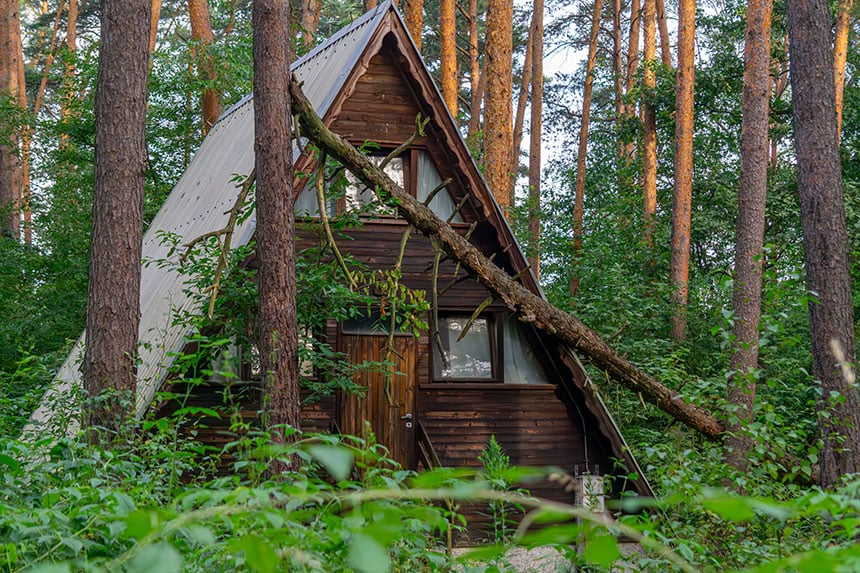
The cabin came later, an A-frame Dad built himself. He purchased the plans from an ad in Popular Mechanics and drafted all of us for free labor. He also roped in a few of his friends and colleagues, who by that time had come to understand his strange devotion to the place.
The drive back to the farm after all these years had been my idea. A selfish one, I suppose. My sister Sarah had been against it.
“He can’t handle a road trip like that,” she said, concerned with Dad’s comfort. “Besides, who knows what you’ll find. It’s been years.”
I’d flown in from Texas to spend time with Dad and help Sarah make the hard decisions about his future care. The welcoming hug that first night startled me, my arms wrapping around the loose, bony frame of a man who had always been so solid.
His sight, his mobility, his thinking — the stroke had weakened them all. My father spent most of the day in his lift recliner, absently watching television or listening to country music. Cristy Lane had always been his favorite. The TV tray beside his recliner spoke quietly of decline. Pill organizers, half-drunk protein shakes, unopened mail, and sticky-note reminders scribbled by Sarah and the rotating caregivers. Some days he seemed nearly himself. Each new setback, though, pulled him further from the man he once was.
But Dad, always the stoic, shrugged it all off.
“People don’t grow younger,” he’d say. “What do you expect?”
He lived in a small condo near Sarah, clinging to his independence where he could. Breakfast was instant coffee and cinnamon toast; lunch, whatever leftovers could be microwaved. The dishwasher got filled, though rarely emptied. He still managed the knobs and buttons on his old radio/CD player. He tackled simple chores (tightening a loose screw or changing a lightbulb in a table lamp), but even these tasks had become time-consuming ordeals. Still, they gave him something to hold on to, and I let him have it. I stepped in only when he asked for help or clearly needed it.
Dad relied heavily on Sarah’s daily visits. Caregivers also came and went. He pretended not to need them.
“He can’t go on like this,” Sarah had said. “Neither can I. We’ve got to consider options.”
I didn’t want to face those options. Not yet. I wanted to take Dad back to the tree farm, to his little corner of paradise where he’d always seemed most alive. I wanted one more chance at sharing his joy, at giving him a piece of what I’d failed to give so many years ago.
Eventually, Sarah gave in. Our road trip was on.
Dad needed no convincing. “Should be fine weather for a drive,” he said, hunting down his Rand McNally road atlas.
We traveled the rural highways, past cornfields that stretched endlessly in all directions toward the horizon, the stalks dry and sun-bleached under the October sun. We passed barns and silos and corn cribs, boxy old farmhouses that looked vaguely familiar, with pumpkins and chrysanthemums clustered on porch steps. The landscape had changed little, yet it felt oddly different now that I was older.
The tree farm would be different, too. It had been 20 years since we last saw it, almost 30 since we sold it.
The air on that farm had an unforgettable scent, a blend of sandy earth, pine sap, Coppertone, and sweat. The fields had been untamed and wild. Scrub oak and prickly pear cactus had crept in, staking their claim and undermining our efforts. The cactus we left. But the scrub oak, with its relentless spread, had to be eradicated. Rooting it out with loppers (saws if we had to) was an unending task.
And those bull snakes. Not poisonous, but large enough to make a grown man shudder. Six feet of muscle coiled in the underbrush. I remember seeing one every now and then slither across the sandy lanes with an unhurried certainty. As a child, their massive size scared the hell out of me.
But this harsh, remote world had been everything to my father. He loved it.
We endured it because we had no choice.
“We’re on Route 94 now, Dad,” I said as we drove out of Aledo. I tried to keep the conversation going to keep him awake. “Not far now. The Bald Bluff cutoff’s coming up.”
Viola, Aledo, Bald Bluff — names I hadn’t spoken in years. They felt distant now, almost surreal, like places I might’ve conjured up in a dream. Forgotten little towns where life had carried on, unaware of our absence and untouched by it.
“We’ll be at the farm soon,” I said.
Dad nodded silently.
“The covered bridge,” he said after a while, almost to himself. “Should be around here somewhere. Haven’t been there in a while.”
I thought of it, too — that old red bridge. I’d always looked forward to stopping there on our way home from the farm, though I can’t say just why. There wasn’t much to do there except run your fingers over the worn wood and wonder about life a hundred years ago.
“I think it’s near Oquawka,” I said. “We can swing by on our way back. Do you want to see the bridge again?”
My father looked at me as if the question had to be carefully weighed. Then he answered, hesitating a bit, “Well, that’s fine … if it’s not too much trouble.”
His words were empty. There was none of the anticipation or excitement they once would have had. Small joys seemed to have slipped from his reach.
The gravel road to Bald Bluff was paved now. The winding curve that once skirted an old barn had been straightened. The barn was gone. The landscape felt bare without it.
As we neared the tree farm, I remembered my father always saying “Almost there!” as if every trip was a new adventure.
“Do you remember this drive, Dad?”
His face slowly lit up.
“Yeah,” he said, stretching the word out and letting it trail off. Then he paused. A searching look came over him, as though he were lining up all the facts, getting them straight before he spoke.
“Used to get smoked catfish over in Keithsburg,” he said. “Not far from Uncle Charlie’s place in New Boston. Always got two pounds.”
The answer made me smile. He was still there, somewhere.
* * *
I almost missed the turn onto the road that ran directly in front of our farm. It used to be a dirt lane, barely wide enough for a single car. Now it was a clean blacktop ribbon, smooth and well-marked. A small insult to the roughness enshrined in my memory.
I crept along, scanning the land on the right. I was searching for any familiar trace of the place I used to know. The huge jagged rock formation (the one that reminded me of a battleship) marked the beginning of our farm.
And there it was.
But after it, nothing looked the same. Where rows of Christmas trees once stood, only a sprawling thicket of scrub oak remained. Several scrawny, twisted pines clung to the edge. I stared in disbelief. Were these the same trees I’d pruned as a kid?
“We’re here, Dad, at the tree farm.” I turned into the lane that split the land in half. My father remained silent, looking alarmed and confused, as if what I said made no sense at all. Given the changes, who could blame him?
A log house stood where we used to pitch our tents. I steered toward it and parked the car.
“We should probably talk to the owners,” I suggested. The words felt strange, like we were visitors. Which, of course, we were.
Dad seemed to understand where he was now. He was already stepping out of the car, eager to see what had become of it all.
I knocked on the owner’s door and felt relieved when no one answered. I didn’t want to share this moment with strangers, who’d be owed introductions and explanations. I wasn’t in the mood for polite small talk.
I turned back toward the car, and there was Dad, surveying the land. His cane was leaning against the car. From a distance, he looked young again.
“No one’s home,” I told him. But his mind was elsewhere.
“Gone to the dogs,” he said, shaking his head.
He was quiet for a moment. Then, more to himself than to me:
“A lot of changes.”
His voice was stronger than it had been on the drive, but somber. He looked out over the land, staring in all directions.
“Remember camping here?” I asked. I tried to read the unspoken thoughts behind his expression.
“Your mother wasn’t too keen on this place,” he said, ignoring my question.
I smiled to myself, thinking of her role in this wilderness adventure: cooking over a Coleman stove for a family of six, managing four children, dealing with her own health concerns, which had not been insignificant. She had been a saint in support of my father’s dream. But the dream had been his — not hers, not ours. My mother’s exasperation was often apparent, expressed not in words but in subtle grimacing looks.
“We were roughing it, for sure,” I said. “Mom always had to check us all over for ticks.”
I spotted a familiar patch of milkweed near the old campsite, the oval pods splitting open, silky fluff spilling out, practically demanding to be pulled apart. No kid could ever resist. I reached for one, tore it open, and flung the feathery seeds in the air. I watched as they lifted off, drifting across the field like tiny parachutes.
Watching those seeds float away brought it all rushing back. The spring plantings, the harvest just before Thanksgiving, the frenzied deliveries in December.
But June — June was the crucible: pruning season.
We couldn’t start any earlier. In May, the trees were still pushing out new growth that was too soft and delicate to cut. By June, it was just firm enough to shape, but not for long. Thousands of Scotch pines had to be trimmed in four weeks before the tips turned woody and difficult to cut.
It was always a race against time.
Weekends, starting on Fridays once school let out for the summer, were marathons. Up at dawn, pruning until dusk. With my round yellow Panasonic radio strapped to my belt, I chopped away, Casey Kasem’s Top 40 echoing through the fields. The heat was blistering, my skin slimy with sunscreen and bug spray, gnats hovering in my nose and ears, cactus and snakes underfoot. From time to time, the god-awful snorts and squeals of feral hogs drifted out from the shadowy woods beyond the fields.
That was pruning season.
But there was always that glimmer of hope, the possibility of ice cream in Aledo if we survived the weekend.
Dad enlisted everyone’s help to get the pruning done. He hired friends, recruited relatives, even sought out locals from Oquawka, who came for the paycheck but left, I’m sure, with a few stories to tell. I rounded up as many friends as I could (though I never got repeat volunteers). A dollar and a half an hour. “Save half for college,” Dad would say. It wasn’t a suggestion.
In the early years, it was all hand shears. Endless chopping, chopping, chopping. Pine sap kept our fingers sticky and fragrant. Then came the generators, and Dad upgraded to electric shears — for the older men, of course. I never used them.
We all wore army surplus combat boots to protect ourselves from snakes and cactus. My sister Sarah, hoping for a suntan, pruned in a two-piece swimsuit and those clunky boots, an absurdity that felt completely normal at the time.
The farm was so remote that the Illinois National Guard occasionally conducted training in the field across from ours. Tanks, howitzers, all the sounds of war within earshot. One year, we found ourselves in the middle of their maneuvers, tanks rolling over our trees, a long convoy of support vehicles following behind. And there was Dad, charging out in front of them like a mad knight defending his evergreen kingdom.
“Radio Springfield right now!” he demanded. “This is private property!”
While we waited, I filled the soldiers’ canteens from the pump. Just another day on the Quality Tree Farm. No big deal. Some light artillery fire and family bonding.
* * *
We were still by the car near the current owner’s house.
“The A-frame has to be that way,” Dad said, pointing with a certainty that surprised me. And damn, the old man was right.
“Let’s check it out,” he added, getting back in the car with that sudden, familiar energy, like something clicked back in place. He was in charge again, the man with a plan.
We drove a few hundred feet into a stand of tall pines, to where we’d built the cabin years ago.
“Should’ve brought my tools,” Dad said, with that familiar trace of humor in his voice. “Old place probably needs some work.”
That was Dad. To him, everything was a project, something to fix, build, or tinker with. Rusted hinges, sagging beams, peeling paint — all opportunities to stay busy. His tools and oil can were never far away. Work to him was like breathing air.
“A break,” he once told me, “is when you stop working on one thing to work on something else for a while.”
We rounded a bend, and the cabin appeared like something rising from a long-forgotten dream, its angular frame jutting upward, slicing into the sky. But decades of neglect had worn that cabin down. It seemed to sigh at our presence.
We stepped out of the car and slowly made our way around it. Neither one of us spoke. My father leaned on his cane, steadying himself on the uneven ground, thickly carpeted with old pine needles. Shingles were missing from the steeply pitched roof, the same ones I’d helped hammer down so many summers ago. The wood frame was deteriorating, the edges frayed with rot.
My father’s gaze moved over the cabin, lingering on the decay. He didn’t say a word.
A rusty lantern swung from a beam, its occasional creak the only sound breaking the stillness. Sheets of discolored plywood covered the windows, though one board was hanging loose. Behind it, a pane of glass was veiled in spider webs.
We peered in.
The maroon yard-sale couch still sat beneath the front window. Its crushed velvet upholstery was shredded. The stuffing had burst out and lay scattered across the floor, matted with pine needles and animal droppings. Raccoons, maybe.
The freestanding cone-shaped fireplace in the corner always reminded me of an old spaceship. The metal surface was rusty in spots. For a moment, I relived those distant autumn evenings. We’d sit by the fire, popping corn over the flames in a long-handled metal contraption bought at Farm & Fleet. The white puffs were always scorched and tasted faintly of wood smoke and pine sap. The shooting sparks would crackle and glow as we huddled close to the blaze to keep warm.
“Hired a contractor out of Monmouth to pour the foundation,” Dad said at last. “Wally Tate helped me frame it up.”
“Remember the shower?” I asked. I pointed at the steel bar still bolted above the back door. Dad had hung a galvanized bucket from it, the bottom punched through with nail holes. Didn’t work worth a damn — and cold.
The hammock that used to hang between two trees was gone, but a length of yellow nylon rope still hung from one of the trunks. The frayed end dangled there, as though waiting for someone to pull it to keep the sway going.
“Always meant to add a rail around the deck,” Dad said.
He motioned toward a large rotting box he’d built from scrap wood. The green paint was nearly gone and spiders crawled in and out of a hole at the bottom.
“Kept all the pruning shears in there,” he said. Then, softer: “This place was supposed to last forever.”
I knew exactly what he meant. It seemed like it should have.
* * *
We stood there silently a while longer. The sky had grown pale by a slow drift of clouds obscuring the sun. Somewhere in the treetops, a bird called out and was answered, faintly, from far off. Bobwhites, I remembered my father calling them.
Dad rested his hand on a weathered railing post, the one he’d always meant to finish. Gentle gusts of wind moved through the tall pines, brushing past us like time itself.
We headed to the car. The breeze offered one last trace of those scents I’d known so well as a child. I inhaled deeply, unsure when or if I’d ever breathe them in again.
“A lifetime ago,” my father said as he opened the car door.
I wanted to leave before the owners returned. But before we left, I drove to the back of the farm, where the fields had been more manageable, free of the scrub oak. The trees there stood tall and stately, undoubtedly the ones we’d pruned so long ago.
We both seemed to want quiet. My memories were vivid, but unspoken: the flatbed wagon rides behind the old tractor, my brother and I jumping on and off as we slowly moved along the sandy lanes; the Fourth of July picnics that marked the end of pruning season; the “swimming pool” Dad made near the pump, a giant hole in the ground lined with plastic and filled with water. Ridiculous but fun. It hadn’t all been work, even if it felt that way.
“Those were memorable years you gave us, Dad,” I said as we pulled back out onto the blacktop road.
“A lifetime ago,” he said again.
* * *
We drove home mostly in silence. There was peace in it, not distance.
We stopped in Oquawka, at the covered bridge. Years ago, it was a place to burn off energy before the drive home. My brother and I used to race across the boards and skip rocks on the water. Dad would call out warnings: “Don’t climb the beams, stay away from the embankment.”
Tall cottonwood trees still shaded the trickling creek. Streaks of the late afternoon sun filtered through their branches, making that old bridge glow. Still red, still solid. Still part of the scenery, but no longer part of us. We didn’t stay long. I’d hoped for something more at that spot. I’m not sure what.
There was no sign of the smoked catfish place in Keithsburg. “Never heard of it,” the teenage clerk at Casey’s said, not bothering to look up from his phone.
My father dozed as we followed the country roads. His head tilted against the headrest, lips parted just a little. He snored. He seemed peaceful, but older than I wanted him to look. His face was noticeably thinner than it was ten months ago. Pale skin stretched tight across his cheeks. His wiry white hair stuck out in all directions.
It had been nearly 40 years since we’d worked that farm together. Dad was in his prime then — rugged, handsome, always in motion, always giving orders. I was young, too young to see beyond the role. I saw the man in charge, not the man himself.
I never asked what that land meant to him. The thought never crossed my mind.
But that day, driving back, things crystallized. It wasn’t the land I wanted to return to. It was my father, the man I never truly knew. Not in the way I wanted my own children to know me.
The feeling snuck up on me but settled deep. I wasn’t mourning something lost. I was mourning something never fully found.
My father loved that farm. He loved the trees, the cabin, the endless work. It was his joy. But his alone. I never tried to share it with him, never stepped inside the thing he loved.
Dad never complained about the hard work like I had. He’d grown up on a farm, always engaged in some needed task. The Christmas tree farm wasn’t something he had to do. He chose it. It was his refuge, where he could shape his own little world. A place where life’s chaos didn’t follow, where nothing judged him. Out there, he could be himself, quirks and all.
Looking back, I see it more clearly. Most of the time I spent on that farm, I stood beside a man I didn’t really know. I knew the jobs. I knew the routines and schedules. But I didn’t know him. I carried all of the weight and none of the meaning.
As he slept and I drove, I thought of my father’s shifting moods, how they changed without warning. His unpredictable temper was like a match, flaring hot in an instant, then gone. Its fleeting intensity often scared us.
I thought of his rigid frugality and practicality. Indulgences, even small ones, rarely made their way into our lives through him. Through my mother, yes. But she always made sure they were never too obvious.
Dad did have a softer side, a generosity we often overlooked. Each December, our garage became a magical place, an evergreen jungle with trees packed in tight, gifts for friends and family. The fragrant pine aroma was thick in that garage, heady and unforgettable.
Leftover trees were never wasted. On December 23rd, we’d load them in the truck and head for the alleys on the other side of town. The poorer side, though we never called it that. Dad drove slowly while I tossed trees near garages, by fences, wherever someone might find them. There wasn’t a plan. We just left them.
On Christmas Eve, we’d drive back through. The trees would all be gone. Every last one.
He never spoke about it. But I’ve often thought of Dad as Santa Claus in a flannel shirt, leaving behind a little Christmas for people he’d never meet.
I think I finally get it. The tree farm was Dad’s way of giving us something — not money, not things, but a way of seeing, a way of being, a love of nature and simple pleasures, of honest work and the quiet pride that comes with it.
It was a gift I didn’t know how to receive back then.
Part of me hoped this return journey would close the distance, that it might make up for the years I didn’t take what Dad had offered.
As an adult, I understand my father a little more. I now crave what he craved: stillness, simplicity, the enjoyment of watching things grow. I look for silence, for spaces where life doesn’t press in so tightly. I see the beauty in the natural world, in its patterns and calmness.
Dad lived life on his terms. I used to think that made him difficult. Now I see: It made him free.
We were kindred spirits, my father and I. We loved the same things. We just happened to love them years apart.
* * *
“We’re back in Aledo,” I said.
My father looked out the window. His gaze was clear now. The nap had done him good.
I spotted the Tastee-Freez up ahead on the right.
“Aledo brings back a lot of memories,” I said, hoping Dad might mention ice cream.
But instead, he replied, “Used to get groceries and ice here on the way to the farm. At the little market. Don’t remember the name.”
I remembered. The Aledo Jack & Jill. They bought trees from us every December. The air inside that store was always chilled, pungent with the metallic tang of butchered meat and the alluring sweetness of old-fashioned pastries. I always eyed the cylindrical cream horns, though I never bothered asking for one.
As we drove through Aledo, Dad didn’t mention the Tastee-Freez, didn’t suggest stopping. And for one brief moment, the child that survives in me felt the old disappointment of wanting and not receiving.
I let it go. I was expecting too much. He was tired. We both were. I said nothing more, just smiled. This time, Dad’s mood didn’t matter. I was behind the wheel. And my mood said ice cream.
I flipped on the blinker and pulled in to that potholed parking lot.
Become a Saturday Evening Post member and enjoy unlimited access. Subscribe now