When the doorbell rings, Jimmy is seated at the kitchen table, a half-eaten peanut butter sandwich in front of him. The light outside is a soft, spring light and the air through the screen smells like rain. He’s been in the garage all afternoon, cleaning out old bicycles, bags of soil, snow shovels, and sleds. In two weeks the house will go up for sale and Jimmy and his mother will board a plane to California, where Jimmy will begin college in the fall and Jimmy’s mother will start a new life. Jimmy’s aunt lives there, his mother’s sister, and California is free of Jimmy’s father. Good enough reasons, Jimmy’s mother said when she made her decision.
Jimmy turns, the scrape of the chair leg loud in the quiet house. Whoever it is will go away. A delivery person maybe, in which case the package will be left at the door. One of the neighbors, although no one stops by anymore. He glances at the clock on the stove. It’s later than he thought, nearly 5 p.m.
He stands, carries his plate to the sink. The bell rings again. He isn’t in any condition to answer. He hasn’t showered today, or brushed his teeth. He’s dressed in the shorts and T-shirt he slept in. It doesn’t matter. He’ll leave the kitchen, climb the stairs, close the door to his room.
A third ring, this time followed by a knock. A tightness comes into his stomach and chest. He tells himself not to be silly. No one is coming to get him. The past year has made him paranoid. In January, after a long, drawn-out trial, Jimmy’s father was convicted of ten counts of fraud and money laundering. In April, he was driven to a prison in Oxford, Wisconsin. The facts are there, but Jimmy doesn’t believe them. His father isn’t a criminal. He’s a businessman, the owner of a small investment firm over 20 years old. Other people believe it, though. He sees it on the faces of his classmates at school, his basketball coach, his boss at the hardware store. There have been threats — a note in Jimmy’s locker with the single word, “crook.” A cartoon jailbird slipped into one of his books. Before the trial began, federal agents at his door, and cameras and news trucks parked in front of the house.
He empties the food into the trash and sets the plate on the counter. Those things are behind him now. He rinses his hands and turns to go. But when he looks at the door he sees movement, a face pressed to the mottled glass. It isn’t a neighbor or the government or the press. It’s Beth. He can just make out the details of her face, her hair, the green of her shirt.
He moves, instinctively, out of her line of sight. He hasn’t seen Beth in almost two weeks. He left school before the line-up of senior activities — the trip to Six Flags, the gown fitting and graduation practice, lunch at Grant Park. He was tired by then of the stares, the gossip. He only wanted out. He left a note in her locker, sent her a text. He thought she would call. She was busy, probably, with graduation, with getting ready to leave town.
He looks to the row of hooks beside the back door. She can’t see him like this, streaked with dirt and smelling of sweat. He takes a hoodie from one of the hooks, pulls it over his head. His mother wears it when she steps outside to run a hose over the flowers or take out the trash. It’s too small in the arms and across the chest, but at least it covers him up.
He walks to the door, fumbles with the lock, opens it. She startles when she sees him, surprised, he guesses, at the way he looks. He should have put on a baseball cap.
She holds up her phone. “I texted.”
His own phone is upstairs, probably, on the floor beside his bed. When he first left school he checked it often, hoping someone would call. After a few days, he stopped.
Beth lowers her hand, puts the phone in her pocket. “Are you sick?”
He shakes his head, no. He is, sort of. His stomach closes when he tries to eat. He can’t sleep. This, at least, would be an excuse. But he wants her to have a different impression of him, one in which he is competent, sturdy — clean.
She looks past him, into the house. “Are you alone?”
He tells her he is. His mother will be finished, by now, with a trip to Goodwill. She’ll be sitting down with one of the lawyers. They joke about this, the lawyers, but he knows how much they need them.
Beth half-turns, gestures toward the sidewalk. “Are you busy?” She turns back. “Can you go for a walk?”
He flinches a little, colors. This is what they did together, days after school when neither had someplace to be. Along the lake or through town, until one of them had to be home. They talked about school, their plans for the future, their years growing up. He wants to ask if she’s read the note, if she’s missed him. But maybe, he thinks, she hasn’t.
He looks past her, out to the street. It’s late May, the weather finally warming. Winter this year was long, with ice and snow and temperatures that went weeks below freezing. The kind of winter that made spring hard to even imagine. But it’s here now. Across the street he sees a row of yellow tulips. The dogwoods are blooming. In the air he smells lilac.
“I can wait while you change.”
He blushes at this but it’s obvious he needs to clean himself up. He thinks to explain, his mother’s request he sort the garage, but he doubts she cares. He steps back, gestures for her to come in. He’s embarrassed, nervous, but he’ll feel worse if he lets her go. He thinks of the mess of the house — the piles of books and clothes, the kitchen half-packed. His mother says it looks as though something exploded. He should lead her outside to the chairs in the yard but she’s past him already and down the hall.
“You can sit here,” he says, following, the solution coming with some relief. The living room isn’t so bad. His mother said they would save this room for last so there’s one place to sit without clutter. She does this at night, sits in one of the chairs, a book open in her lap, although she doesn’t read so much as stare down at the pages. She taught third grade at the local elementary school. She left this spring when some of the parents complained. It doesn’t matter, Jimmy, she said, when she came home and told him. The school year was almost over, and she’d already made her decision to leave. But his father’s crimes have cost him the friends whose parents lost money, the easy rapport he’d held with his basketball coach and teammates, the joking kindness of his boss at the hardware store. His mother’s job feels like one more blow, the town turning against them.
Beth takes in the sofa and two chairs, the shelf of books, the print of Lake Michigan framed above the mantel. She walks to one of the chairs and turns to face him. “I’ll wait.”
He thinks to offer her something to eat or drink, the way his mother does when someone comes to the house, but he has little to offer and he senses from her she’s impatient. He turns, stumbles over his feet, pads down the hall and up the carpeted steps. He lets out a breath he didn’t know he was holding. Beth is here, in this house. He wants to be angry with her for going silent, but the part of him that’s happy she’s here is bigger. He’s loved her since the first time he saw her. He knows how this sounds, but it’s true. She came at the start of the year, a new student in a school where most everyone had known each other since kindergarten. He can’t imagine a move like that, but Beth didn’t seem to mind. She seemed only curious. He’s come to think she’s the most self-reliant person he’s ever met. She’s here because her mother is sick; some days, she can’t sit up or walk from one room to another. They came for the care of a doctor. Beth’s father was out of the picture; when Jimmy asked that was all she said. So it was Beth and her mother, here for one year, at the end of which they would return to North Carolina, where Beth and her mother were from.
He reaches the top of the steps, walks down the hall. A row of pictures hangs here of Jimmy and his mother and father. Proof, he thinks, of their happiness. Jimmy when he was small, holding his parents’ hands; the three of them smiling at Millennium Park; his father with his arm around him, Jimmy holding the basketball trophy he won when his team went to state. He overheard the realtor telling his mother the house’s selling points — its location, two-and-a-half blocks from the lake; its fenced-in yard; the kitchen with west-facing light. Some family will love this house, she said, and he wanted to say that family was his.
He walks to the bathroom and turns on the shower, lets it run hot. When his father’s name first began to appear in the news, Jimmy thought he would come to him and explain. It was all a mistake, he would say, a misunderstanding. But his father never seemed to be home. When the trial began, he moved his things to the rental they owned five miles north, to give Jimmy and his mother some space. When he thinks of his father now he remembers him happy, carefree — driving with the radio turned up, singing, or juggling a bottle of Gatorade and three oranges, laughing when one of them falls. Things will be all right, Jimmy thinks. His father’s absence a temporary setback that can be reversed.
He sheds his clothes, steps under the stream. The water feels good. Warm. A comfort. He takes hold of the soap, works it over his body. In the four classes they shared, Beth and Jimmy sat next to each other. They both had a last name beginning with “R.” They followed the same path through school, ate lunch together, their lockers were in the same hall. When the trial began, he waited for Beth to avoid him, to look at him differently, the way other people did. But she continued to walk with him in the halls, she waited for him at the end of the day. She asked about the trial, which made it easier. He didn’t have to hide. She wanted the facts and wasn’t afraid of the answers. Whatever she thought of his father, she kept to herself. He found himself leaning on her to feel better. She made it possible for him to get out of bed, to go to school, to care less what people thought.
He steps out of the shower, towels his body, crosses the hall to his room. He chooses a pair of jeans and a Cubs T-shirt, one of his favorites. He looks gaunt in his clothes but at least he’s clean. He isn’t the most handsome, he knows this, but he has his good points. His mother’s dark eyes and dark hair, her easy smile. Before the trial he’d been trusted, and liked, the same as his father. The loss of this hurts him. He returns to the bathroom, brushes his teeth, combs his hair, puts on deodorant and an aftershave that smells something like pine. He smiles at himself in the mirror, straightens his shoulders to prove he’s all right.
In the living room he finds her seated in one of the chairs, a book open in her lap. It’s one of his mother’s, a book she brought home from the school library. These are the ones she loves best, stories about children who leave home to live in a museum, a china rabbit lost for years from its owner.
Beth looks up, sets the book down, stands. He was too distracted to notice her when she came to the door but now he does. She wears cut-off shorts, a green tank top. Her hair, cut short as long as he’s known her, is tucked behind her ears. He misses the hours in class with Beth in front of him, the slope of her shoulders, her bare arms as the weather warmed, the knowledge that, at any time, she might turn in her seat.
“Ready?” she says.
He tells her he is.
* * *
On the sidewalk the air feels good on his face. For the past two weeks he’s barely left the house. He used to take long runs on the weekends, winding routes that led him from one side of town to the other. He misses the feeling of freedom, his heart beating, the certainty he’s alive. He matches his stride to Beth’s, takes in the houses and boulevards, the flowers and trees, things he knows by heart. He’s studied the pictures in the college brochure, trees and plants the names of which he has to look up, buildings constructed to withstand earthquakes and heat. When he tries to imagine himself in California, he only sees himself here.
They walk the half-block to the corner, then right to the lake. The water is calm, he can see the stillness before they reach it.
“What have you been doing?” Beth says. “All this time.”
It’s the first she’s acknowledged her silence. He thinks of the letter, wonders again if she read it.
He answers the question: packing. Emptying the house.
She nods, accepting this. “When are you leaving?”
They make way for a group of runners, three of them. As they pass he feels their exertion. He thinks of the boxes, his mother’s daily tally — how much they’ve done, how much still left to do. He tells Beth the day, two weeks from now. A Sunday morning. He thought they’d stay longer; the lease on his mother’s apartment doesn’t begin until the first of July, but the realtor advised them the sooner they put the house on the market, the better, and what is the point, his mother said, of staying.
Beth gestures at the lake, the path. “You’ll miss it here.”
He told her, when she first arrived, how much he loved this place. Beth was homesick for the mountains, the sea, and he took it upon himself to convince her — the lake and the way it measured the seasons, Chicago just a train ride away. Too much has changed, though, soured and softened. He’ll miss his life the way it was, not the way things are now.
They pass a man pushing a stroller, then a woman out on her bike.
“How was graduation?” He’s wondered about this, hates that he has to ask. It took place one week before. His mother asked if he wanted to go, she said she would take him, but he didn’t want to endure the stares or hear the sound of his name, a name he shares with his father, called as he crossed the stage. He would have gone to sit next to Beth — he imagined her there in the rows of folding chairs, listening to the speeches, tossing her cap. He would have gone if he’d heard from her.
Beth shrugs. “I didn’t go.”
He looks at her, surprised. “Why not?”
She tucks a piece of hair from where it’s come loose, shrugs. “My mother was sick.”
Her answer shouldn’t surprise him. It’s the one she’s given all year when she isn’t at school or suddenly has to go home. Over the course of the year her mother has gotten better. The doctors have helped. But she still has bad days. There isn’t a cure.
“I’m sorry,” he says, although he knows she’ll say nothing to this, isn’t asking for help.
They move to make way for a man and a dog, then two women laughing, their arms intertwined. The path moves in toward the water, closing the space of green.
“When are you leaving?” he says. This is why she’s here, he realizes. To tell him goodbye. He tries to remember what she told him, her mother’s plans, her own. Her mother teaches theology at Duke. This year she’s taken a leave, but their lease is up and she needs to get back. Beth will go there, too. She swore to Jimmy she wouldn’t, but now she’s happy with her choice. The school is a good one. She’ll live on campus and still be able to help.
Beth steps from the path onto the grass without answering. “Let’s sit.”
They’ve only just begun to walk and he wants to keep moving — he can feel a loosening in his shoulders, his chest — but she’s turned already. He follows her to a bench.
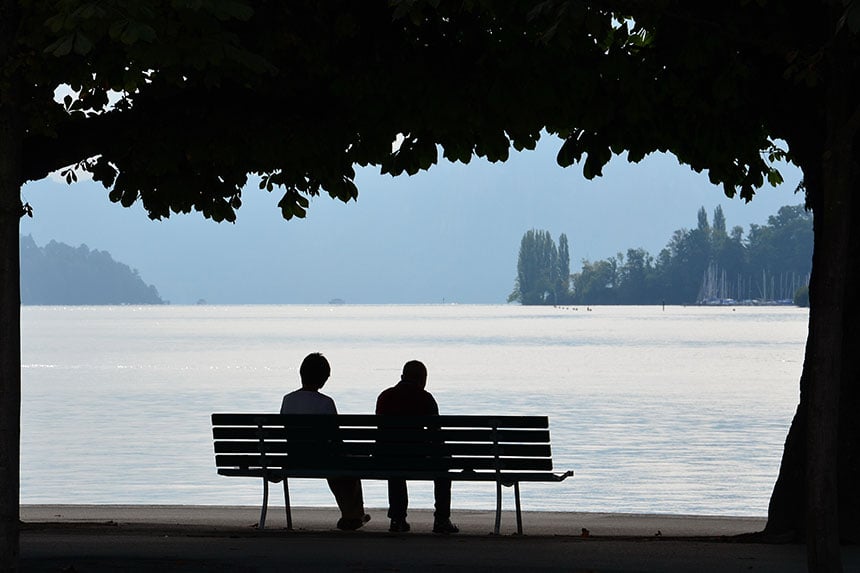
They sit, adjust themselves. From here he can see the water and the college campus, a half-mile north. His mother used to walk him there and tell stories about the landmarks — University Hall, the oldest building on campus; the library and green; the Shakespeare garden with its near-hidden gate. A selling point, the real estate agent said, although he knows residents complain about the noise students make, the garbage they leave, the crowding in restaurants and shops. He thought of applying, he wanted to stay close to home, but now he can’t imagine it.
Beth shifts, takes something out of her pocket. It’s the note he wrote her before he left school. He can see the words, written in pencil, his name signed at the bottom.
She holds it in place with her palm and looks up at him. “I wanted to know what you meant,” she says. “Writing this.”
Her words are straightforward, direct. Not accusatory so much as asking. It’s the same way she talked to him about his father. He appreciated it then, needed it, for someone to speak so clearly about something that for him was so muddled. But now he wishes for something else.
He looks away from her, out to the water. A boy races toward it, followed by a woman calling for him to stop. In the letter he told Beth he loved her, a thing he guessed she already knew. There were reasons not to say it, reasons he hadn’t. In the end it felt like courage to tell her. But he knows why Beth is asking. She has a girlfriend in North Carolina. She’s told him about her. He knows her name, Abby, and that she plays soccer and that next year she’ll attend a school in Virginia. He knows how much Beth misses her. It’s not that he doesn’t believe her. It’s only that he hoped — they spent so much time together; he feels close to her in a way he’s never felt with anyone before — she loved him, too.
Beth waits and he knows he should say something. Explain. Apologize. But there’s something on her face that makes him stop.
“I’m sorry, Jimmy,” she says, finally. “I wish I could say it back.”
He shakes his head, no. “I shouldn’t have written it.” The words come out gruff.
She touches his arm. “I’m sorry I didn’t say anything. After you left. It wasn’t because —” She stops. “You’ll think it was but it wasn’t. My mother was sick and things have been busy.” She looks at him. “I didn’t know what to say.”
“Okay,” he says. He tries to make his voice easy, sure. It isn’t such a surprise she feels this way. He guessed as much, when he didn’t hear from her. He kept hoping — how could he not? But that’s not what’s bothering him now.
From the campus he hears a thin strand of music, a violin warming up. There will be an outdoor concert tonight, the first of the season. His mother will hear it, driving home. He imagines her rolling down the window, slowing to listen. He remembers going to those concerts when he was a child, sitting on a blanket with his mother and father, lying back as the music went on and closing his eyes, falling asleep.
He leans forward suddenly, holds out his hand. “Can I have it?”
She looks at him, surprised.
“I shouldn’t have written it.” He tries to make the words relaxed, matter-of-fact. Not like the way he feels.
She hesitates, but he doesn’t lower his hand. When she gives it to him he folds it, shoves it into his pocket. Asks, with what he hopes sounds like ease, when she’s leaving.
She’s quiet for so long he thinks she won’t answer. But then she says, “Tomorrow.” She looks at him. “I didn’t want to leave without saying goodbye.”
The music starts up, the concert beginning in earnest. Celebratory, heroic notes that strike him now as comic. He shifts on the bench and then stands. “I should go.” There’s a buzzing in his hands, in his feet. She’ll think he’s trying to be rid of her but he’s not. It’s just that he needs to move.
Beth stands too, puts her hand on his arm. “What’s wrong?”
He shakes his head. Nothing. It’s a relief not to sit, his body unfolded.
Two children pass in front of them, playing a game of tag. He thinks of following, of simply beginning to run.
“What’s wrong?” she says, again.
He turns to her, makes himself stay. “Can I walk you home?”
Not an answer, but an offer she accepts.
* * *
When he returns to his house, the car is parked in the driveway. He goes in through the front door, takes off his shoes. The rain began just as he was rounding the corner, and his T-shirt is wet, but he isn’t soaked through. His mother is in the living room, sitting in one of the chairs.
She lifts her head, opens her eyes. “You’re home.” Then, as though reading his mind, “I wasn’t sleeping.” She takes him in. “You went for a walk?”
He tells her he did.
“Alone?”
He nods his head, yes. The book Beth had been reading is there on the table. His mother will guess, but he knows she won’t ask.
“How did it go with the lawyers?”
“Mm,” she says. “Fine.”
The rain begins in earnest. She asks him to close the window and he crosses the room and pulls it shut. She returns her head to the chair. “There’s food in the fridge.”
He crosses the room, takes a blanket from the edge of the sofa, drapes it over her legs. She touches his hand, closes her eyes.
In the kitchen he finds take-out cartons of Indian food. He should be hungry, he’s barely eaten all day. He lets the refrigerator door close and walks to the cupboard, takes out a glass and fills it at the faucet. His mother has tidied the kitchen, wiped down the counter, set a glass of daffodils on the sill. The new kitchen will be smaller. She showed him pictures. A one-bedroom apartment in a complex Jimmy’s aunt has assured them is clean and safe, a short drive to the beach. Nothing like the life they live now, he said, to which his mother replied, half-joking, who wants the life we live now?
The rain comes down harder, it obscures his view of the yard. He should close the window but he likes the sound of it, the smell. He walks to the table and sits. After Beth stood, they returned to the path, crowded now with people on their way to the concert. They crossed Sheridan and walked through the neighborhood, past the stretch of shops and restaurants to the apartment complex on Ridge where Beth lived with her mother. Beth told him her plans for the summer, she and her mother would drive to the Outer Banks, it was hot already in North Carolina and they’d need the relief. He could hear in her voice she wished he would say what was on his mind, but he couldn’t. He told her what little he knew of his plans — his aunt promised to take them to the beach, to the restaurants she said were her favorites. Places that didn’t feel real to him. When they reached Beth’s door, he studied the building while she got out the key. He missed the town already, but he was glad he would no longer pass this place and think of her.
She looked at him and a seriousness came over her face. “You’re going to be okay.”
He didn’t know if she was asking or telling, so he told her he would. She stepped forward and hugged him, her arms tightening around him. It took him a moment to hug her back, not because he didn’t want to but because he did. He could feel the warmth of her body and smell the soap and sweat on her skin and he didn’t want to let her go.
When she stepped back she said she would miss him and would keep in touch and he told her the same. The storm was moving closer, there was lightning, and when she turned to go she called back to him to hurry.
Now, at the kitchen table, he reaches into his pocket and takes out the letter. He’d written it in a hurry, holding it up against a locker. He can see the metal’s rough grooves in the marks of the pencil. The words were silly, sentimental, but he didn’t think he would regret them. He loved her and it had taken courage to say it. The thing that made him ache was the look on her face when she asked him why. He didn’t know, at first, what it was, but then the memory came and it was all he could do not to snatch the letter away.
He puts it on the table in front of him, smooths it down with his palm. A handful of weeks before, on a day that was not quite spring but the light was better and longer and the promise was there, his mother came to the door of his room in the morning and said they shouldn’t be inside on a day like today, he could skip school and they’d drive to the beach. He dressed and ate a bowl of cereal and then stood at the counter and helped his mother make sandwiches and thermoses of tea and they got into the car and drove north. Not many people knew the beach was there and this was what Jimmy liked, the feeling they’d gone somewhere to escape, where no one could find them. They listened to music his mother liked as they drove, Joni Mitchell and Nina Simone, and when they arrived they carried their things to the sand and his mother spread a blanket and she and Jimmy sat and looked at the water. The air was chilly, Jimmy wore sweatpants and a hoodie and his mother, her winter coat, but the sun was shining and the lake was still and when it came time for lunch he was hungry. As they ate, his mother talked about the things they’d been through that year. It was too much, she said, she knew this but she also knew they would be okay. A part of him wished she wouldn’t speak; things with his father felt, for a moment, further away, as though they couldn’t touch him and wouldn’t destroy him. But he guessed it was because his mother felt the same that she could talk about it at all. I know it must be a shock, she said, what your father’s done, and will be for a long time, but it won’t always be like this, your life will go on. And that was when he turned to her and said what he so fervently believed, his father was not guilty, and his mother looked at him the way Beth had, surprised and sorry and sad.
In the kitchen he stands from the table and folds the note and walks with it to the recycling bin, overflowing now with old newspapers and magazines, things his mother is ready to be rid of. He looks at the note and drops it in. He’ll remember the words but he doesn’t want to see them again. He walks back to the table and sits. The rain continues, steady. It seems to fill up the room. He remembers the way, on the beach, he thought of the things he could say to his mother to prove her wrong and the fear that, if he spoke, his certainty would further push loose. He pulled his knees to his chest and sat silent. He became aware again of the stillness of the water and the slow-moving traffic on the road behind them. He felt the chill in the air and his weight in the sand. An airplane went by overhead and when the sound was past his mother said, her voice reaching out to him, “This could be the ocean.” He looked out at the water, its far-off, invisible shore. This was how he had gotten through — by wanting to see a thing’s beauty, by thinking of what could be. In the kitchen he wonders what he will do, now that he knows what is not.
Become a Saturday Evening Post member and enjoy unlimited access. Subscribe now



Comments
An enjoyable, well-written story, Heather. I like the descriptive and conversational writing style. At its core, it’s dealing with a lot of life’s uncertainties; being apprehensive yet hopeful at the same time. Jimmy and Beth will probably never see each other again, but I’m glad they had the closure they did.