“Keep moving! Go, go, go!” he shouted. The cars ahead staggered through the intersection as his cell phone buzzed in his pocket. He fought the seatbelt to get it. The red light caught him.
“Can’t anybody drive anymore?” He pulled out his phone as the traffic light glared at him with its glassy red eye.
“Don’t forget your anniversary,” said the text from his daughter. Glancing up at the menacing light, he replied, “Thanks.”
He had forgotten it. He thought about it this morning and was going to wake up his wife, but she was sleeping so soundly. Then he got busy at work and forgot about it.
The light grudgingly turned green, and he hung a left. He remembered a florist somewhere along this stretch. His wife had sent him there to buy balloons for his daughter’s birthday.
It was late, but he figured any decent flower shop would stay open for a desperate husband’s last-minute dash to buy flowers. He knew there were plenty more like him: busy men who could forget an anniversary, a birthday, or another celebration of affection.
He anxiously watched the clock on the dash click to 5:57. Accelerating, he spied the “Friendly Flowers” sign glowing up ahead. His worry increased as he wheeled into the empty parking lot. Bounding up the steps, he saw “HOURS: 8 AM TO 6 PM” on the door. The neon “OPEN” sign was off. He knocked on the door and then tried it, and it creaked open. A boisterous bell above him chimed ding-a-ding-a-ding.
The shop was dark except for the glimmer of the purple fluorescent lights in the case behind the counter. As he approached it, he felt its refrigerated coolness and saw the drops of moisture trickling down its frosty doors. The case was stuffed with playful pink, purple, and yellow flowers littered with sprigs of green and white. In a corner, he saw a stash of chilled red roses.
The lights flickered on, and a short, elderly woman parted a tattered curtain hung over a doorway. She wore a faded bib apron, and her frizzy gray hair was tied in a loose bun. She shuffled over to the counter where she picked up a pair of wire-rimmed glasses.
“Must be an emergency,” she said, stretching the glasses over her ears.
“I’m sorry I’m late,” he said, “but I forgot my anniversary. It’s today.”
“Don’t worry,” she said, mustering a smile. “You’re not the only one.”
“I guess other people forget, too?”
“You’d be surprised,” she said. “Everyone’s so busy.” She pushed the glasses against her nose, magnifying the wrinkles around her eyes. “How many?”
“Maybe a dozen. Yes, a dozen would be fine,” he said.
“Years,” she chuckled. “How many years have you been married?”
“Oh, yeah. Uh, 25 … maybe 26?” he guessed. He felt a twinge of guilt for not knowing. But like birthdays, the more anniversaries he had, the less he could keep up with them.
“I’m pretty sure it’s 25,” he declared. “My daughter’s 24, and she was born a year after we got married.”
“Twenty-five years. A quarter of a century.”
“Wow. A quarter of a century.”
“How about some roses, then?” she asked. “I just got in a fresh batch this morning.”
He surveyed the array of floral options in the case and wondered if he really had any other choice. Weren’t roses the sincerest expression of a man’s love? And wouldn’t any other floral offering be just a consolation prize?
“Yes, a dozen roses would be perfect,” he said. Then he mused, “Is there something else I should get her … for a quarter of a century?”
“Twenty-five is the silver anniversary,” she explained. “You could give her something silver. Some jewelry, earrings.”
“A little late for that,” he said. “It just slipped my mind. I’ve been so busy at work.”
“The roses will be fine,” she insisted. “We’ll give them a nice touch.”
“I just forgot. My daughter reminded me. I know my wife didn’t forget.”
He glanced over at the roses in the case. “But she’s lucky I could find a flower shop open this late.”
She paused and peered over the top of her glasses. “Lucky?”
“Yeah, I mean … to get her flowers . ..this late.”
“Your wife is lucky?” she repeated. “Your wife has given you the last 25 — the best years of her life — and she’s lucky?”
He cleared his throat. “You know … since you were open,” he fumbled.
She began to tap the counter with her finger. The bags under her eyes seemed to swell.
“I guess, uh … I’m the lucky one,” he stuttered, “to be married to my wife for 25 years.”
“I believe you are,” she said, locking his eyes. “And do you still love this ‘lucky’ lady?”
“Uh … yes,” he said warily. “Yes, I do. I love her very much.”
“That’s good,” she said. She reached into her apron pocket and pulled out a pair of exceptionally long scissors and pointed them at him. He took a step back.
“Don’t ever forget that,” she warned, chuckling to herself.
“So, can I get a dozen roses?” he asked timidly.
She nodded her head. The wrinkles around her eyes deepened with amusement. “A dozen roses coming right up.”
After decades of running a flower shop, this was one of her few remaining sources of entertainment: exposing the floral illiteracy of men. She had spent a lifetime educating thick-headed husbands and boyfriends on the etiquette of flowers. Florists, along with the women who usually received the flowers, had invented these arcane customs. You had to abide by them.
He watched her write the order on a yellow pad, noticing her swollen knuckles. Summoning his courage, he asked, “How long have you been selling flowers?”
“Forty-one years.” She paused from her writing and looked up, seemingly grateful for his interest. “My husband and I started this shop when we got married. We had three kids, and they all worked here. Raised our family in this shop.”
“That’s nice,” he said.
“The kids are all grown and gone,” she said, resuming her writing. “My husband’s gone too, so now I run it by myself.”
“Sorry about your husband,” he said.
She looked up over her glasses, flashing a wry smile. “He left six years ago. Ran away with one of my customers. Good riddance,” she said, as her smile faded.
“So those are the fresh roses over there?” he asked, redirecting her attention.
“Yes,” she said, “just got them in this morning.” She walked over to the case and opened the glass door, releasing a puff of vapor. Retrieving a batch of flowers, she clutched them under her arm and shut the door.
“Pick out the ones you want,” she said, spreading them on the counter.
Was she serious? He had never been asked to pick out his flowers. What was with this lady? Usually when he bought flowers they were all wrapped and ready to go.
“Go ahead, pick out a dozen,” she insisted.
He tentatively began to sort through the cold flowers. Although he had bought roses in the past, he had never paid much attention to them. But as he inspected these, they provided a hint as to their peculiar powers.
He knew, as did most men, how a bouquet of roses could cause a woman to swoon when presented as an unsolicited gesture of affection. He also knew how an armful of roses could break an interminable stalemate after an argument. Even a single rose offered by a penitent husband could melt the ice and allow the rivers of forgiveness to flow.
He examined the flowers one at a time, carefully avoiding the knife-like thorns winding around the thick, green stalks. The sharp thorns stood at strict attention, like soldiers brandishing their swords. They issued a stern warning: Handle our lady with care and show her your respect — or suffer the consequences.
“This is a hard decision,” he said, sorting through the flowers. “They’re all so pretty.”
“It’s not so hard,” she said, snipping at a roll of green wax paper with her scissors. “Smell them.”
He held a flower up to his nose, expecting a pungent perfume. Nothing. He sniffed harder and detected a faint fragrance, the ghost of a scent.
“They don’t have much smell,” he said, looking at her cautiously. He wondered if she was testing him again. “These are not regular roses, are they?”
She spread the wax paper on the counter. “Just pick out the biggest ones,” she said. “You need four more.”
He selected four more flowers, pulling out the largest ones and laying them on the green paper. She gathered the rejected flowers and returned them to the case, shutting them behind the foggy door.
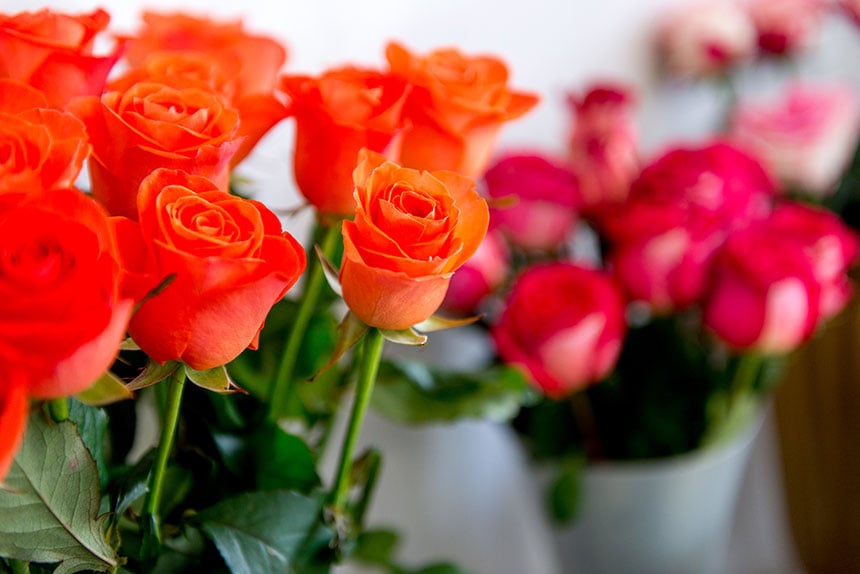
Picking up the roses, she gripped the thorny stems with her bare hands and arranged them in a neat bouquet. Pinching off the straggling leaves, she wrapped the flowers in the green paper, leaving their blushing, red faces peeking out of the top. Pulling a roll of wide silver ribbon from under the counter, she cut off a long strip and looped it around the bundle, cinching it in a knot. As a finishing touch, she tied a large, silver bow around the bouquet that hung down like the sash of a summer party dress.
“Something silver,” she said. “For 25 years.”
“That’s perfect,” he said. He watched her primp the flowers and noticed the pink scratches on her hands.
“The thorns, don’t they bother you?”
She opened her palms and looked at the small pinpricks. “I don’t notice it.” Wiping her hands on her apron, she said, “I guess I don’t feel much anymore.”
She slid the flowers into a clear plastic bag and plucked a roll of stickers from her apron. Pressing a “Friendly Flowers” label on the bag, she laid them on the counter. To his surprise, she gave him a broad, unreserved smile. Her deep wrinkles cascaded down her cheeks.
Leaning on the counter, she spoke in a quiet voice as if she was sharing a secret. “It’s the way they grow the roses now. I used to take them out of the case, and their aroma would fill the room. Now you can barely smell them.”
“What happened?” he asked, interested.
“They breed them to grow bigger and faster. Lights and chemicals, I guess. I don’t know what they do to them, but they lose a lot of their fragrance.
“People today only care about how things look. They want pretty things.” She gently rubbed the back of her hands, massaging the crepe skin. “That’s all that matters anymore.”
“Roses that don’t smell,” he remarked. “But they sure are pretty.”
“That’ll be 30 dollars,” she said.
He reached for his wallet and handed her two 20s. “Keep the change,” he insisted. “You probably saved my marriage.”
“Thank you,” she said, tucking the bills into her apron. “I hope she enjoys them. And happy anniversary. Twenty-five years is something to be proud of.”
Cradling the roses in his arm, he thanked her and walked toward the door.
“Would you lock the door behind you?” she asked.
“Sure,” he said. He opened the door and twisted the lock. The doorbell sang ding-a-ding-a-ding over head as he pulled the door closed. The shop went dark.
Getting into his car, he laid the flowers on the passenger seat and pulled the phone from his pocket. There was a text from his daughter.
“You get mom something?”
“Yes,” he texted. “Thanks for the heads-up.”
As he started the car, she texted back, “She thought you forgot.”
Then she asked, “What did you get?”
He looked at himself in the rearview mirror. A quarter of a century, he thought, running his hand through his thinning gray hair.
“Something silver,” he replied.
Become a Saturday Evening Post member and enjoy unlimited access. Subscribe now