In many parts of the country, the onset of autumn is heralded by a flurry of colors. Bright yellow school buses emerge from hibernation caves (or wherever they go in summer) to ply the roads again. The leaves of most kinds of deciduous trees turn colors – lots of red and orange in the Northeast, Great Lakes, and Upper Midwest regions, and plenty of dazzling gold in most other parts of the U.S. Where I live, red, gray, and black squirrels streak across the yard all day, caching food for later use.
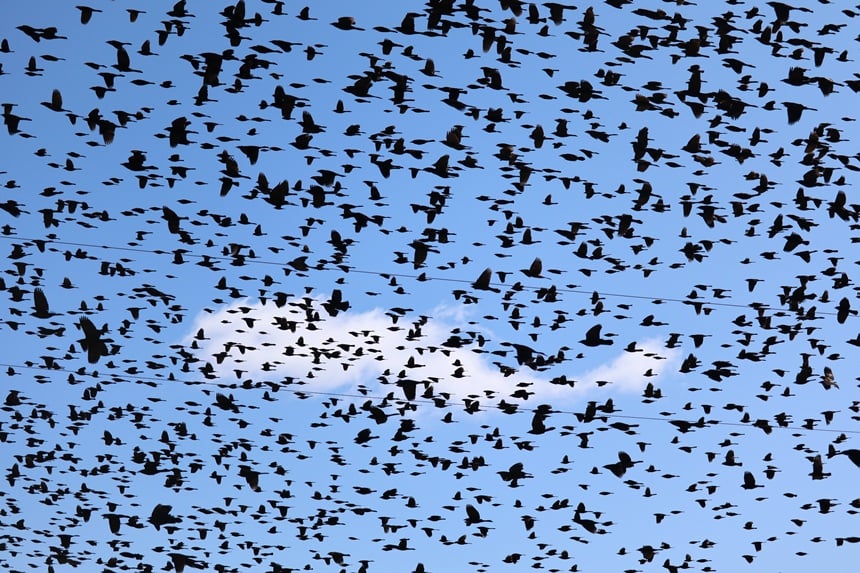
I wonder if kindergarten teachers and other types of cat-herders are jealous of the way geese organize themselves, youngsters included, into nifty V-shaped formations without any apparent squabbles. However, with all due respect to migratory geese, as well as to teachers who somehow get preschool kids to form a straight line for more than two seconds, blackbirds get the prize for teamwork. If you’ve ever seen a flock of blackbirds turn, climb, and dive in perfect fluid synchrony like a school of fish, you know how captivating these performances are.
The term blackbird is broad, and includes species that aren’t entirely black, like the brown-headed cowbird. With roughly 92 million of them in the U.S., many of us have spotted these shameless brood parasites. We also have three kinds of grackles that together span the continental U.S. The most common grackle, numbering around 100 million, is (surprise) the common grackle. Yellow-headed blackbirds are found on the Great Plains and south into Texas, while rusty blackbirds make their home in the eastern half of the country. There are others as well, like the invasive European starling, but my favorite is the red-winged blackbird.
Starlings exhibiting synchronous flocking behavior (Uploaded to YouTube by National Geographic)
If you look at a range map for red-winged blackbirds, they either breed or overwinter across every contiguous state, and even Alaska has pockets where they nest. I’ve always lived where winters hang on into April, and it does my heart good to see a flash of red (with a splash of yellow) wing patch and hear the brazen “conk-a-chee” calls in late March when snow still covers the ground. Maybe that’s why I like them so much.
A red-winged blackbird’s “conk-a-chee” call (Uploaded to YouTube by Lang Elliott’s Nature Channel)
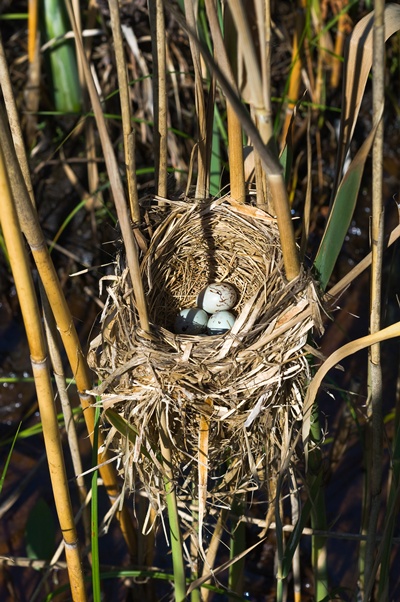
Part of my land is a marsh, where red-wings nest among cattails in relative safety from predators like raccoons and foxes. I recall canoeing with my young daughter through cattails one spring, peering into red-winged blackbird nests while adults hovered overhead, objecting loudly and diving close to our heads. Though marshes afford red-wings protection from four-legged critters, hawks and owls take a toll on blackbirds regardless of where they nest.
Considering that red-winged blackbirds are one of the most abundant birds in North America, it seems odd that we don’t often notice their migration. Migrating geese are hard to miss – their chevron-shaped flocks catch our eye, and their loud honking let us know what’s up, so to speak. But blackbirds tend to travel at night, and their calls don’t carry far.
In late summer they form flocks, and while it’s sad to see them leave for the winter, it’s also fun to watch thousands of them dip and weave as a cohesive unit. This is called synchronous flocking behavior. One fall morning years ago, a small flock of perhaps a few hundred red-wings took a break from stunt-flying and poured into a big sugar maple in my yard. A few minutes later, I watched in awe as they flowed up out of that tree in a tight stream, and then gracefully poured themselves down into another large maple nearby like an avian hourglass.
Hundreds of Thousands of Red-winged Blackbirds and Short Murmurations (Uploaded to YouTube by Observing Nature)
People have long wondered how large groups of birds – flocks of red-wings can number over a million – manage to stay in sync without a lot of bumping into each other. In recent years we’ve made some progress thanks to high-speed cameras, algorithms, computer modeling, and brain imaging. Although we’re working toward solving this mystery, no one claims to have all the answers.
One piece of the puzzle came about ten years ago when biologists found that each bird in a flock keeps track of its seven closest neighbors and coordinates its movements with them. No matter how many times they turn or dive, they maintain about the same distance between themselves and the seven closest birds.
In late 2025, researchers from the University of Konstanz and the Max Planck Institute of Animal Behavior in Germany discovered a neural basis for flocking behavior. They found there is something called a ring attractor network in the brains of most animals, and it may account for flock synchrony more than any other explanation. My understanding is that it’s literal ring of neurons that are only firing in one small region or “activity bump” that instantly changes position on the ring depending which way the animal turns its head.
According to the scientists, when birds gather in large groups, their neural rings sync-up, which allows for spontaneous and collective movements. The scientists also think that birds probably still use their senses to track their seven closest peers, and their brains integrate that information with what’s happening in the neural ring. Whether this is the complete solution to the mystery of flocking remains to be seen.
In the words of an Italian ornithologist deeply involved in studying starling flock behavior in Rome, “The exact way it [flocking behavior] works, no one knows.” I like an honest researcher.
Become a Saturday Evening Post member and enjoy unlimited access. Subscribe now