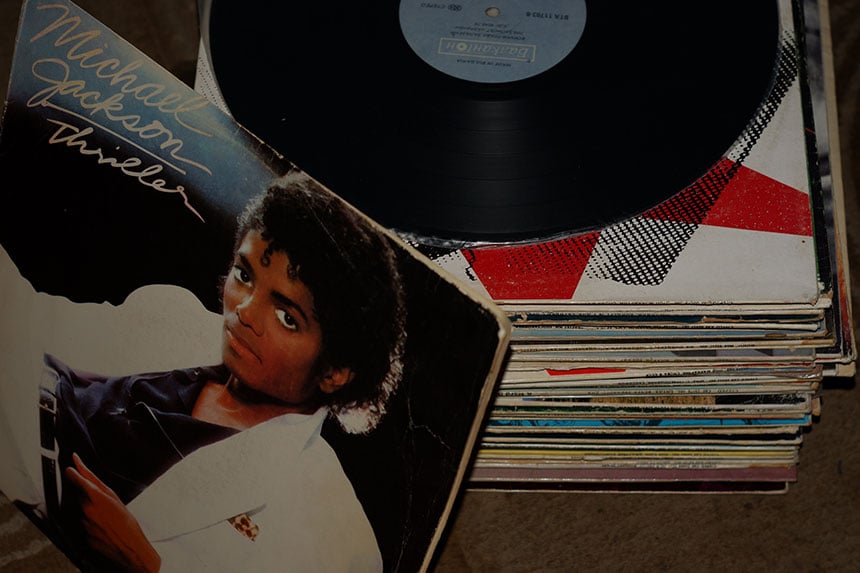
As we recently noted in our look at the actual biggest hits of the 1970s: It’s said that hindsight is 20/20, but it can also cloud your vision. Let’s look at the charts as tabulated by Billboard magazine with their ’80s-era methodology of reported sales to discern what were actually the biggest hits of the decade. They might not be what you remember.
How Many #1s?
Billboard tracked 231 #1 songs between 1980 and 1989. Of those tunes, 92 held the top spot for a single week. For our purposes, we’ll be starting with songs that spent at least five weeks at #1. That takes the total number down to 17 tunes that were the biggest-selling — and, arguably, most played on radio — songs of the decade.
The Fresh Fives
“Jump” by Van Halen (Uploaded to YouTube by Van Halen)
Three songs held the #1 spot for five weeks in the Reagan Era. The first came attached with melancholy, as it was a posthumous chart-topper for John Lennon. The first single from Lennon and Yoko Ono’s Double Fantasy album, “(Just Like) Starting Over” hit the top after Lennon’s murder on December 8, 1980. The other two five-week #1s both landed in 1984. Van Halen’s “Jump” from the appropriately titled 1984 album was the group’s biggest hit and their sole #1 single. On July 7, 1984, Prince took the top with “When Doves Cry” from the album and film Purple Rain. It was the artist’s first #1 and has the musical distinction of being the only track on the album that didn’t employ bass guitar at all.
The Serious Sixes
“Like a Virgin” by Madonna (Uploaded to YouTube by Madonna)
Seven songs had a six-week run at the top in the 1980s. Blondie’s second #1, “Call Me,” following 1979’s “Heart of Glass,” reached the summit in April of 1980. Kenny Rogers logged nine Top 40 hits before hitting #1 with “Lady” in November of 1980. In February of 1982, The J. Geils Band held on for six weeks with “Centerfold.” Also in 1982, Survivor’s Rocky III anthem “Eye of the Tiger” fought its way to the top that July. Another movie #1, Irene Cara’s “Flashdance . . . What a Feeling,” had its moment in 1983. In December of that year, Paul McCartney and Michael Jackson’s “Say Say Say” began its run. The final 6-weeker was a smash for Madonna: “Like a Virgin” was her first #1, taking the spot in December of 1984.
The Strong Sevens
“I Love Rock ‘n Roll” by Joan Jett and the Blackhearts (Uploaded to YouTube by Joan Jett and the Blackhearts)
Joan Jett and the Blackhearts covered The Arrows to great effect; their version of “I Love Rock ’n Roll” dropped dimes in the jukebox in March of 1982. Immediately after, Paul McCartney and Stevie Wonder found gold with “Ebony and Ivory.” And on March 5, 1983, Michael Jackson moonwalked away with the top spot via “Billie Jean.”
One Awesome Eight
“Every Breath You Take” by The Police (Uploaded to YouTube by The Police)
Perhaps the most misinterpreted song on the list, “Every Breath You Take” by The Police was a dark tale of possessive obsession that many took for a straightforward love song. It made its move in July of 1983. In a 1993 interview with The Independent (not conducted by Trent Crimm), Sting said of the tune, “It sounds like a comforting love song. I didn’t realize at the time how sinister it is.”
Gnarly Nines
“Bette Davis Eyes” by Kim Carnes (Uploaded to YouTube by Kim Carnes)
Two songs served nine-week runs, both in 1981. The first, kicking off in May, was “Bette Davis Eyes” by Kim Carnes; it was a cover of a Jackie DeShannon track from 1974. The tune won both Record of the Year and Song of the Year at the Grammys. That August, the duet “Endless Love” by Lionel Richie and Diana Ross dominated the charts. One of many soundtrack hits of the decade, it was written for the film of the same name by Richie. The song marked rites of passage for both stars; it was Ross’s final single for Motown and Richie’s first single as a solo artist (he would leave the Commodores the following year).
A Treadmill-worthy Ten
“Physical” by Olivia Newton-John (Uploaded to YouTube by Olivia Newton-John)
“Every Breath You Take” may have been the most misunderstood song on the list, but younger listeners in 1981 probably thought this song was about exercise. And it was, of a sort. “Physical” by Olivia Newton-John was an innuendo-powered beast on the charts. The single shipped two million copies almost immediately and remains the longest-running Billboard #1 by an artist from Australia.
Newton-John’s team thought that the song might add additional sexiness to the singer’s girl-next-door image (apparently Sandy’s makeover at the end of Grease didn’t stick). The song almost wasn’t hers. It was originally intended for Rod Stewart; Tina Turner also passed. But Newton-John leaned into the winking nature of the tune and, accompanied with a very popular video, she took it to the top.
The song represented a second peak in Newton-John’s career. By the end of the 1970s, despite having 14 Top 40 hits in the U.S., her last two singles of that decade took a deep slide (“Dancin’ ’Round and ’Round” made it to #82). She bounced back in 1980 with an Andy Gibb duet (“I Can’t Help It”) and three big hits from the soundtrack to box office flop Xanadu: #1 “Magic;” #8 “Xanadu;” and #20 “Suddenly” with Cliff Richard. The momentum from “Physical” carried her through 1985 with six more Top 40 hits. Her final original tune to make the Hot 100 was 1992’s “I Need Love.” Newton-John passed in 2022; with more than 100 million records sold, she remains the highest-selling female recording artist from Australia.
Unanswered Questions
While the above tracks certainly represent chart success, they don’t tell the entire story of the 1980s. What can be seen is the impact of MTV, as songs with extremely popular videos (like “Physical” and “Billie Jean” and “Every Breath You Take”) experienced demonstrably long runs. While there is a little representation (Blondie, for example), we don’t see the influx of New Wave bands that foreshadowed the rise of college rock/alternative rock, which leapt exponentially forward in 1987. There’s no hip-hop presence and no metal, despite both being defining genres of the decade. Part of that is the three-way split between what was popular on mainstream radio versus college radio, what sold well as singles versus what sold well as albums, and what the reported data was versus actual sales data (a number that would change greatly with the advent of advanced tracking like SoundScan in the early 1990s). By 1988, Billboard would introduce the Modern Rock Tracks chart; the following year, they added Hot Rap Tracks. The two new lists would reflect the widening diversification of music tastes that would become even more pronounced in the next decade.
Become a Saturday Evening Post member and enjoy unlimited access. Subscribe now

Comments
According to Billboard, there were 10 artists who had at least four #1 songs in the 1980s:
Michael Jackson (9); Madonna, Whitney Houston, Phil Collins (7 each); George Michael, Lionel Richie, Hall & Oates (5 each); Stevie Wonder, Bon Jovi, Prince (4 each).
Most total weeks at #1 during the decade were Michael Jackson (27 wks) and Lionel Richie (21). Coincidentally, those two men co-wrote the #1 hit “We Are The World”.