In the spring of 1965, the air inside the unassuming home on Lapsley Street in Selma, Alabama, was heavy with the weight of a nation’s future.
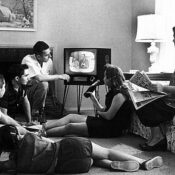
In the living room, Dr. Martin Luther King Jr. sat in an upholstered armchair, huddled with fellow civil rights leaders around a black-and-white television, waiting for President Lyndon B. Johnson to address the nation. For countless nights, King and his co-organizers had gathered around the maple dining table inside this modest bungalow — the home of local dentist Dr. Sullivan Jackson and his wife, Richie Jean Sherrod — to share ideas and plan protests and demonstrations.
Ordinarily, Mrs. Jackson might have been in the kitchen brewing coffee or preparing food for her guests. But on the evening of March 15, she sat quietly at Dr. King’s feet.
As they watched the leader of the free world deliver a passionate, nationally televised demand for comprehensive voting rights legislation — and adopt the Movement’s own anthem, “We Shall Overcome” — Dr. King was visibly moved, and he was observed wiping away a tear.
It was a profound turning point. While public demonstrations filled the streets of Selma and communities in the South, this humble residence served as the private testing ground where the foundation for the Voting Rights Act of 1965 was laid. The Jackson Home provided civil rights leaders with a secure sanctuary to break bread, meticulously plan strategy, and conduct high-stakes telephone negotiations with the White House.
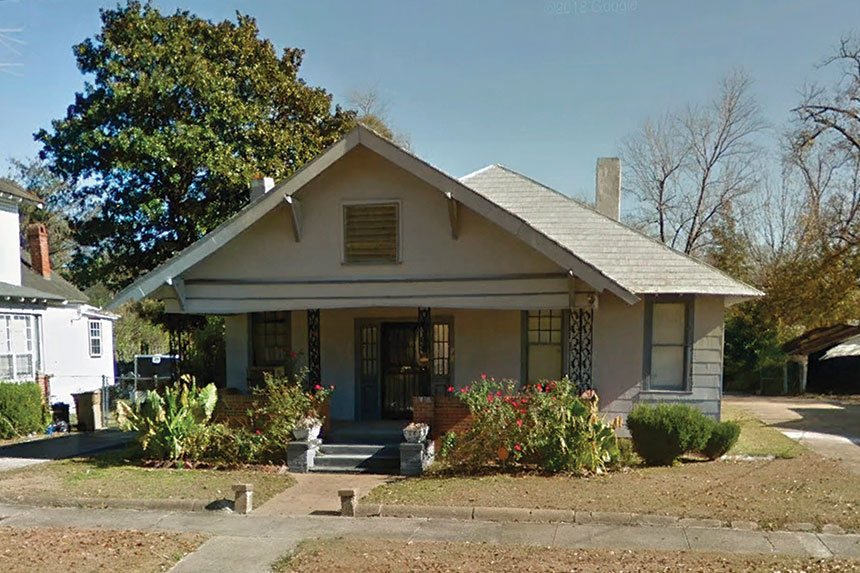
Built in 1906, the Dr. Sullivan and Richie Jean Jackson house endures as an iconic monument to the Civil Rights Movement. Beyond its prominent role in national history, the house tells an important story about the Black professional upper-middle class that helped establish the structural backbone of the Selma movement.
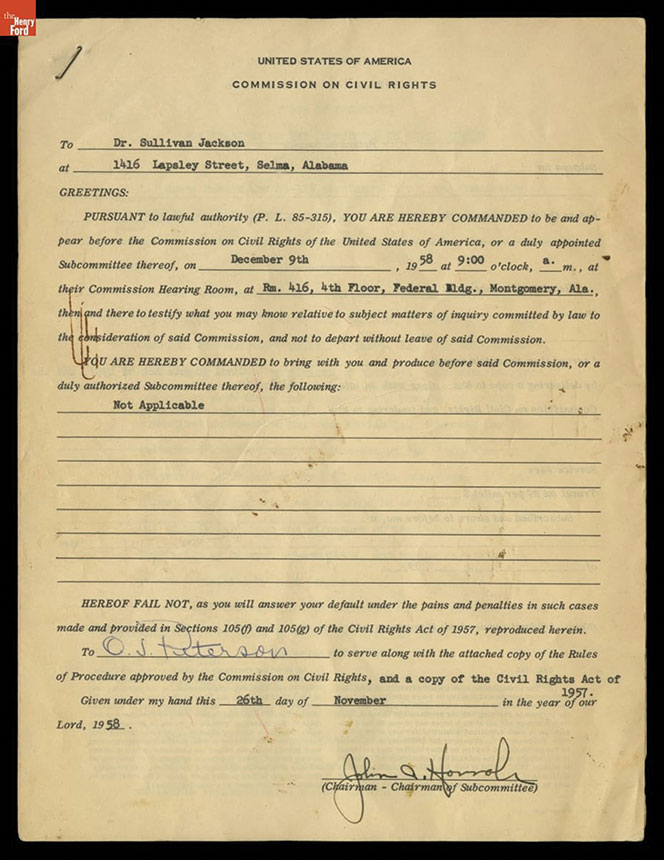
The Jacksons were Black educators and entrepreneurs who lived a seemingly ordinary daily life, but who took extraordinary risks. Dr. Jackson, a World War II veteran, was completely stripped of his right to vote when he moved to Selma. In 1959, he bravely testified before the U.S. Civil Rights Commission regarding this disenfranchisement. At the time, Dr. Jackson owned a private dental practice but also worked for the city of Selma. Taking such a public stand against his own employer meant facing immediate risk. Because of their activism, the family faced economic and systemic retaliation; Mrs. Jackson was fired from her job, and like many others at the time, the family lived under the constant threat of physical violence and death.
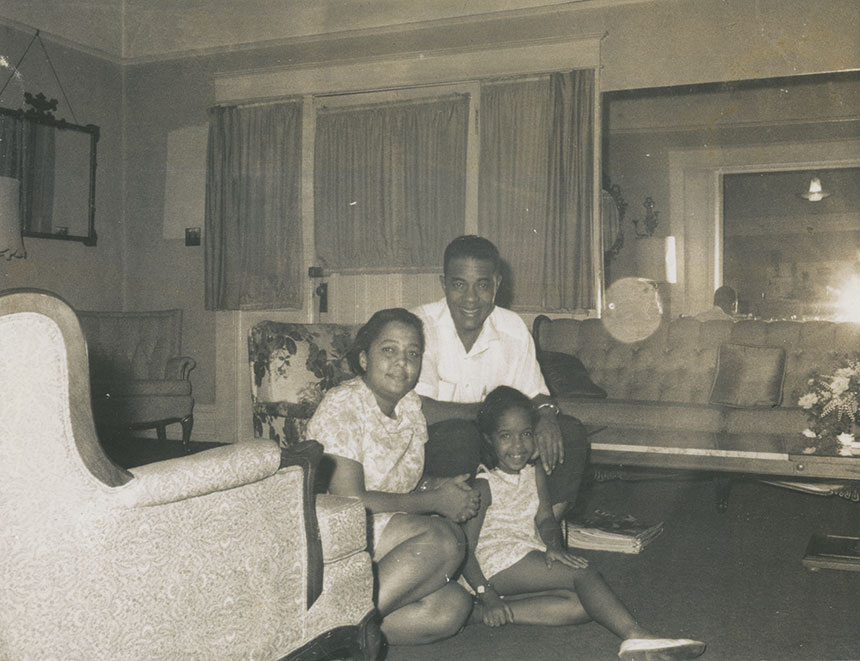
The Jacksons were long-time, well-connected friends of Dr. King and his wife, Coretta Scott King, dating back to the mid-1950s. When the Southern Christian Leadership Conference was invited to join local voter registration efforts in 1964, Black organizers could not safely stay in standard hotels due to Jim Crow segregation. The Jacksons opened their doors as a haven to Dr. King and his leadership team, hosting them extensively between January and June of 1965.
Dr. King used the residence as his ground-floor headquarters to map out the strategy for the historic Selma marches. The Jackson Home stands as an example of how important local organization is to national movements; in this case, local groups kept the fight alive long before outside organizations arrived.
Today, that very armchair, that maple dining table, and the walls that sheltered a movement remain precisely as they were — but they are no longer in south-central Alabama. They have found a new, permanent home more than 1,000 miles away, in a living history museum in the Midwest — Greenfield Village, part of The Henry Ford in Dearborn, Michigan.
Initially established by automotive titan Henry Ford as an open-air classroom in the late 1920s, Greenfield Village today is part of an expansive museum complex in the Detroit suburb. Designed as a New England-style town, Greenfield Village preserves historic structures, workshops, and landmarks associated with American innovators, including the Wright brothers, Thomas Edison, and Noah Webster.
The Jackson Home now sits on Maple Lane, nestled between the George Washington Carver Memorial and the William Holmes McGuffey Birthplace, near the rural Illinois courthouse where Abraham Lincoln practiced law early in his career. The arts and crafts bungalow is the first home added to the village in 40 years — the last being the 19th-century farmhouse from tire tycoon Harvey Firestone’s boyhood.
In its new, pastoral setting, the Jackson Home perfectly aligns with the museum’s mission: telling the stories of ordinary Americans who accomplished extraordinary things and altered the fabric of American culture. It serves as a reminder that innovation isn’t just born in laboratories; sometimes, it is forged through the quiet heroism of community, courage, and open doors, observes Amber Mitchell, the first Curator of Black History at The Henry Ford.
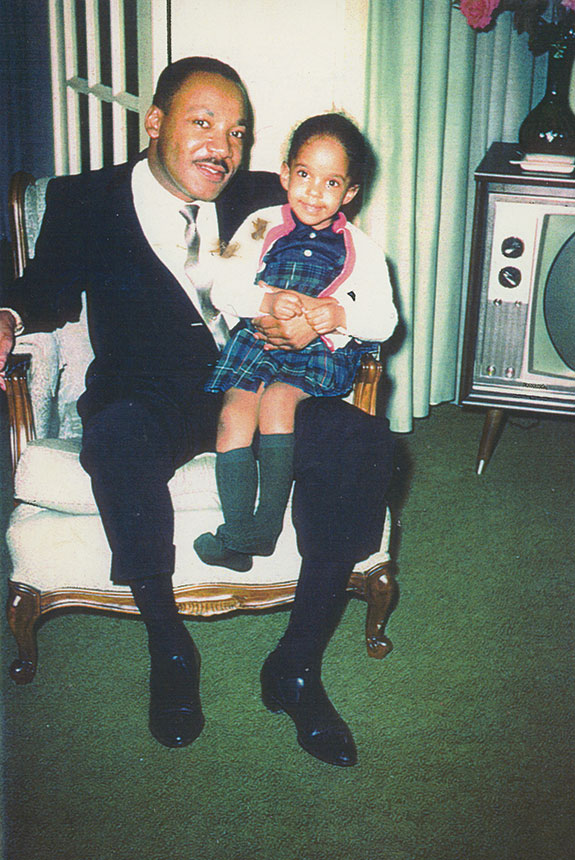
Following the passing of her parents, Jawana Jackson — the couple’s only child and the building’s sole owner — operated her childhood home as a museum for several years starting in 2014, treating it as a sacred trust.
“Preserving the home meant safeguarding an extraordinary chapter of the Civil Rights Movement. Everything inside was entirely original; my parents saved everything, and Dr. Martin Luther King Jr. — whom I fondly knew as Uncle Martin — slept in every bed in that house,” Jackson says. “I made a promise to my parents that I will protect the house. ”
Recognizing the need for long-term stewardship of the structure, she reached out to The Henry Ford in 2022. Patricia E. Mooradian, president and CEO of The Henry Ford, recalls her initial reaction: “I was a bit surprised because she was absolutely certain that her childhood home needed to be moved to Greenfield Village. She was so passionate when she told us the story of her parents and their relationship with Dr. King, we began assembling teams within the organization right away.”
Following a year of careful planning, an agreement was reached in April 2023 to acquire the home and its massive archive of more than 9,000 artifacts — preserving everyday objects, photographs, and historical documents for generations to come.
“When we decided to acquire this home, we immediately understood that this was not just another preservation project,” Mooradian explains. “This was an opportunity to safeguard a cornerstone of American democracy — the very home where strategy, courage, and conviction converged to secure voting rights for millions of Americans.”
The acquisition also marks a conscious, organization-wide investment to tell a deeper, more complex story of Black American history — a commitment reflected in the creation of Mitchell’s role as Curator of Black History. The home joins existing Black heritage spaces in the Village, including two historic plantation structures and a 1927 interactive farming cabin. “These structures tell a different story,” Mitchell explains. “These belonged to people who were looking to make their way in a country that never accepted them as citizens.”
The Jackson Home helps connect the dots with other “social transformation stories we share,” Mooradian explains, “including the Rosa Parks Bus, which is in the With Liberty and Justice for All exhibition.” By bringing the bungalow to Greenfield Village, the institution creates a powerful historical arc spanning from the 1955 Montgomery bus boycott to the 1965 Selma marches.
To honor this heritage, The Henry Ford is actively building community goodwill in Selma and the wider Black Belt, gathering a massive oral history collection from surviving movement participants and launching student exchange programs coinciding with the opening of the home in the Village.
The Jackson Home officially opened to the public on June 12, 2026, with Greenfield Village hosting a ribbon-cutting ceremony and a vibrant, three-day block party to commemorate the milestone. Jawana Jackson and Selma Mayor Johnny “Skip” Moss III, alongside local and state dignitaries, delivered uplifting remarks at the dedication. Weekend festivities enveloped the 80-acre village with Southern-fried foods and live performances of gospel, blues, and ragtime, alongside panel discussions and lectures focused on Southern farmers, preserving Civil Rights history, and curating the Jackson Home.
The physical relocation of the 2,000-square-foot home was a feat of modern engineering; rather than dismantling it board-by-board, crews literally cut the home in half, transporting both sections to Michigan on flatbed trucks before seamlessly fusing them back together.
Hundreds of visitors passed through the Jackson Home during its opening weekend. Guests first enter through a modern interpretive annex that outlines the era, anchoring the structure in its proper historical context. From there, they cross the threshold through the back door — the exact path Dr. Martin Luther King Jr. and fellow leaders once took to maintain discretion.
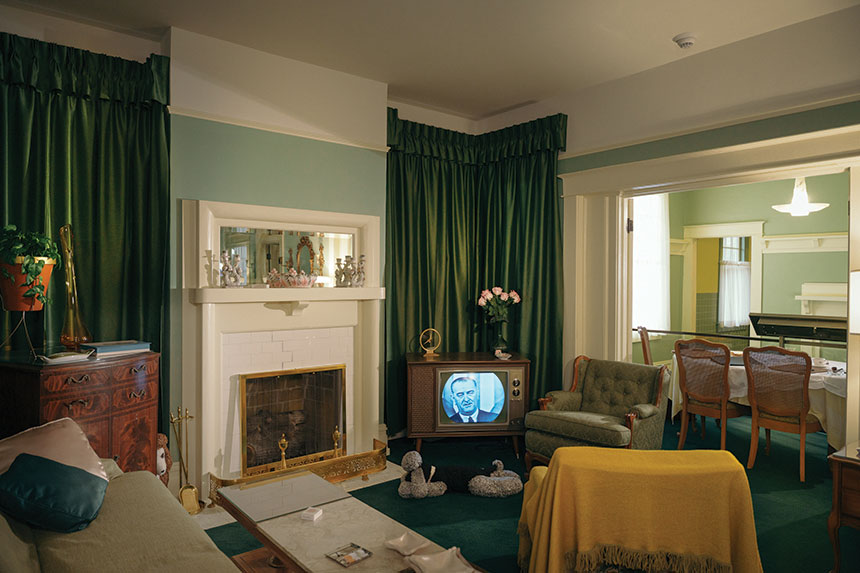
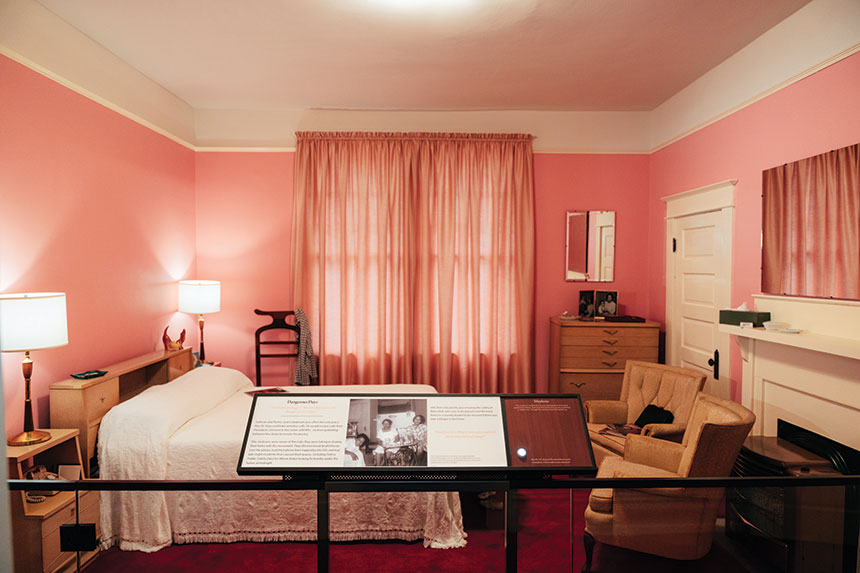
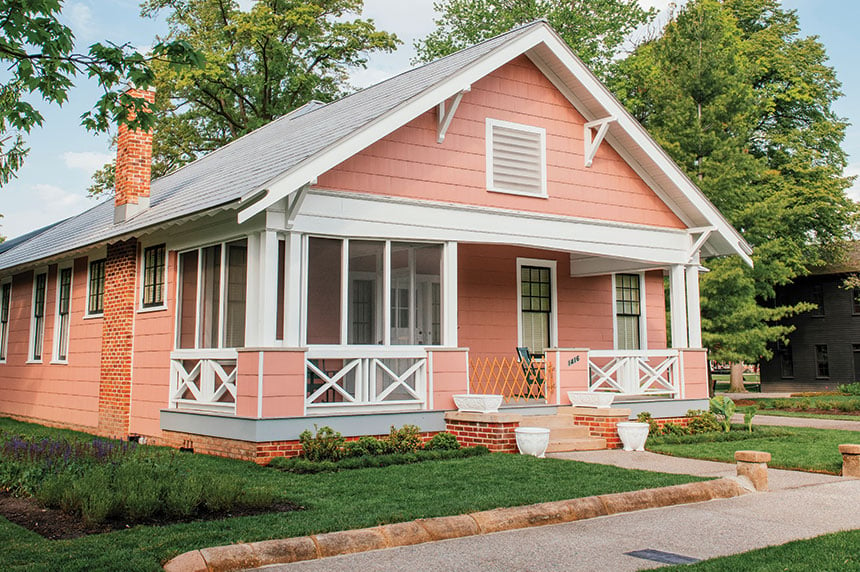
Inside, visitors step directly into the spring of 1965, with every detail painstakingly restored to its original mid-century appearance. Using family photographs and Richie Jean Jackson’s own memoir, The House by the Side of the Road, curators used paint-matching technology to return the home to its historic 1965 color palette — including a vibrant exterior of salmon pink with white trim.
The living room serves as the central hub of the house. The immersive layout features the upholstered armchair facing a black-and-white television broadcast of President Lyndon B. Johnson’s historic “The American Promise” address — delivered to a joint session of Congress in the immediate, raw aftermath of the “Bloody Sunday” violence at the Edmund Pettus Bridge.
The entire first floor is displayed precisely as it was during those high-stakes months. The walkthrough includes the bedroom where Dr. King stayed to rest and think, as well as Jawana’s bedroom, beautifully arranged with original mid-century modern décor and restored artifacts.
Reflecting on the emotional resonance of the restoration, Mayor Moss noted that seeing the house carefully reassembled in Michigan serves as a powerful metaphor for the movement itself. Just as civil rights protections can be systematically dismantled, they can always be reconstructed through dedication.
“It’s important to walk through that house,” says Moss, whose grandparents lived just two doors down from the Jackson Home in Selma. “You feel the energy. You feel the history and how critical it was as a strategic hub for the movement. It’s vital that we help rebuild what has been taken from us since then. Democracy doesn’t disappear overnight — it’s dismantled piece by piece.”
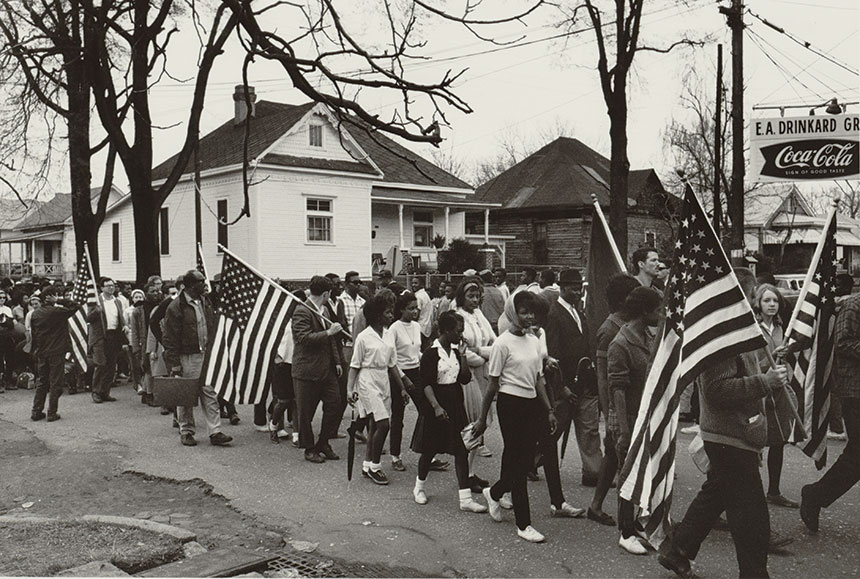
That message hits home in the back bedroom, the final stop on the tour. Here, visitors learn about the prayer sessions and the final planning held on the morning of March 21, 1965 — the day the third Selma march began. Displays encourage citizen involvement and registration, leaving visitors with a poignant question: “What is Your Role?”— a parting reminder of personal responsibility.
“Everybody had a role to play,” says museum curator Mitchell. “It was not just any one individual. It was not just Martin Luther King Jr. It was not just the Jacksons. It was many individuals — just everyday people. That individual can be you. What does that look like for you? What role will you play?”
“This space gives people the context to unlock their own personal power,” Mitchell adds, “You don’t have to be a big famous person to make a difference.”
Greg Tasker is former managing editor of Cadillac Magazine, whose work has appeared in Parade, BBC Travel, AAA Explorer, AARP, and Fodor’s, among other publications.
This article is featured in the September/October 2026 issue of The Saturday Evening Post.
Become a Saturday Evening Post member and enjoy unlimited access. Subscribe now