History shows how hard it is to see where new technology will take us.
It’s certainly true of Artificial Intelligence, just as it was over 60 years ago when television was introduced.
Critics quickly dismissed it as a novelty of no enduring value. Americans already had an electronic medium for entertainment: radio. And the average American in the 1940s listened to it more than four hours every day. A big part of its appeal was that its audience could listen while doing something else. Television would require viewers to drop what they were doing and continuously watch a screen. They might do it for a short while, said critics, but certainly not for hours. One man quoted in the Wall Street Journal probably spoke for many when he predicted people would soon grow tired of staring at a plywood box every night.
But television proved highly popular despite its many shortcomings. The first sets had small screens, high prices, low-resolution pictures, and were plagued by interference and a tendency for the picture to continually scroll up the screen.
When TVs Broke Down Every Week — And Nobody Knew How to Fix Them (Uploaded to YouTube by The Technology Archive)
It was also limited by the small number of broadcasters that, in the early days, restricted reception to areas surrounding big east-coast cities.
As if these drawbacks weren’t enough, television was hindered by minimal budgets. Broadcasters put most of their revenue into radio, so early TV programming relied on inexpensive offerings like wrestling.
Yet TV was such a novelty that people would watch almost anything. Despite the fact that an average set could cost the present-day equivalent of around $5,000, a million American homes had television by 1948. About six million sets were sold every year throughout the 1950s. By mid-decade, most American homes had a TV, and 90 percent had a set by 1960.

As viewership rose, television’s ad revenues grew. Programs budgets were raised. Networks gave their TV shows better equipment and better talent. Programs gained devoted followers. Viewers made sure they wouldn’t miss their favorite programs, and they were continually seeking new programs, which was how TV Guide eventually became America’s most popular magazine.
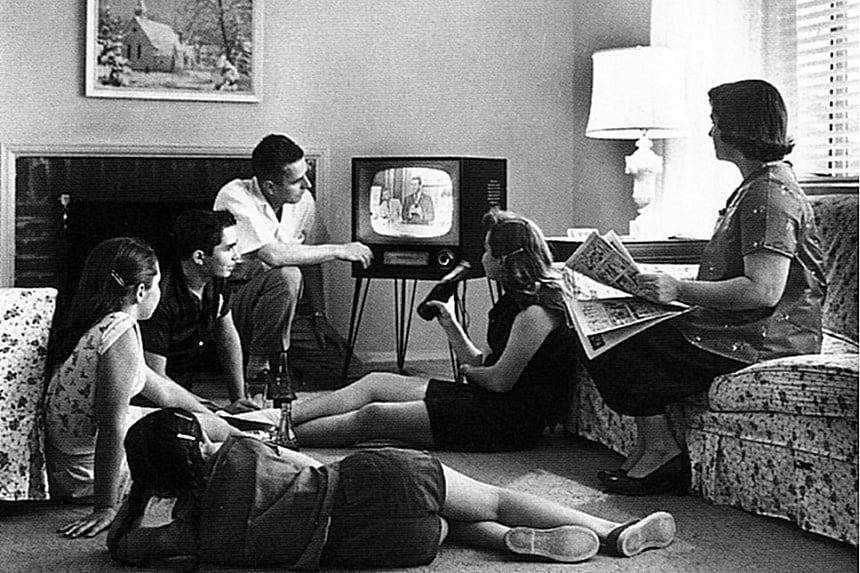
By 1955, Americans were spending the same amount of time watching TV as they previously had listening to the radio. They spent so much time watching, they rearranged their living room furniture so all the seats faced their set. They bought frozen dinners designed to be consumed in their own aluminum trays so viewers wouldn’t miss anything on screen.

Now critics were concerned that Americans were watching too much television. It had become a way of escaping reality. Famed broadcaster Edward R. Murrow believed its ability to distract citizens from painful realities threatened the survival of the nation. Many Americans were troubled by television’s power to influence opinion, having seen demagogues captivating and dominating their countries.
Novels like Brave New World, 1984, and Fahrenheit 451 described future worlds where people were numbed and manipulated by television.
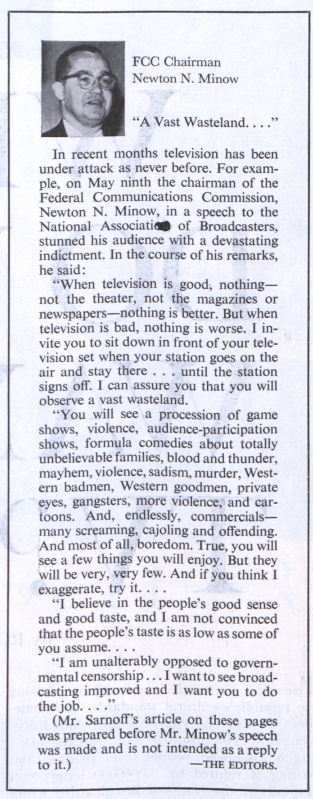
The quality of the entertainment was also challenged. The head of the FCC said that, while television had some good programs, when it was bad, nothing was worse. He challenged Americans to watch one full day of television, without a book, newspaper, or stock market report. Do nothing but watch television until the stations signed off at night. “I can assure you that what you will observe is a vast wasteland.”
In 1950, the president of Boston University said, “If the television craze continues with the present level of programs, we are destined to have a nation of morons.”
Doctors warned television could damage your eyes. Children were told not to sit too close to the screen.
The biggest concern was the violence. The dramatic content that would engage parents was thought to be too intense and too influential for children. Radio had featured violent programs, like Gangbusters, but the violence was left to the imagination, not acted out. Parents worried their children would become juvenile delinquents from watching too many violent dramas.
We shouldn’t discount those long-ago apprehensions. Television was a new medium and new technology that few people understood. No one could tell how hours of television would affect the minds of viewers, or, especially, of their children.
However, we have seen two unexpected effects. First, it has created a public expectation of continual entertainment. For years, television stations would broadcast filmed shows and old movies. When they ran out of programming, the shows were run again. And late at night, with their content exhausted, stations simply stop broadcasting. Then, in 1980, CNN began broadcasting continually on the principle that there was always news to report. Now, almost every station broadcasts nonstop. There’s always something to watch. And if you should forget this fact, you’ll see game shows, talk shows, and movies playing on televisions in airports, restaurants, barber shops, and waiting rooms to remind you.
Another effect has been the creation of a popular monoculture. When individual broadcasting stations were gradually absorbed by national networks, the nation was routinely exposed to standards of speech, behavior, dress, and ethics. Regions of the country still retained some of their character in their newspapers and local radio broadcasts. But television channels all seemed to show the same sort of people: white, middle-class families who shared their undistinguished accents and attitudes.
Americans also developed a shared taste for TV programs. Adults could assume their friends and coworkers watched the same programs they watched. No matter where Americans went in their country, they could find other Americans who knew the significance of “Just the facts, ma’am.” “Get out of Dodge,” and “To the moon, Alice!”
Television’s full impact is still unknown, and now we have AI as the great, ominous unknown. It probably won’t be possible to measure how either technology has affected Americans because there’s not a significant population without television or computer to serve as a control group.
Become a Saturday Evening Post member and enjoy unlimited access. Subscribe now




Comments
A fascinating feature Jeff, with great accompanying links throughout. The YT video on why televisions broke down or “on the blink” so often was made very understandable here, even if no less frustrating until improvements came along, which included the self tube testing.
We had the TV repairman over a lot at our house. More than once, to my mother’s aggravation and frustration, the TV worked fine once he got there, having not just the day (and hour) before. He told her she was paying for a new set and not getting one. That’s when my Dad bought a new TV; the first one also in color.
The immediate worries of SI/AI seem mainly concerned with the dissolution of industries and jobs, but will have more consequences yet unknown. From the beginning, TV was/is an advertising medium whose unspoken purpose was to get viewers to watch the commercials, with the shows keeping them there TO watch them. This why ratings (which determined ad rates) were so important. I’m sure they still are.
The last I checked, the main advertisers were from the pharmaceutical industrial complex more than any other single source of product(s) otherwise.
I see many similarities between the controversies of broadcast television in its infancy and AI (Super Intelligence, if you will). The concerns people had with TV were addressed and harnessed by the FCC. The same type of concerns which may be more ignorance, unknown, or unexplored related will be addressed and harnessed as well. SI (or AI) is only as intelligently helpful as developers program or design it to be. Fifty years down the road the question will be why was there such a row of this tool. There are a lot of misinformed or even uninformed people out there that are making a lot of noise over various means (usually over TV) who just don’t know what they are talking about and truly don’t know their @$$ from a hole in the ground and furthermore don’t want to explore the sources and learn the true facts behind SI/AI. The world is full of ignorance and ignorant people and sadly those are the ones making the most noise and getting the most attention. I am happy to say I have explored the possibilities of SI/AI from the technical side and do not feel threatened whatsoever it can do. I still have a reasonable amount of sense and know “when to hold and when to fold.” As a retired Information Systems Manager, systems analyst, programmer, and former software designer & developer for mid-range IBM Systems I do know what is involved behind the scenes in producing a successfully utilized software application. Any political leanings, right or left must be thrown out the door when development & design happens for the application to be successful. “Just the facts” as Sgt Joe Friday used to quote on the “Dragnet” TV show also applies to information being spewed regarding SI/AI. That’s all we need to know and should expect, “the truth and nothing but the truth.” Period.