It’s a Grand Old Flag
The two men looked at the island from the mainland, where it was safe.
“He ain’t really gonna do it, is he?” asked Mort Sumpter, town councilman, referring to one Jack Planter, owner of Buck Island, sitting out there in Lake Champlain like a moored barge with a house and a few maple trees on it that made it look festive in autumn.
“Says he’s seceding,” said Mayor Junior Bishop. “Sent me a declaration.”
The Mayor handed a paper with a fancy border on it, twining vines, to Sumpter.
From Buck Island, formerly of Vermont
To Wit:
I, Jack Planter, being of sound mind, do solemnly declare that the whole town can go to blazes, and do hereby declare my island an independent nation, so stick that in your pipe and smoke it. Anybody who says different can lump it.
Buck Island is now The Republic of Gondwana.
Jack Planter, President
“Harley Edison notarized it,” said the Mayor. “I recognize his vine border. Guess that makes it official.”
“Harley thinks he’s funny.”
“Couldn’t pass it up. I hear Jack commissioned Debbie Dorfman to sew him a flag. Gondwana. Wonder where he got that?”
“He’s nuts, you know.”
“Harley?”
“Jack. He can call himself Canada, it don’t mean anything. There’s no legal force in it. We had a Civil War, and look what good that did. We’re still 50 states. What’s eating him, anyway?”
“Says he needs to be free, whatever that means,” said the mayor. “I told him he’s free as a lark. Then he says, ‘Larks don’t pay property tax.’”
“Figures, he’s out in the middle of the lake, so’s he’s not attached to the town, that it?”
“Looks like. He’s got a shotgun.”
“He’ll shoot his own ass off. Go talk to him, Junior. You’re the blessed mayor.”
“He’s not really bothering anybody. Besides, I don’t want to get my ass shot off.”
“He’s violating the law. Arrest him.”
“For what? Man can live on an island, be private.”
“But if he don’t pay his property tax …”
“That won’t come up for three months. We’ll deal with it then.”
Sumpter harrumphed. “He makes us look foolish,” he griped. “Republic of Gondwana. Don’t think the news media wouldn’t glom on to a story like that. It could go national. Why are you laughing?”
The mayor said, “Mort, you hit the nail on the head. Wouldn’t that be advertisement? Bring tourists to our town? Let him be Gondwana. This could bring in some revenue. Hell, I’ll call WPXJ myself. They’re always looking for a good story.”
“Ain’t nothing good going to come out of it,” said Mort Sumpter, and spat on the beach.
* * *
“What do you think of it?” Debbie Dorfman, owner of Sew What?, asked her customer. He was in town to pick up his flag, and a few supplies, such as Maxwell House coffee, the only kind he drank, and a box of shotgun shells. He scrutinized Debbie’s work and grunted.
“Didn’t think you’d do it,” he said.
“I got my rebellious side,” said Debbie.
The flag showed a pair of legs, a rump, and trousers pulled down over said legs.
Wilder’s Notch, Vermont, population 1,502, or 1,501 now that Jack had showed his hinder to the rest of the town, was not a vacation spot. Tourists mostly visited Burlington, or the ski resort in Stowe, dropping by on occasion to buy $21 half-gallon cans of Vermont maple syrup, and take a gander at a genuine American small town.
“Small time,” Mort Sumpter liked to say.
Jack hoisted his new flag over the east gable of his house, an old two-story colonial with a widow’s walk and a long front porch where Jack could watch the lake for loons and loonies, as he put it, the birds being welcome, the nuts — like those hippy trespassers fishing for mermaids, stoned as Mount Mansfield, who high-tailed it when he showed them his Purdy 12-gauge, and good riddance to them — not. A shotgun had a sobering effect.
When the news team stopped by on Thursday, just one day after he raised his ensign, he was in the kitchen, fixing fried perch he’d caught earlier when he took his rowboat out on the lake. Someone was knocking on his front door. Harley sometimes stopped by on Friday to shoot the breeze and drink beer, but that wasn’t Harley’s knock. Harley used his fist like a gavel; this knocker used his knuckles. Rappity-tappity.
It turned out to be a woman, dressed in a conservative gray pantsuit, a pretty blonde with dangly earrings, holding a microphone up to his face as soon as he opened the door. A shaggy-haired guy with a $7,000 Black Magic video camera perched on his shoulder was filming him. Without so much as a “Do you mind?”
“I’m Mary Forthright,” said the reporter, “from WPXJ of Burlington. We’d like to interview you, Mr. Planter.” Isn’t that great? her smile flashed.
He turned to fetch his Purdy, but the news people mistook this for an invitation to come in, and in they came.
“We’re talking to Jack Planter,” said the perky news reporter into the camera, “the self-proclaimed president of … Gondwana?” She smiled. She could take a joke as well as the next person. “What made you break off from Wilder’s Notch?”
“And Vermont, and the whole U.S. of A,” Jack replied from the vicinity of his hall closet, where he kept his shotgun.
“Is this a political protest?” Mary lost the smile and looked serious.
Brandishing his weapon, Jack came around the corner, motioning toward the front door.
“Don’t call me,” he said. “I won’t call you.”
Before they could cajole the interviewee into telling his interesting story, WPXJ’s finest were quickly escorted to the runabout that had dropped them off. The boat belonged to Junior Bishop. So that’s how it was going to be. Junior waved to him as they motored off for the dock on Shore Drive on the town side of the lake. The shaggy cameraman was getting some good footage of Jack standing there holding his shotgun, looking like what he was, the town kook. He got a good shot of the flag, too, hanging from the gable, unfurled in the breeze, mooning the whole damn lake.
* * *
The story ran during prime time. Junior Bishop helpfully filled in the details for the media, mentioning Gondwana and Jack Planter’s rebel stance. The interview had been a flash in the pan, but Jack’s aggressive actions, chasing them off the island at gunpoint, made up for it.
Then it started. The stampede.
People came from Burlington to visit the Notch, which had hitherto ducked under the tourist radar. Harley made up some Where the Hell Is Wilder’s Notch? bumper stickers at his print shop, and Lucille Clark’s bakery sold cakes with Gondwana written in frosting on them, a little candy man holding a shotgun sitting on top like a wedding cake. Shotgun wedding. The Darling Diner served a Gondwana Special (meatloaf with a little flag stuck in it, swimming in gravy as watery as the lake); businesses from Vermont Crafts to the Grand Union (or Grand Disunion, in honor of the secession) savored respectable profits.
Cars from Plattsburgh, New York, and Adams, Massachusetts, ousted local residents from scarce parking spots. Boats plied Lake Champlain like a small armada, including Mayor Bishop’s runabout, carrying Mary Forthright and her unshaven and unshorn cameraman for another try at talking to the president of Gondwana, who stood on his widow’s walk, brandishing his shotgun like John Wayne at the Alamo. Jack had posted border signs around the island, warning the lookie-loos and would-be trespassers that this was sovereign territory.
“Gawd damn it,” said Jack, when he saw the evening news, “it’s on CNN.”
The whole point had been to keep to himself, back into his hermit crab shell, and come out when he felt like it, or ran out of coffee. The last thing he wanted was a spotlight on him.
He was going to have to erect an electric fence around the whole island. People knocked on his door at all hours, peeked in his windows. It made you want to spit. Privacy was all he wanted. They’d raised the property tax; that galled him. But it was his personal liberty that most concerned him. He got along well enough with his neighbors, as long as there was a lake between him and the town. He’d thought his fellow townsfolk, being Vermonters, would understand the idea of good fences making good neighbors. To each his own. You go your way, I’ll go mine. He’d declared himself a nation because the fancy had taken him. Raising his flag like the marines at Okinawa. He owned the island; it wasn’t like he’d captured it. But there was a certain satisfaction in thumbing your nose at the authorities.
He considered creating an anthem: “Gondwana, my Gondwana, you’re small but you’re wiry. Gondwana, the gem of Champlain.” And then something unprintable. Well, nowadays you’d be hard-pressed to find anything somebody wouldn’t print. Moral collapse, that’s what it was. Then again, he should probably keep quiet; don’t give them anything they could print. Or film.
The stunt had backfired. A retiring soul such as himself needed his alone time. He considered putting an “Out of Business” sign on the beach. Should just keep mum and pay up, he thought. But he was constitutionally disinclined to keep his bazoo shut.
* * *
Mayor Bishop, watching the news with Mort Sumpter, congratulated himself on his business savvy.
“Jack’s good for the economy,” he said.
“He’s requiring passports, you know,” said Sumpter. “For people who want to visit his country. Harley paid ten bucks. Offered to design his own currency for him, by God. If that isn’t counterfeiting, I’ll eat the paper it’s printed on.”
The mayor laughed. “He’s becoming a celebrity. It must gall him.”
“It’s his own fault. Nobody was bothering him before he raised that flag. Isn’t there an ordinance about displaying pornographic material in public? Or at least in broad daylight.”
“You can’t see anything until you get close to the island,” said the mayor. “People are taking pictures, no doubt sending them to friends. You’d have to go out of your way to get a gander at it. Looks sort of like a peach to me. If a peach was a few shades paler, and wore trousers.”
“Well, you need to get your eyes checked. It looks like what it is to me. He should at least get a ticket for public indecency.”
“He wouldn’t pay it. Probably declare sovereign rights or diplomatic immunity. Say it was a bum rap.”
“It ain’t funny, Junior. It’s just embarrassing.”
“Your trouble, Mort, is, you can’t take a joke. But the joke is on Jack. Wilder’s Notch is in the history books now. We’re not just a sleepy little town nobody’s ever heard of. Where’s your civic pride?”
“I got as much pride as the next man. Doesn’t mean I have to agree with this Gondwana guff. We might’s well be on one o’ them TV shows where people fall down a lot and look stupid.”
“Don’t worry about it, Mort. It’ll blow over quick enough. Enjoy it while it lasts.”
* * *
The quiet little rebellion in Vermont was into its third week. The former Buck Island, named for a deer that swam over in 1956 to eat apples fallen off the single apple tree — majestic, full-antlered, made into a logo on cans of Sweet Life syrup (a product of Wilder’s Notch, Vermont, in case you should forget where you got it) — hadn’t seen a deer since the commotion began. The deer were missed. The tourists were threatened with the law.
Sheriff Boyd Freemont pleaded lack of facilities to house that many violators.
“Sell tickets,” the sheriff suggested.
The President of Gondwana considered hiring security guards, but that defeated the whole point of being a loner. The irony was not lost on him. He needed people to keep people out.
Jack Planter and Gondwana had captured the nation. Gondwana was a symbol of freedom, good old American gumption, an example to the malcontents, people with chips on their shoulders, pranksters, and downright nuts declaring their homesteads, and in one case a used tire yard, independent states. Personal flags in the tradition of Gondwana waved over private houses and even in a public park. The fad wasn’t fading.
He could cash in on it, as Sheriff Wiseacre suggested, but he was comfortably situated. His Uncle George had left him a tidy sum from his lumber business, and he’d purchased Buck Island, alone out there in the lake, except for the occasional deer; perfect for a Robinson Crusoe existence, if Crusoe had access to civilization when he needed it. It was Junior Bishop who started all this. Thought he was funny. Funny like a fox. The council, too, who had the gall to raise his property tax. The flag showed what he thought of tyranny. He could afford to pay it, but that wasn’t the point. It was extortion. He thought of that movie Braveheart: “Freeeeedom!” He considered painting his face blue, but that would only add fuel to the fire.
He had to have his groceries delivered, to keep out of the limelight. His hair was looking a little long because he couldn’t cross the water to get to Roscoe’s Barbershop without some yahoo spotting him, or visit Doc Brennan for booster shots against whatever all those island peepers might be carrying. Through the telescope poking out of his upstairs bedroom window he watched the mainland, spying license plates from Delaware, for Pete’s sake, and Pennsylvania. He’d had to show his shotgun to a dozen tourists, snapping pics and filming him, with no expectation of getting shot. He should have at least wounded one of them. That idiot with the pot belly wearing a baseball cap that read GONDWANA would have done. Debbie was cleaning up.
He wasn’t going to be a dog and pony show. And he wasn’t going to back down, either. If he kept mum, stayed hidden, eventually the public’s short attention span would find a new novelty to gawk over. Don’t poke a beehive and you won’t get stung. Boats swarmed around his sanctuary. Dozens of them.
Landmines, he thought. That’s what I need.
* * *
Six weeks into what he was beginning to think of as the siege, Jack had taken to throwing the cherry bombs he used to ward off crows that robbed his little garden at the inconsiderate SOBs who violated his private beach. It worked for a while, but new batches of Gondwana seekers, like a second wave of soldiers storming the beach at Normandy, took their place.
He was still on TV. News anchors waved miniature versions of his flag. Wasn’t that a copyright violation? Not to mention in violation of network standards? He had become a symbol.
The quiet life. That’s all he ever wanted. Harley brought a six-pack of Coors over, and they watched a Celtics game while they talked about a postage stamp.
“I figure,” said Harley, “we can print up stamps with a picture of Buck Island, and Gondwana underneath.” He spread his hands for emphasis. “It’d be a collector’s item, I’ll bet. I talked to Nat at the post office. He thought I could do some post cards, too.”
“Debbie Dorfman wants to be an ambassador to Gondwana,” said Jack. “Hell, I was just mad when I sent that proclamation to Junior. Never expected all this foofaraw.”
“What you need is a couple of rottweilers,” said Harley.
“Can’t abide dog poop,” said Jack. “Besides, they’d scare away the deer.”
“The tourists are doing that.”
“I guess you think I should throw in the towel.”
“Not me. I’m making money off this.”
“Well, I’m not surrendering. I got my principles.”
“And you’re as stubborn as a badger. Maybe you should try a little public relations. Smooth the waters. Give a couple tours. Do some gladhanding.”
“Harley, you’ve known me for 20 years. Can you see me gladhanding anybody?”
“You got a point there. You might have to move. There’s a small island farther north, across from Plattsburg. You’d have to build a house on it, but you can afford it.”
“I planted my feet and my flag on this ground,” said Jack, “and here I’ll stay.”
“You won’t lack for company,” said Harley ironically.
* * *
October came in a fall of leaves that carpeted the ground like a trap laid for leaf peepers, eager to drink in the ambience of a sleepy New England town. Wilder’s Notch had a small share of the autumn colors trade, usually, but the Notch was famous now. The covered bridge over the Sanskutuck River rattled with SUVs and Mini Coopers alike, testing its 200-year-old timbers. Trout were being pulled out of the river faster than Charlie Barrow, the game warden, could check for fishing licenses. The season had been fairly rainy, but Charlie headed off campfires, as a precaution against a forest fire. Larson’s Woods sprouted tents. The scent of woodsmoke, thick as a London fog, drove Charlie crazy.
The quiet life, thought Mayor Bishop. The attractions of fall compounded the lure of Gondwana. Well, he’d beaten the drum for it, hadn’t he? Only a few locals would have known about Jack’s little stunt if he hadn’t gotten it into his head to turn the tables and play a little joke of his own. A money-maker and a town promoter, but it had its side effects.
Traffic on Main Street was in a perpetual snarl. The Mayfair Hotel was booked solid, leaving angry travelers to look for lodging in private homes. Harley sold passports to Gondwana, but Jack refused entry to “foreigners.” Car accidents, vandalism (someone spray-painted the bronze statue of town founder Noah Wilder in the town square), drunks, fights, and pet accidents on the sidewalks (when people couldn’t be bothered to walk their animals in Wilder’s Park) disrupted life in what had once been Mort Sumpter’s small-time America.
After the robbery at Kaufman’s Dry Cleaning, a town meeting was convened in Liberty Hall. Three hoodlums had broken into the till, making off with $382.72.
“They were pros,” said Sheriff Freemont, moving around so that his leather holster creaked like a warning. Truth was, he just liked the sound of it. “The crime rate has gone up 200 percent. My jail is full of pickpockets, vandals, a car thief, and there’s no telling if a bank robbery is on the horizon. The streets are so crowded, it looks like we’re hosting the Macy’s Day parade.”
The bank robbery conjecture notwithstanding, Wilder’s Notch wasn’t as safe as it used to be. There were assaults, shoplifting, and trespassing, not just on Gondwana, either. Mort Sumpter spoke up. “I told you,” he said, giving Mayor Bishop a pointed look. “It’s getting out of hand. So long as Jack is allowed to play president of his cockamamie country, we’re going to have trouble.”
Heads nodded in unison. Butts scooched uncomfortably on the wooden benches as concerned citizens talked among themselves, gaveled to silence by Mayor Bishop.
“I called Jack,” he said, “but he’s a clam on the issue. He hates the crowds, but he won’t withdraw his withdrawal, as it were, from the town.”
“I seen that flag o’ his on the BBC news,” said Mort Sumpter. “Even the limeys know about it. We’re at capacity as it is. Something’s got to be done about it.”
“Unless Jack volunteers to come back to the fold,” said Mayor Bishop, “there’s really nothing we can do.”
“What if he shoots somebody?” asked Mort, chin out.
“Well,” said the mayor, “then we’d arrest him. In the meantime, we’ll just have to ride it out.”
* * *
Another month and there would be snow, which should slow down the visitors, but in Mayor Bishop’s “meantime” the town played host to a host of curiosity seekers who brought their wallets, and Mort’s “trouble,” along with them.
Jack discharged his shotgun from the upstairs window, aiming wide. Invaders, as he called them, scattered, but they weren’t deterred. He wasn’t taking Junior’s calls, so the mayor sent him emails. Like a diplomatic exchange. It was like fighting a war. That’s it, the thought struck him as he reloaded his Purdy 12-gauge and let fly with both barrels, the buckshot peppering the Adirondack chair on the front lawn.
Harley called him pigheaded, and maybe he was, but a man had to stand by his beliefs, and he believed he’d been wronged. The council believed he was in violation, but no amount of statutes gave them the right to hold his island in ransom. “They’re holding everybody else,” Harley told him. That was their own fault, he’d retorted, for not standing up for their rights.
He liked New Hampshire’s state motto: Live Free or Die. Had a nice ring to it. When Billy Dorfman, Debbie’s son, delivered his groceries, with a howdy from his mom, Jack gave the boy a five-dollar tip and a note to go with it.
“Deliver this to Mayor Bishop,” he said, as if Billy were his personal courier and spy. Billy read the note, said, “You want some tea to throw into Lake Champlain? We don’t have a harbor.”
Smart aleck.
* * *
Mayor Bishop read the note.
Mort read the note.
The whole town council read the note.
“Is he kidding?” Mort wanted to know.
From Jack Planter, President of Gondwana, to the Honorable Junior Bishop.
The die is cast. In these troubled times there is only one thing to do. I am declaring war on Wilder’s Notch. Wait until the media gets ahold of that one. Unless, of course, you are open to negotiations about the issue at hand. Let me know through official channels. In writing.
Respectfully yours,
Jack Planter
“The son of a bitch is crazy,” said Mort.
The town council was of the same opinion.
They sat at the long council table, the radiator clanking as the heater kicked in. Maureen Hampton, the town librarian, hauling out her vocabulary, declared that Jack’s actions would start a conflagration.
“Well,” said the mayor, “it’s not like the bombing of Dresden, but it’s going to make things worse, that’s for sure.”
“Makes it worse for him, too,” said Mort. “He thinks he’s being disturbed now, wait till he springs this. He’ll never get any peace again.”
“That’s it,” said the mayor.
“What’s it?” said Mort.
* * *
Mayor Bishop made a couple of phone calls, then sent an email to Jack, addressing it to President Jack Planter of Gondwana.
* * *
The delegation consisted of the mayor; Mort Sumpter; Sheriff Boyd Freemont and a deputy, Newton Ford, freshly graduated from Bennington College; and news reporter Mary Forthright, of WPXJ, accompanied by her cameraman, Rich. They were concerned that Jack would show them his shotgun again, but Mayor Bishop told them not to worry.
“He knows you’re coming. To film the armistice.”
Rich, the cameraman, hefted his Black Magic video camera, filming the upcoming island, once just part of the scenery, now no man’s land, and the cabin cruiser with partying beer drinkers toasting the hero of Buck Island. Excuse me. Gondwana.
* * *
Jack wore his best suit, a tweed, with a maroon tie that he had last donned when he took Mabel Kaufman out for a fish fry on St. Patrick’s Day. (He may have been a hermit, but he wasn’t a monk.) His jazz oxfords gleamed, his hair was brilliantined, and he held a cane with a brass handle, which he used when his gout acted up; the symbol of his office. At least as of now, in honor of the delegation Mayor Bishop was sending to — ha! — surrender.
“We can’t fight you” had been the mayor’s stance. They were ready to talk terms. To settle. The mayor’s exact words were, “We’re going to settle this.”
The war idea was, of course, a shot in the dark. The threat of it going public had done the trick. He’d seen the chaos in town; laughed like hell at the mess that had boomeranged on old Junior. They could both share the blame, but who asked him to go to the news people? Mayor Bishop was a wily politician, but now the tables were turned.
When he heard the knock on the door, shave and a haircut, two bits, he thought it was Harley, but through the peephole he saw the official entourage. He was ready to receive them. He couldn’t say that about most visitors.
He’d even brewed up some Maxwell House to serve for the occasion, and set out a plate of banana nut muffins left over from his last grocery delivery.
“Come in,” he said formally, opening the door to his guests.
Those news snoops he’d chased off before were filming him. The show’s over, he thought. He’d rehearsed a gracious victory speech that had the tones of an obituary. The farewell address of the president of the phantom country that was about to fade into the past.
Everyone came into the house, solemn, not saying anything. He motioned for them to sit, but nobody moved.
Sheriff Freemont had come along, with that fresh-faced Newton, just out of college, looking stern. Then the sheriff nodded at his deputy, who took out a pair of handcuffs and clamped them on Jack’s wrists.
“You’re under arrest,” said Sheriff Freemont.
“What for?” Jack demanded.
“Disturbing the peace,” said Mayor Bishop.
* * *
The jail was right out of Mayberry, looking as homey as a place of detainment could get, if you ignored the barred cells.
“You can’t hold me,” said Jack. He would have gripped the bars, or run a tin cup over them, but he wasn’t in a cell. Newton had removed the handcuffs, which were just a show of force anyway. Jack sat across from the sheriff’s desk, staring defiantly at Mayor Bishop. WPXJ’s team stood by, Shaggy shrugging his camera up on his shoulder. Why were they still here? he wondered.
“We’d like to talk to you, Jack,” said Mayor Bishop, all folksy. “As you are aware, we have a situation here that is not benefiting either one of us. We need to settle this before it gets worse. We want you to lower your flag, on camera, and declare you’re rejoining Wilder’s Notch.”
That’s why the news was here.
“You could have said that back on the island,” said Jack.
“Well,” said the mayor, “we needed to get your attention.”
“Threaten me, you mean. What do I get out of it? Tit for tat.”
“Peace of mind,” said the mayor, holding out the thought like an olive branch.
“That puts me back to square one,” said Jack. “Forget it.”
“If you don’t go along,” said Mort Sumpter, “we’re going to appropriate your land.”
“You can’t do that!” Jack fumed.
“We can if you don’t pay your taxes,” Mort rejoined.
Jack gave a so-be-it nod.
“Okay, I’ll go on camera,” he said, “and tell everybody and his uncle I’m at war with Wilder’s Notch. We’ll be drowning in a tidal wave of tourists. There’ll be a media circus. WPXJ won’t be the only news snoops around here.”
“The town will be ruined,” said Mayor Bishop. They could hardly keep up with the interest the world was already showing them. “What can I do? My hands are tied.”
“The town council is as stubborn as you are,” said Mort Sumpter. “They won’t let you off the hook for refusing to pay your fair share. It could start a precedent.”
“Live free or die,” said Jack, and stood up as if he were about to give a speech.
Mary Forthright switched on her microphone. Rich, the cameraman, started filming.
Sheriff Freemont hitched up his belt, which gave a satisfying leathery squeak, and warned Jack that he would be charged with reckless endangerment, assault with a deadly weapon, inciting to riot, and mayhem if he didn’t cooperate. They’d brought him to the jail for intimidation purposes.
“That will keep you out of circulation long enough for things to cool down,” said the sheriff — if they’d left the news people behind. The camera was still rolling.
“You stubborn mule!” said Mort, motioning for the cameraman to stop shooting. Mayor Bishop advanced on Jack as he started to speak.
“Mr. and Mrs. America,” said Jack, “I, Jack Planter, president of the sovereign nation of Gondwana, declare that I am — ”
— dissolving Gondwana,” the mayor cut in, reaching around Jack’s shoulders, “to become the permanent caretaker of the Buck Island Wildlife Sanctuary, recently granted historic — tax exempt — landmark status. Right, Mort?”
“Closed to visitors,” said Jack, and smiled for the camera.
* * *
Wilder’s Notch, population 1,502 once more, settled down like a sleeper under a quilt as winter arrived. It had become famous enough to bring in regular tourists, but nobody was stepping on anybody’s toes since the mayor invoked emergency measure SOT — Save Our Town. Made up off the top of his head. Mort was still mad about it.
From the top of the house on Buck Island, a rude flag still flew.
“Thought he’d burned it,” said Mort Sumpter, watching the deer on the island eating fallen apples with Mayor Bishop from the quiet beach on the town side of the lake.
News of the Week: The Blizzard of ’26, TV for Dogs, and the Great Peanut Butter Cup Controversy
Random Notes
I’m someone who loves the winter, but with yet another big storm last Monday — a blizzard, with 60 mph winds, flooding, and power outages — even I’m sick of it and ready for warmer temps. Of course, ask me again in July when I’m complaining that it’s 89 degrees and humid and I’m killing ants.
If the saying “You are what you eat” is true, I am 40 percent pasta, 30 percent tea, and 30 percent chocolate.
I bet you don’t know what the old saying “the real McCoy” means. Well, now you do.
There’s a prescription medication commercial running right now that says, “Don’t give to children less than two.” Less than two? Shouldn’t that be “younger than two”? It’s one of those grammar things that, even if it is technically correct, we shouldn’t do.
When I took out the trash Monday at 4 a.m., I noticed fresh animal tracks in the snow on the stairs. Different animals, too. I’m guessing skunk and coyote, neither of which I want to meet at 4 a.m. on a Monday morning.
Wasn’t Skunk and Coyote one of the Looney Tunes cartoons?
You Got Compound Coatings in My Peanut-Butter-Style Crème!
Much of the 30 percent of chocolate that I eat is from Reese’s Peanut Butter Cups.
Do they seem different to you?
That’s the complaint from Brad Reese, the grandson of H.B. Reese, the inventor of the candy. In a letter to Hershey, Reese says the company has replaced the chocolate with “compound coatings” and replaced the peanut butter with “peanut-butter-style-crème.” He says they’re using cheaper ingredients and harming the reputation of the company.
It’s funny but … I’ve noticed a change too. At first I thought that maybe my taste buds had changed, and that’s why they didn’t taste quite the same. Not that they’re not still great! But I do notice a difference, though I can’t put my finger on what is different.
But maybe it’s just my imagination. The company says there has been no change to the regular peanut butter cups (well, besides their size, but that’s another rant). The regular ones are made the same but some of the other Reese’s products and their seasonal/holiday ones that come in different shapes are made from different ingredients. (For the record, I think their Christmas tree-shaped peanut butter cups are great!)
I’m at WKRP in …
Baby, if you ever wondered. Wondered what you would do if you owned the rights to the radio call letters WKRP? Well, they’re for sale.
It’s weird that no station in the Cincinnati area has ever used them in the past 45 years, isn’t it? The first thing the winning station should do is have a big turkey drop.
Television for … Dogs?
Did you know there’s a streaming network called DogTV? It’s content to make our dogs content.
I don’t know what’s on it, but it would be a shame if they didn’t air nonstop reruns of Lassie and Rin Tin Tin.
RIP Eric Dane, Robert Carradine, Lauren Chapin, Bill Mazeroski, Linda Seger, Edward Hoagland, and John Wheeler
Eric Dane played Dr. Mark Sloan on Grey’s Anatomy and had roles on Euphoria, The Last Ship, and Charmed, as well as roles in films like X-Men: The Last Stand and Marley & Me. He died last week at the age of 53.
Robert Carradine starred in such films as Revenge of the Nerds, Escape From L.A., The Big Red One, Orca, and Coming Home. He was also Lizzie’s dad on Lizzie McGuire. He died Monday at the age of 71.
Lauren Chapin played youngest Anderson child Kathy on Father Knows Best. She died Tuesday at the age of 80.
Bill Mazeroski hit one of the most famous home runs in baseball history, a walk-off homer against the New York Yankees that gave his Pittsburgh Pirates the World Series championship in 1960. He died last week at the age of 89.
Linda Seger was an acclaimed script consultant and author of several books on screenwriting. Her methods helped people like Ron Howard, Ray Bradbury, and Peter Jackson. She died earlier this month at the age of 80.
Edward Hoagland was called one of the best essayists ever by people like John Updike and Philip Roth. He wrote about nature, his travels, and ultimately his blindness. He died Tuesday at the age of 93.
John Wheeler was a character actor who appeared on Star Trek, The Odd Couple, The Brady Bunch, ER, and The Dukes of Hazzard, and in films like Apollo 13, Mame, and Sgt. Pepper’s Lonely Hearts Club Band. He also appeared on Broadway, played Santa in several movies, and was the manager in a famous McDonald’s ad. He died earlier this month at the age of 95.
This Week in History
Your Show of Shows Premieres (February 25, 1950)
This live, 90-minute variety show is somewhat forgotten today, unless you’re of a certain age or a fan of TV history. But it was quite popular and influential and had an amazing cast of actors (Sid Caesar, Imogene Coca, Carl Reiner, and Howard Morris) and writers (Neil Simon, Mel Brooks, Selma Diamond, and Danny Simon).
Henry Wadsworth Longfellow Born (February 27, 1807)
He wrote the famous poem “Paul Revere’s Ride,” among others. It’s memorable, even if a lot of it is inaccurate.
This Week in Saturday Evening Post History: Frigidaire (February 21, 1959)

I remember having a freezer that would get encased in frost and ice. When it got really bad, you had to chop the boxes of Birds Eye out like an Arctic explorer.
March Is National Frozen Food Month
You can’t have recipes that incorporate frozen foods without one from my favorite cookbook by one of my favorite writers, Peg Bracken. From her terrific I Hate to Cook Book comes this recipe for Hellzapoppin’ Cheese Rice.
By the way, Bracken was a regular contributor to the Post from the 1940s to the 1960s, including this piece from the December 1, 1962, issue, “Why Husbands Die Young.”
Allrecipes has a recipe for Chicken Pot Pasta, Birds Eye has a Chuckwagon Beef and Bean Skillet, and Weight Watchers has this Chicken, Broccoli & Tortellini Soup.
And if you have a premade frozen pie crust in your freezer — preferably Oreo or graham cracker — you can make this no-bake Frozen Reese’s Peanut Butter Pie from Food Folks and Fun.
Next Week’s Holidays and Events
BNP Paribas Open (March 2)
Also known as Indian Wells, this is one of the bigger tennis tournaments outside of the four Grand Slams. Tennis Channel will have full coverage.
National Anthem Day (March 3)
Lawyer Francis Scott Key wrote a poem titled “The Defence of Fort M’Henry” after witnessing the British attack Fort McHenry in Baltimore. The lyrics were later set to the music of “The Anacreontic Song.” It was officially named the National Anthem of the United States on March 3, 1931.
There are actually a lot more words to the song than what you hear at sporting events. Thankfully, nobody sings all the verses.
Review: The Napa Boys — Movies for the Rest of Us with Bill Newcott
The Napa Boys
⭐️ ⭐️ ⭐️
Run Time; 1 hour 32 minutes
Stars: Nick Corirossi, Armen Weitzman, Sarah Ramos
Writers: Nick Corirossi, Armen Weitzman
Director: Nick Corirossi
Reviewed at the Toronto International Film Festival
There is subversive pleasure in discovering a movie that absolutely, positively does not care whether or not you get it, nor understand it, nor feel you even occupy the same universe. Such films plunge ahead, like icebergs in a sea of lava, doubling down on their twisted vision with each passing second, plowing forward with single-minded, exponential urgency.
I’m not sure I can recommend The Napa Boys for anyone beyond an audience segment more slender than a grapevine tendril. Yet I feel compelled to write about it. Heed my words of warning and befuddled admiration and make your own decision when the film arrives at an independent theater near you.
The setup for The Napa Boys is not just high concept; its concept hovers at an altitude where oxygen does not exist and, quite possibly, solar flares lick at your feet: The film’s opening credits present the title The Napa Boys 4: The Sommelier’s Amulet—in other words, this is supposedly the fourth installment in an ongoing series of films about The Napa Boys, four or five guys whose previous adventures all unfolded in the world of high-stakes wine making (under, it seems, low-rent budgets that have steadily diminished over the years).
The conceit is this: There are no Napa Boys prequels. But we’re asked to pretend we remember them.
The script by cowriter/director/costar Nick Corirossi (YouTube’s Unsordid) frequently implies we should know these guys’ backstories and comprehend their interpersonal relationships, but the effect is one of parachuting into the grossest moments of the American Pie series or the endless character cameos in Lord of the Rings: The Return of the King, without any context whatsoever. So when one character (Jamar Malachi Neighbors) is repeatedly referred to only as “Stifler’s Brother,” we must presume the original Stifler was once played by another actor who has since left the franchise, and so is a replacement character, Stifler’s brother, was introduced (Stifler, I should note, is the name of a primary character in the American Pie movies – so maybe we’re supposed to imagine some Hollywood lawsuit in which the producers of American Pie sued the Napa Boys filmmakers for stealing their character’s name, and so the Napa Boys people got around it by specifying that this guy is not Stifler, but instead Stifler’s brother. Or maybe I’m overthinking this). When a preening villain named Squirm (Inglorious Basterds’ Paul Rust) flounces onto the screen, it is clear from the Napa Boys’ reaction that he is a perennial nemesis. Even the names of the two main Napa Boys, Miles Jr. and Jack Jr. (co-writers Armen Weitzman and Corirossi) imply these guys were not around for the original Napa Boys installment, but were written in as offspring replacements for the long-gone Napa Boys O.G.s.
Get it? Confused yet? I suspect that’s all part of the devilish shell game behind Napa Boys.
The genius in Napa Boys is the in-your-face ways in which the film mocks and memorializes the B-picture ethos: Cutaways to avoid expensive action moments; plentiful re-use of footage; repeating over and over “Here we are in Napa!” in the hope audiences will ignore the fact that we are, instead, filming on some failed and/or burnt-out vineyard in Simi Valley. The promised “reveal” of a mythical character called The Sommelier—who has clearly been reverently referenced numerous times in the first three installments—comes with the clear implication that he will be played by a major-name star. It turns out to be D.J. Qualls, who was featured in the similarly themed Road Trip (2000), which likewise spawned multiple, incrementally more poorly received sequels (as an added bonus, it’s clear that Qualls’ scene was filmed in the absence of any of the other actors).
To be fair to the fictional filmmakers, there is in the later scenes one delightfully incongruous cameo by a world-famous pair who have starred in a legitimately classic series of sequels. But even their presence cements The Napa Boys as a celebration of pitch-perfect cinematic failure, a must-see for all aficionados of bad movies.
You have been warned.
1976: The Spine of Classic Rock
When it comes to music, everything is eras (just ask Taylor Swift). Whether you’re talking about the British invasion, the punk movement, or the rise of hip-hop, there are certain inflection points that mark a sea-change. In the 1970s, radio evolved in a direction that cemented the classic rock radio format. And within that genre, there’s one year that holds the whole thing together: 1976.
Classic rock radio has its roots in a 1964 Federal Communications Commission decision. Previously, AM and FM radio stations under the same ownership were allowed to broadcast the same programming at the same time (“simulcasting”). Under the new rule, each station would have to have original programming. Naturally, there were legal challenges, and it wasn’t until 1967 that the split was official.
“Truckin’” (Uploaded to YouTube by Grateful Dead)
This led to radio stations branching into completely different formats. One strain would come to be called Album-oriented radio and later, Album-oriented rock (AOR). For a while, stations had a more freeform method of programming, with DJs picking the songs. This led to more airplay of newer and harder rock acts, like The Grateful Dead or Steppenwolf. Around 1970, programming started to become tighter, with stations dictating playlists and a more hits-forward approach. By the mid-1970s, most of the play decisions were in the hands of programming directors.
What’s interesting in the long run is that a number of songs that were popular in this era have never left AOR or “classic rock” radio. While the format has slid to include popular metal acts of the 1980s (Metallica, Guns ‘N’ Roses) or alternative acts of the 1990s (Nirvana, Pearl Jam, Soundgarden, Alice in Chains), the spine of the format continues to be songs that were popular in the middle of the 1970s. And no year plays on repeat more heavily than – you guessed it – 1976,
All of these songs were released as singles during that foundational year.
1975 album tracks that were 1976 singles
Note: These lists are roughly chronological by release date.
“Crazy on You” by Heart (Uploaded to YouTube by TopPop)
“Crazy on You” and “Dreamboat Annie” – Heart
“Squeeze Box” – The Who
“Slow Ride” – Foghat
“Rhiannon” and “Say You Love Me” – Fleetwood Mac
“Fox on the Run” – Sweet
“Evil Woman” – ELO
“Love Hurts” – Nazareth
“Tenth Avenue Freeze-Out” – Bruce Springsteen and The E Street Band
“Bohemian Rhapsody” – Queen
1976 Releases
“Hurricane” – Bob Dylan
“Show Me the Way,” “Feel Like We Do,” and “Baby, I Love Your Way” – Peter Frampton
“Station to Station” and “Golden Years” – David Bowie
“Beth,” “Detroit Rock City,” “Shout It Out Loud,” and “God of Thunder” – Kiss
“Takin’ It to the Streets” – Doobie Brothers
“The Boys Are Back in Town” and “Jailbreak” – Thin Lizzy
“Overture/The Temples of Syrinx” and “A Passage to Bangkok” – Rush
“Achilles’ Last Stand” – Led Zeppelin
“Blitzkrieg Bop” – Ramones
“Back in the Saddle” – Aerosmith
“It’s A Long Way to the Top” and “TNT” – AC/DC
“Cherry Bomb” – The Runaways
“Poor Poor Pitiful Me” – Warren Zevon
“Don’t Fear the Reaper” – Blue Oyster Cult
“Fly Like an Eagle,” “Take the Money and Run,” and “Rock’n Me” – Steve Miller Band
“More Than a Feeling” (Uploaded to YouTube by Boston)
“More Than a Feeling,” “Peace of Mind,” “Foreplay,” “Long Time,” “Rock and Roll Band,” and “Smokin’” – Boston (radio basically played most of the album)
“Blinded by the Light” – Manfred Mann’s Earth Band
“Rich Girl” – Hall and Oates
“Still the One” – Orleans
“Do Ya” – ELO
“Carry on Wayward Son” – Kansas
“Rock and Roll Never Forgets” and “Night Moves” – Bob Seger
“American Girl” – Tom Petty and the Heartbreakers
“Calling Dr. Love” and “Hard Luck Woman” – Kiss
“Hotel California,” “New Kid in Town,” and “Life in the Fast Lane” – Eagles
“Tie Your Mother Down” and “Somebody to Love” – Queen
“X Offender” and “Rip Her to Shreds” – Blondie
“Let Your Love Flow” – The Bellamy Brothers
December 1976 Single for Impending 1977 Album
“Go Your Own Way” – Fleetwood Mac
“Go Your Own Way” (Uploaded to YouTube by Fleetwood Mac)
As you can tell, 1976’s releases, aside from being generally huge, have stuck around in the pop culture firmament. Listen to classic rock radio for an hour or two, and it’s almost a guarantee that you’ll hear one, if not three or four, of these tunes.
Why, you may ask? Are they just that good? Well, many of them are. And many of them became emblematic of classic rock as a whole: big guitars, lots of hooks, vocal heroics, memorable beats, and so on. That’s not to say that the rest of the 1970s, for example, didn’t have a ton of hits from the likes of Foreigner and Meat Loaf; however, the latter years of the decade were dominated by an influx of disco and teen-directed acts while R&B hits that might have played on AOR in its first years were siphoned off onto other radio formats.
But considering when the format calcified into its new iteration, these crossover years and their tracks became the pillar of what we generally refer to as classic rock. They’ve stuck around for 50 years. And if there continues to be radio, they’ll probably stick around for 50 more.
True North: Scandal and Subterfuge in the Race to Reach the North Pole
The steamer Hans Egede arrived at Lerwick, capital of the Shetland Islands in the North Atlantic, on a clear morning in early September 1909. A skiff was lowered into the water, and Dr. Frederick Cook and the ship’s mate rowed over to the docks where the herring boats delivered their catches for curing. After tying up, the men walked through a historic village of sandstone buildings to the hilltop telegraph station. When Cook handed over his handwritten message, the operator glanced up in surprise.
“Reached North Pole April 21, 1908,” began the telegram to the New York Herald.
The message went on to describe Cook’s discovery of land in the far north, and the promise of an exclusive report on the historic expedition for a fee of $3,000. The American would claim that in February 1908, he set out from the hunting settlement of Annoatok in Greenland. With him were nine Inuit, eleven sleds, and over a hundred dogs. About 360 miles from his goal, he sent most of the party back and continued onward with two top men, Ahpellah and Etukishook. The trio spent 24 days making a final push to the Pole.
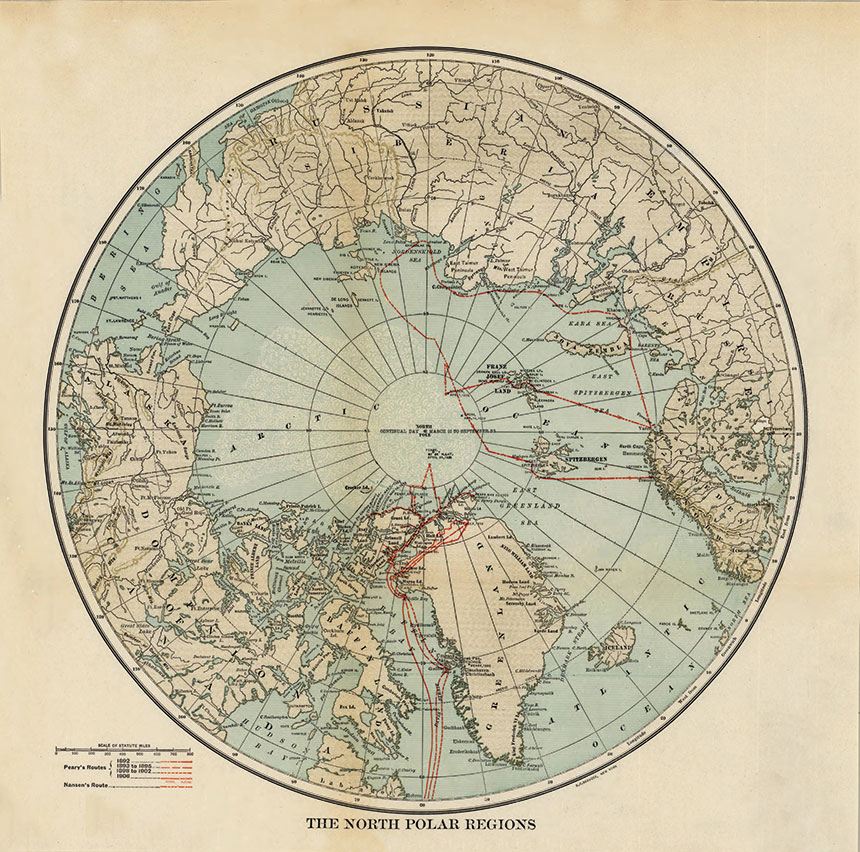
During the return journey, disaster struck when the pack ice broke up and their path was blocked by open water. They were forced to shelter in a cave on Devon Island until the following winter, desperately hunting for game to avoid starvation. When the sea refroze, they finally returned to Annoatok after 14 months of hardship. There they learned that everyone assumed they had perished. The lesser-known arctic explorer — the conqueror of Mount McKinley, called Denali in Alaska at the time — had surprised everyone once again. For decades, explorers had tried and failed to reach the elusive North Pole. Several infamous expeditions had ended with boats trapped or crushed by the drifting pack, with survivors setting out across the ice and often freezing to death. Now Cook’s party had braved the elements to achieve the crown jewel of exploration.
By the time the Hans Egede reached Copenhagen three days later, Cook was being hailed worldwide as a hero. Adoring fans and reporters gathered at the harbor, waving their hats and cheering. The smiling Cook wore the suit of a gentleman sailor and a mariner’s cap. He certainly looked the part of a rugged but aloof adventurer. For one thing, the 44-year-old had lost his front teeth during the expedition, though he soon had them replaced in the Danish capital.
Over the coming days, there were celebrations and banquets. Cook gave well-received lectures to packed houses. Various authorities in Europe and America had no reason to doubt Cook’s claim. They said they looked forward to examining the explorer’s data when he was ready to share his journals. Documentation of daily mileages, compass bearings, and astronomical observations was expected from record-seeking explorers to verify their discoveries.
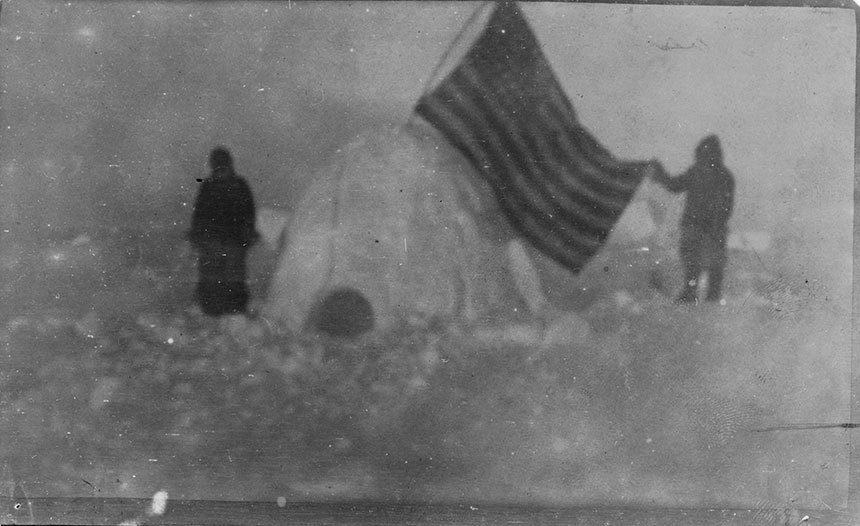
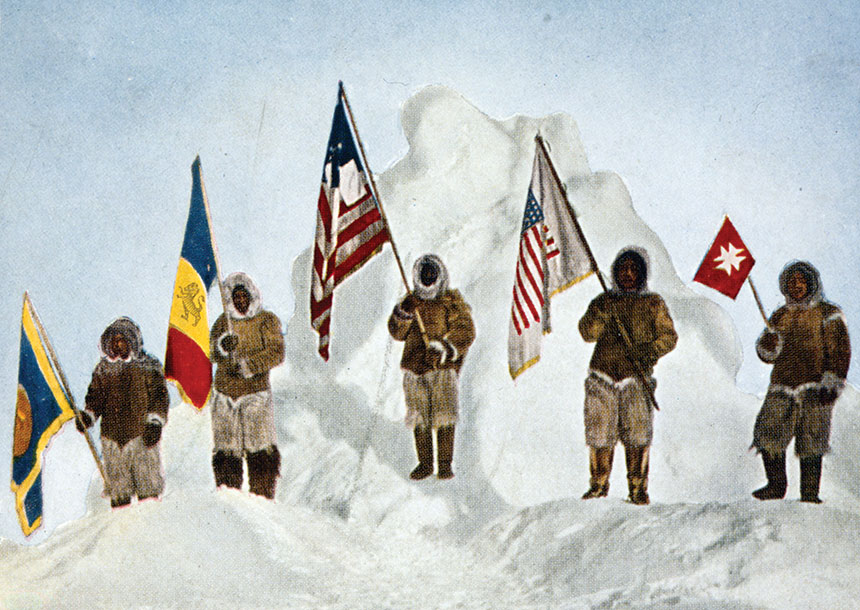
“Peary Discovers the North Pole After Eight Trials in 23 Years” was the headline in The New York Times on September 7, 1909. The article described how, five days after Cook’s declaration, the famous explorer Robert Peary emerged from the Arctic. He walked into a telegraph station at Indian Harbour in Labrador, Canada, and sent his own triumphant announcement.
“I have the pole, April sixth,” Peary had wired, with subsequent messages elaborating upon his claim. Peary was a 53-year-old U.S. Navy officer who was frequently sponsored by the National Geographic Society. He had spent decades developing the sledging practices and frozen routes to reach the North Pole. In the process, he’d lost all but two toes to frostbite. Yet he always trudged onward, never abandoning his dream of being first to reach 90 degrees north.
Upon returning to the edge of civilization, Peary was shocked to receive so little attention for what he expected would be the news of the century. When he learned the reason, he was furious. Peary considered Cook to be a trivial explorer with little chance of winning the prize. As a younger man, the latter had been a field surgeon for Peary during a lengthy Greenland campaign in the early 1890s. Peary was initially impressed by Cook, whom he judged to have a calm temperament, positive attitude, and the requisite physical endurance.
However, the two men had a falling out when Cook sought permission to publish a book about the expedition. The domineering Peary refused. Lacking the influential backers that Peary had long cornered, Cook embarked on his own series of shoestring expeditions to the far north. After completing an impressive first circumnavigation of Denali in 1903, he returned three years later to bag the summit of the tallest mountain in North America. With this feather in his cap, Cook found enough notoriety to line up a single benefactor for a longshot bid at the Pole.
To investigate Cook’s claim, Peary arranged an interview with Ahpellah and Etukishook. With a damning transcript in hand, Peary felt satisfied enough to wire a rebuttal to The New York Times.
“Cook’s story should not be taken too seriously,” Peary wrote. “The Eskimos who accompanied him say that he went no distance north. He did not get out of sight of land.”
The public response was, once again, not what Peary expected. Most of the establishment, including wealthy businessmen and esteemed members of the National Geographic Society, stuck with the celebrity explorer. Everyone else was firmly on the other side. The general public viewed Cook as a plucky underdog competing against a sore loser who belonged to the elites.
Cook particularly helped his case by maintaining a congratulatory and professional demeanor toward Peary. As the controversy deepened, and Peary’s wrath grew, Cook refused to publicly criticize his rival.
“I believe him!” Cook once said. “There is glory enough for us all!”
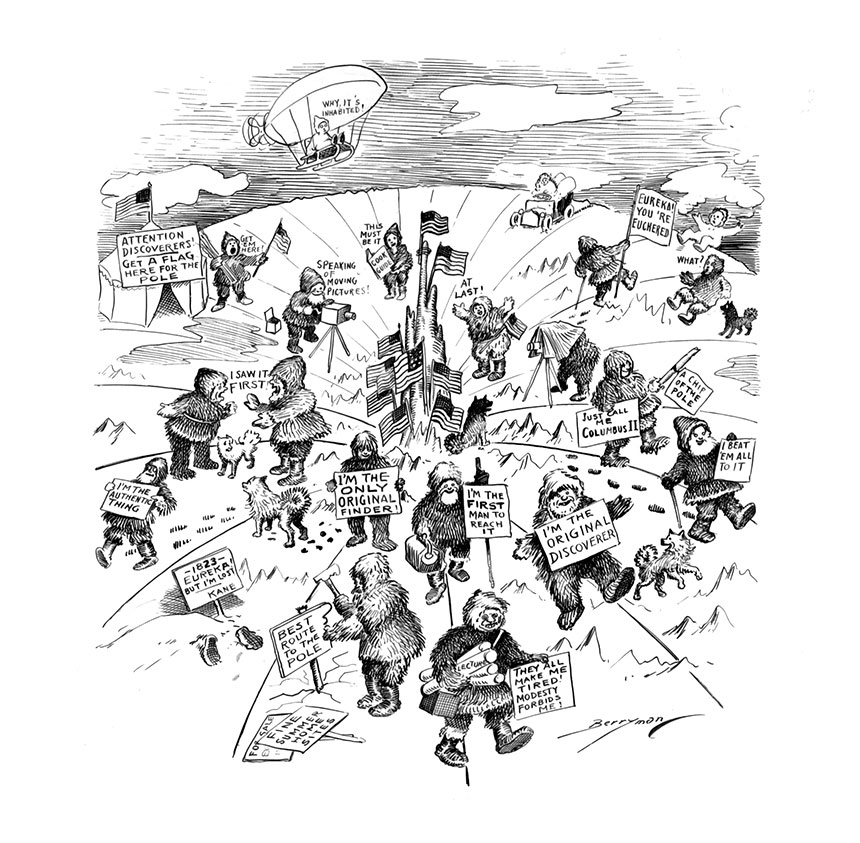
“We Believe in You” read a banner in Brooklyn. A hundred thousand spectators lined the parade route welcoming home Frederick Cook in late September. He was a native son, the child of German immigrants. After falling into poverty at age 5, when his father suddenly died, the tenacious Cook had worked his way through medical school. He was a self-made man who epitomized the American Dream, and every one of his fellow citizens seemed to have an opinion on the matter. Several newspapers conducted polls, including one by the Pittsburgh Press that reported 73,238 voters sided with Cook. Only 2,814 believed Peary.
Adding to the controversy was the fact that neither explorer had yet shared any proof of their polar accomplishments. Cook claimed he’d left his documents in the far north, for safekeeping, where they’d been lost. Peary said he was withholding his data so that the impostor Cook couldn’t steal the figures. As a result, the issue devolved into a debate about which one of them made it that was based upon the character and pedigree of each man. So, Peary and his allies launched a new front in their discreditation campaign.
In October 1909, Edward Barrill arrived in New York City with a wild story to share about the Denali expedition three years before. After failing to find a southern route up the mountain, the main party had been retreating toward the Pacific Coast during late summer of 1906. Along the way, Cook suddenly decided he wanted to split off and perform some foothills reconnaissance for next season’s attempt. He invited Barrill to be his lone partner. When Cook returned to civilization, he announced to the world that the two men had reached the top of the continent. Barrill went along with the ruse in hopes of making some money. Now the remorseful accomplice signed a sworn affidavit admitting it had all been a lie.
Regarding Denali’s summit at 20,310 feet, Barrill said the two men never got closer than 14 miles, nor did they ever climb higher than 8,000 feet. The dramatic summit photo that Cook had published to great acclaim? Staged on a minor outcropping that would come to be called “Fake Peak.” During their homebound journey, Cook had borrowed Barrill’s journal and doctored the entries that later were used as proof.
Supporters of Cook seethed that Barrill could not be trusted. They correctly surmised that he was being paid by the Peary camp to offer his testimony. However, other members of Cook’s 1906 Denali attempt soon came forward to corroborate Barrill’s account. The expedition photographer said that Belmore Browne had emerged as the strongest mountaineer in the party, serving as de facto leader when Cook kept leading them astray.
Browne and other members insisted the nature of the mountain made Cook’s claim impossible. Called the “High One” in local Athabascan, Denali was a massif that rose 18,000 feet above the surrounding tundra. Though there were taller mountains in the world, Denali had the greatest rise on land from base to peak. There was no way Cook and Barrill could have reached the summit during the brief time they were alone.
“I knew it in the same way that any New Yorker would know that no man could walk from the Brooklyn Bridge to Grant’s Tomb in ten minutes,” Browne later wrote.
Cook’s response was a mix of surprise and denial. He was given several opportunities to defend himself from both scandals, with invitations to testify before the Explorer’s Club and the National Geographic Society. Not only did Cook refuse to appear, but he soon claimed exhaustion and left the country. He was later spotted in Copenhagen, where he failed to renew any support from the Danish authorities who had once extolled him.
The public backlash against Cook was swift and severe, at home and across the world. Only the occasional die-hard fan continued to defend him. Most observers begrudgingly admitted that Peary was right after all. He’d been first to the North Pole. However, the adulation that the connected explorer sought never materialized, due to unfavorable impressions that formed during the scandal. The whole affair was dismissed as a farce. Numerous editorial cartoons lampooned both men, sometimes depicting them as children or brawlers slugging it out on pack ice.
When Peary agreed to submit his records to the National Geographic Society, the quick confirmation seemed almost perfunctory. A few observers raised concerns that Peary’s claims seemed equally improbable. One critic was Roald Amundsen, the daring but fastidious Norwegian explorer who would successfully ski to the South Pole in 1911. However, few people seemed to care anymore. Not about the North Pole and not about Denali.
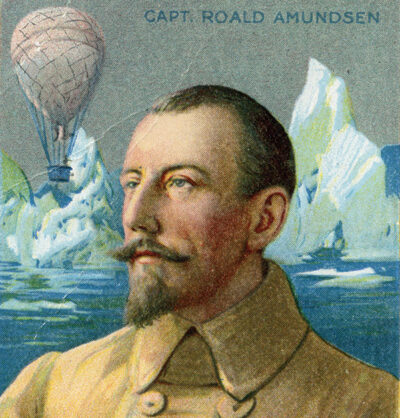
In time, Robert Peary’s 1909 claim on the North Pole would also be mostly debunked. After seven expeditions over two decades had come up short, the fatigued and aging Peary knew his eighth attempt would likely be his last. On April 1, 1909, he found himself out on the pack ice. He was the closest he’d ever been, but still 133 miles south of the Pole. Each day, they managed to sledge about 10 miles, at most 17. Sometimes it was less, given how often they had to navigate around pressure ridges of jagged ice or dangerous gaps of open water.
Then Peary made a particularly suspicious decision, sending back his second-in-command and strongest sledge driver, Bartlett. He was the only other expedition member capable of using instruments to verify the leader’s distances, bearings, and astronomical observations. Once Bartlett was gone, Peary, along with a personal assistant and four Inuit, made an improbable dash to the Pole in two-and-a-half days. Then he was back at Indian Harbour in Labrador four-and-a-half days after that.
To accomplish this incredible rate of travel, Peary’s small team would have had to cover a total distance of 429 miles in a week. Sledging an average of 60 miles per day, across the rough terrain of drifting pack ice, would have been a feat that had never been accomplished before. Nor has such speed been repeated since, though some Arctic adventurers have tried.
For pointing out these concerns, Roald Amundsen and other contemporary skeptics were mostly dismissed by the exploring establishment of the era. The Norwegian shrugged off the criticism, skied to the South Pole, and then became the first explorer to verifiably reach 90 degrees north as well. Only a few days before Amundsen arrived, yet another explorer had claimed to fly over the Pole in a propeller plane. His unverified claim was later debunked, whether due to mistaken navigating or purposeful fraud.
On May 12, 1926, Amundsen and a party of American and Italian adventurers floated over the North Pole in an experimental blimp. Because Peary’s claim remained widely accepted at that time, they didn’t know for certain that they were the first. They didn’t seem to care. They went because they wanted to see what was there.
The North Pole was a beautiful but obscure point that generations of brave explorers had sought to reach. There was no continent nor land of any kind. It was a frozen region that became the final resting place for many lost souls — including Amundsen. He would disappear in the Arctic two years later during a failed rescue mission to save other explorers.
The northernmost point on Earth was a serene expanse of drifting ice with an uncertain history of haunting lies.
From the Archive: Keeping Score
Like everyone, The Saturday Evening Post was following the North Pole controversy with interest but with perhaps a less serious stance on the whole hullabaloo:
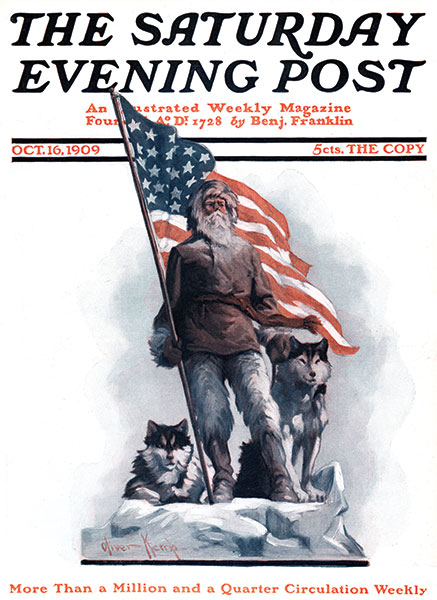
And so this Cook-Peary controversy is practically settled! Up to the hour of going to press the score stood as follows:
Cook Peary
Columns of newspaper notice 17,869 9,453
Times portrait was published 1,387 783
Dinners 369 0
Cash receipts $21,846 $3,427
Commander Peary is a good, deserving man, but it seems quite impossible that he should overcome this enormous lead. Regretfully we consider him as good as beaten. His expedition was well planned and up to the very culminating point it seems to have been conducted with admirable ability. But in the final crucial dash to the front page, the grub, and the box-office, he played — to borrow a sporting phrase — on a dead card: He got off on a blind lead and marooned himself, while his more fortunate competitor took possession of the goods.
As to which of the two discovered the Pole, that, of course, is immaterial. It is generally conceded that several Scandinavians came to America long before Columbus; that an Italian, and not Henry Hudson, discovered the river which bears the latter’s name; that Fulton did not invent the steamboat. Probably the verdict of history will be that Swan Johnson, of Minneapolis, discovered the North Pole in 1914, while trying to find his way home from a Sons of Thor lodge meeting.
—“The Discoverer of the Pole,”
Editorial, November 6, 1909
Mike Bezemek is an author of five books, including Discovering the Outlaw Trail and Space Age Adventures. His work has appeared in Outside, Smithsonian Magazine, Men’s Journal, National Parks Magazine, and others. For more about the author, visit mikebezemek.com.
Excerpted from Mysteries of the National Parks: 35 Stories of Baffling Disappearances, Unexplained Phenomena, and More, Copyright © 2025 by Mike Bezemek. Used with permission of the publisher, Sourcebooks. All rights reserved.
This article is featured in the March/April 2026 issue of The Saturday Evening Post. Subscribe to the magazine for more art, inspiring stories, fiction, humor, and features from our archives.
Con Watch: Panera Bread, the ShinyHunters Data Breach, and Class Action Lawsuits
Steve Weisman is a lawyer, college professor, author, and one of the country’s leading experts in cybersecurity, identity theft, and scams. See Steve’s other Con Watch articles.
Data breaches are a common occurrence and can readily lead to your identity being stolen. Recently, the hacking group ShinyHunters successfully stole personal information from approximately 5 million customers of Panera Bread, including customer names, email addresses, phone numbers, home addresses, and account details. In the last year, ShinyHunters has also hacked Google, Farmers Insurance, Allianz Life, Workday, Pandora, Cisco, Chanel, Dior, Louis Vuitton, Tiffany, and Qantas. In the case of Panera Bread, the hackers obtained access to a Panera Bread database through social engineering, where they posed as an IT worker and lured Panera Bread employees into providing access credentials.
Companies must do a better job of protecting themselves from not just technologically sophisticated cyberattacks, but also less sophisticated, but equally effective, social engineering attacks such as the Panera Bread data breach.
Two lawsuits have been filed seeking class action status regarding the data breach. They allege that Panera once again failed to protect sensitive customer data (Panera suffered a similar data breach in March of 2024). The lawsuits also allege that Panera still hasn’t notified affected customers about the breach, although they have acknowledged it.
If a settlement is approved by the court regarding the class actions, you will receive a notice from the court with instructions regarding how to claim benefits. While generally the actual cash payouts from class actions like this are quite small, often the settlements will offer free credit monitoring and identity theft insurance coverage. In addition, if you do have out-of-pocket costs related to the data breach, settlements generally will cover those costs. Additionally, while the payouts may not seem worthwhile, data breach class actions serve a public purpose in inducing companies to enhance their security.
If you don’t yet know if you were affected by the Panera data breach, you can find out if your email address was among those compromised by going to the free data breach notification service haveibeenpwned. Have I Been Pwned identified 760 MB of documents from the data breach on ShinyHunters’ dark web site, where it posted the documents after Panera Bread failed to pay a ransomware extortion.
If you have a Panera account, change your password and add dual factor authentication to your account for extra security.
While personal information of the kind compromised in this particular data breach does not pose the immediate threat of a compromised Social Security number, it does enable a cybercriminal to create more specifically targeted spear phishing attacks that appear legitimate.
You should also freeze your credit. Freezing your credit is something everyone should do because it protects you from someone using your identity to obtain loans or make large purchases even if they have your Social Security number. It’s free and only takes a few minutes. Here are links to each of the credit agencies with instructions on how to get a credit freeze:
You should also monitor your credit reports regularly for indications of identity theft. The three major credit reporting agencies now provide free weekly access to your credit reports. Go to AnnualCreditReport.com to get free credit reports from all of the agencies. Note this is the only place to get truly free reports. Some scammers have websites that appear to offer “free” credit reports, but if you read the fine print, you often may find that you have signed up for unnecessary services.
With data breaches so common, it is also important to limit the amount of personal information you provide to any company to no more than what is absolutely necessary. Many companies ask for your Social Security number although they have no real need for that information. Don’t provide it if possible.
Be wary of anyone who calls asking for personal information to help you with a data breach, as that is a favorite tactic of hackers. Also, as always, never click on a link or download an attachment to an email or text message unless you have absolutely confirmed that it is legitimate, and don’t provide personal information in response to an email, text message, or phone call unless you know the communication is legitimate.
Cartoons: You’ve Got Mail
Want even more laughs? Subscribe to the magazine for cartoons, art, inspiring stories, fiction, humor, and features from our archives.
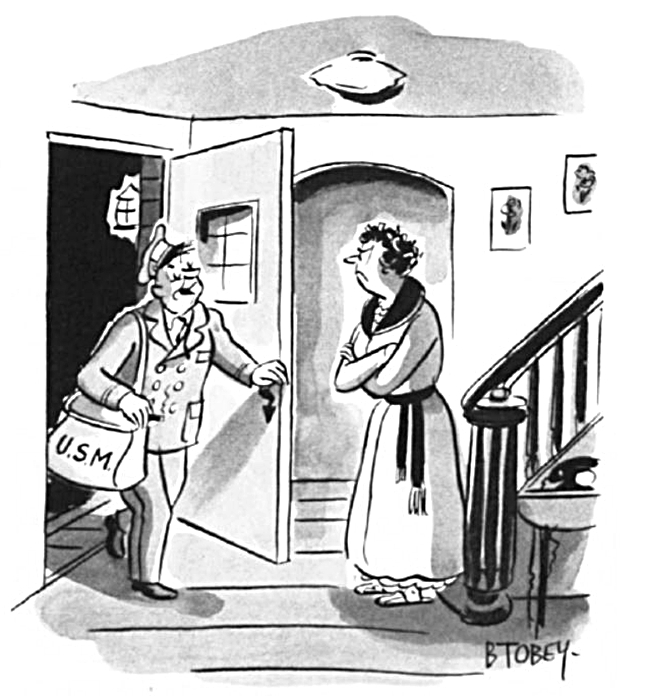
Barney Tobey
October 11, 1958
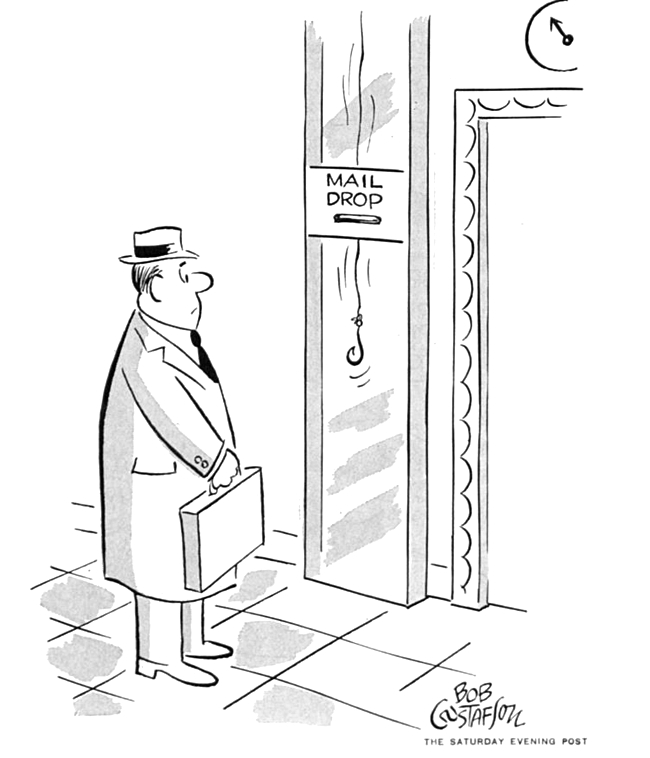
September 26, 1964
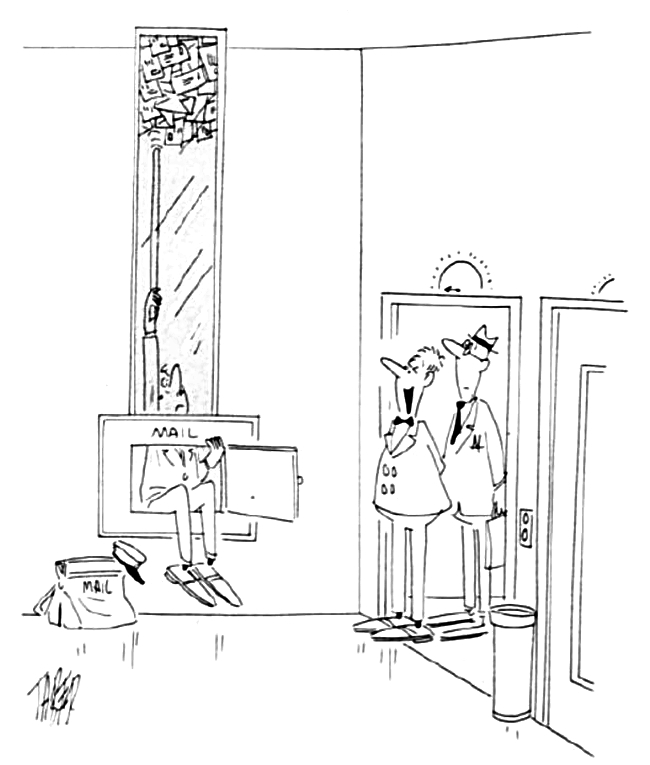
Scott Taber
July 25, 1959
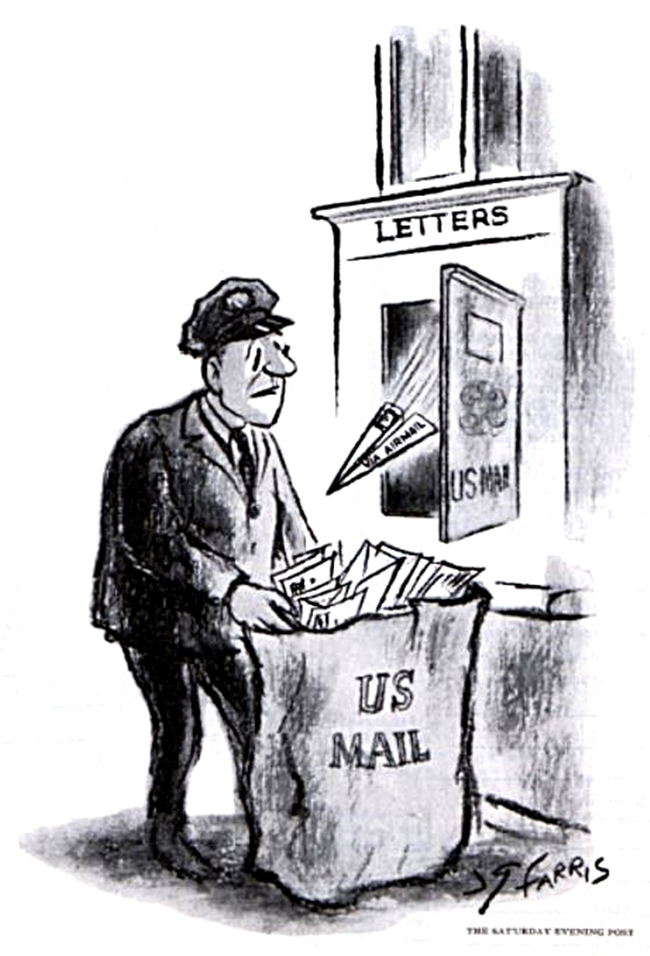
June 24, 1961
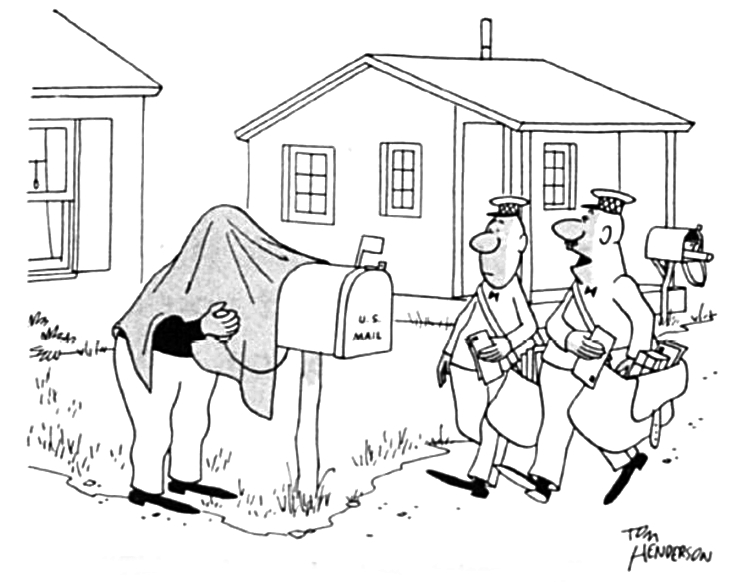
Tom Henderson
June 9, 1963
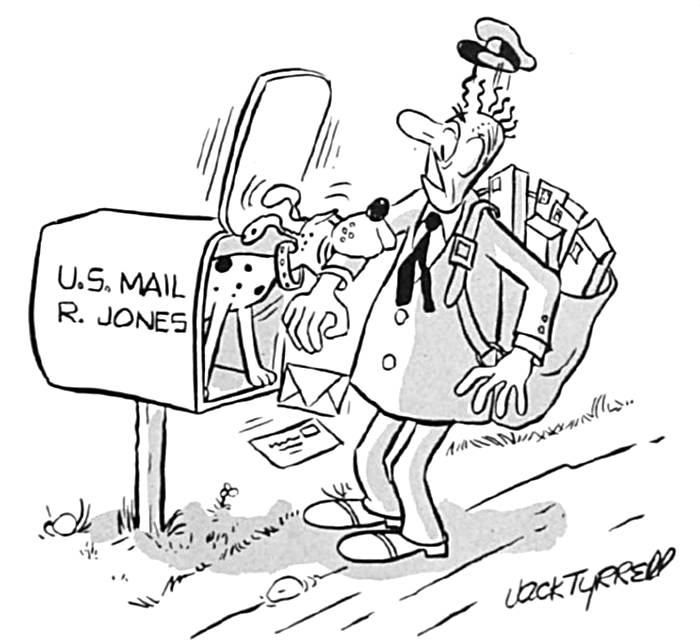
November 16, 1957
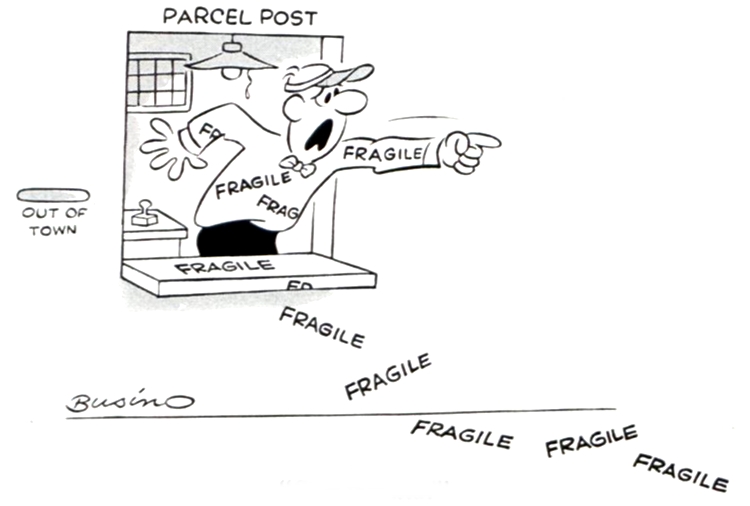
Orlando Busino
October 24, 1964
Want even more laughs? Subscribe to the magazine for cartoons, art, inspiring stories, fiction, humor, Deand features from our archives.
Feedback Fatigue
Ask me anything. Fire away. Guaranteed I’ll speed your descent into a nice slumber as I share more than you ever imagined knowing about such topics as my complicated immigrant story, pathetic college grades, even my recent prostate surgery. Whatever. I will gladly answer every one of your questions, except if you quiz me on the recent repair of my refrigerator. Because a man has to draw the line somewhere.
And that’s sort of the problem. Not with the fridge, but rather with the survey I one hundred percent knew would follow its fix. On his way out the door, the tech reminded me that I’d be receiving a questionnaire about his work, and he’d be grateful if I awarded him a perfect score because, y’know, his job depended on it. Sure enough, the online survey arrived a few days later. It was quickly trailed by another, asking if I had additional remarks to offer. All this to button up a 20-minute service call.
Enough already. Survey fatigue is real. Real annoying. Must we survey everything Americans think, buy, or experience? How about just leave us the heck alone?
Why should I willingly reveal to any person or organization my thoughts about their performance? Does their product do what was promised, or does it suck? How was the service? (And here I use the word service in its broadest possible definition.) If I have something to say, I’ll reach out and say it. Prodding me into unloading to a stranger — or an expertly coached A.I. chatbot — does not endear me to you, sorry.
Ostensibly, all these surveys are intended to lead to some interpretation of “better lives” for consumers — us. Now, does anyone seriously think we’ve seen improved products and services over the last couple of decades? Okay, Amazon deliveries maybe, but other than that? (Privately, I suspect some major companies don’t survey their customers because they know the feedback will be brutal.)
Let me share with you a not atypical 48-hour period in my world. Email brought questionnaires from CVS, Reuters News Service, my car dealership, Apple, two restaurants, a political action committee, an automotive-review site, a hotel, and one of my photo-storage apps. All wanted to know how they’ve been doing. Were they satisfying my expectations? Had they offered guidance that made me leap for joy? Also, no surprise, there was a rather lengthy Q&A form from a hospital E.R. I’d visited.
And then, as if to deliver a kick to the groin: While reviewing these morning messages, at one point I found myself listening to a bank’s representative as she announced on a recorded phone loop her desire to “exceed my expectations” — and would I “agree to a brief survey” after the call. Sure, after I attempt to disembowel myself.
Survey fatigue is not an American phenomenon alone. What we know is that almost everywhere the survey industry is hyperactive, people pretty much hate on it. But it seems that here, in the greatest consumerist society ever, we win in our degree of contempt because, let’s face it, we are questionnaired up to our eyeballs — online, on our phones, in person. Also, crucially, we are famously not good at being good when responding to surveys.
As I said earlier, you can ask me anything. However, these days, if you’re in the survey game, I might counter with an abrupt question of my own: “Hey, how about you mind your own damn biz?”
In the last issue, Cable Neuhaus wrote about Americans’ overreliance on GPS navigation systems.
This article is featured in the March/April 2026 issue of The Saturday Evening Post. Subscribe to the magazine for more art, inspiring stories, fiction, humor, and features from our archives.
Kevin Nealon Is on the Loose in His First Comedy Special in More Than a Decade
Loose in the Crotch, now streaming for free on 800 Pound Gorilla Media’s YouTube channel, is Kevin Nealon’s first comedy special since 2012. Not that he’s been idle. He has amassed roughly 40 film and television credits (including two movies premiering at Austin’s SXSW film festival in March). He published a book of his celebrity caricatures, I Exaggerate: My Brushes with Fame (his artwork is available for purchase at kevinnealonart.com). He attended SNL50, where Bill Murray ranked him among the show’s top 10 “Weekend Update” anchors. He also hosted five seasons of the off-the-beaten-path celebrity talk show, Hiking with Kevin.
But the stand-up stage is Nealon’s natural habitat, and Loose in the Crotch finds him in peak silly and absurdist form. To quote comedian Pete Holmes, Nealon is “funny in a fun way,” and that is a welcome quality these days.
He spoke to The Saturday Evening Post about what he’s been up to, including his most prestigious credit yet as an executive producer of the profoundly moving Oscar-nominated documentary Come See Me in the Good Light, available on Apple TV.
Donald Liebenson: In comedy, timing is everything. It’s been more than 12 years since your last special. Why now for a new one?
Kevin Nealon: It was organic — I didn’t have any plans. I’ve been doing my stand-up over the years and I was dropping a lot of good material. It’s some of my best work. I thought I should document it and make it available. I’m excited people will discover it.
DL: Like the treasured pair of blue jeans that give your special its title, your comedy is very comfortable and makes you feel good. We could use that right about now.
KN: That is my persona. I like to have a good time. I don’t like to make anything too serious because it makes me feel uncomfortable, I guess. I’ve been told my comedy sneaks up on you.
DL: When you were preparing your special, did you watch other specials? Are you a good audience?
KN: No, I’m not the audience you want for comedy. I watched a lot of Netflix specials. I’ve been doing this for 46 years, and I’ve seen every style of comedy. I usually know where they’re going with a joke. I’m too analytical, but occasionally I’ll let myself just enjoy somebody.
DL: You have an original comic voice. Growing up, was there a comedian who inspired you or shaped your sensibility?
KN: Every comedian was probably influenced by somebody, whether it was another comic or family or friends. When I was a teenager, I would watch people like Stanley Myron Handelman and George Miller on The Tonight Show — they all influenced me. But when I started thinking about comedy more seriously, I loved the originality of people like Andy Kaufman, Steve Martin, and Albert Brooks. Garry Shandling, too. He was a mentor to me; he taught me a lot about the art of writing and the craftsmanship. When comics are starting out, they emulate people until they find their own voice or style.
DL: You’re a member of Adam Sandler’s stock company. What is it like to hang out on a Sandler set?
KN: It’s a great hang. When we did the first Happy Gilmore, there was a lot of playing basketball, golfing, eating a big meal, and playing the guitar. A lot of laughing.
DL: You attended the SNL50 celebration. Reflecting on your near-decade on the show, do you remember the first laugh you got in a sketch that made you think, “I’m going to be here nine years”?
KN: The first sketch I did was my character Mr. Subliminal. I was about to go on — there was maybe 10 seconds before they came back from a commercial break — and Lorne came over to me, put his hand on my shoulder, and said, “Are you sure this is what you want?” But it did go over well. The very next day people were stopping me on the street to say how much they liked the character.
DL: A successful sketch can become a viral sensation. But on the flip side of that, what is it like being in a sketch that bombs on SNL?
KN: I wrote a sketch for Christopher Walken where I was an obsessed fan and all I wanted to know about was him. I asked him a question, like “What do you do in your spare time?” and he said, “I like to go to the shooting range with my uncle,” and I interrupted him to say, “I don’t want to hear about your uncle, I want to know about you,” and we had a back-and-forth. About 20 minutes before the sketch aired, Lorne came up to us and said we need to cut that down by two minutes or we can save it for another show. When you save something for another show, it never gets on. I cut it and it just didn’t do it justice.
DL: In addition to your stand-up, acting, and hosting Hiking with Kevin, you can add executive producer to your credits. How did you get involved with Come See Me in the Good Light, which is nominated for an Academy Award for Best Documentary?
KN: I was in Marchmont Village in Los Angeles with my wife and son. [Comedian] Tig Notaro was walking down the street. I asked what she was up to, and she said she was putting together a documentary about poet laureate Andrea Gibson, who was facing a diagnosis of terminal cancer. It’s about how she faces that with radical joy.
DL: At what point in the production did you get involved?
KN: We got on board that day. I said, “Sign us up.” It’s a thrill to be a part of it.
DL: I saw it on demand alone in my living room and it was a powerful experience. What is it like to see it with an audience?
KN: I can never see it enough times with an audience. It’s so life changing. It really is. When people hear about it, they think it will be a downer, but, really, it’s uplifting. Life is short, and it reminds you to be grateful for the amount of time you have here.
DL: How did it impact you?
KN: It was inspirational and motivating. Watching them get up on stage at the end to do spoken word, and seeing the reception they received from that adoring crowd — that’s where it got me. It is really impactful. Fortunately, she survived to see the film win at the Sundance Film Festival.
Survivor Stories: Helping Children Fight Cancer with Books
Melody Lomboy-Lowe was 6 years old when she planned her own funeral. She chose the clothes she would wear. She decided which toys would go to which friends. A passionate swimmer, she requested a funeral plot overlooking a pool. Lomboy-Lowe had been diagnosed with leukemia, and in 1983, treatment options were limited. Doctors gave her a 50 percent chance of survival. Planning her funeral, she says now, was like occupational therapy.
“It was good for me,” she says. “I was in charge of something. I had control over one thing, and that was it.”
The funeral never happened. Lomboy-Lowe survived — and she now helps other children fighting their own cancer battles. Since 2020, she and her 36-year-old niece, Gracelyn Bateman, have run the Los Angeles-based Luna Peak Foundation (lunapeakfoundation.org) to publish books for kids and their families on cancer and grief, and to provide inspiration, hope, and support. Luna Peak has donated over 4,000 books to families, hospitals, palliative care and hospice centers, therapist offices, schools, and universities. This includes workbooks and children’s books such as Follow Me, Cancer Free, based on Lomboy-Lowe’s own childhood experiences, and Sean’s Best Week at Camp Luna Peak, inspired by a fellow cancer patient who died as a boy.
“I created the books I wish I’d had when I was a child,” Lomboy-Lowe says. In Follow Me, Cancer Free, “you finish treatment and everybody’s happy. But not every kid that gets a diagnosis is going to be cancer-free, so that’s why we wrote Sean’s Best Week.”
Her cancer journey began in Sierra Madre, California. The youngest of six kids, she loved swimming, but began suffering nosebleeds when she’d exit the pool. On her first day of first grade, her mother was brushing her hair and made a discovery: Her lymph nodes were swollen. By that afternoon, the swelling had doubled. The family’s pediatrician seemed unconcerned, but her worried mom insisted on tests. A bone marrow aspiration and spinal tap found leukemia.
The family had already been rocked by cancer. Weeks before Lomboy-Lowe was diagnosed, her grandfather had died from colon cancer. Her parents were open and honest with her about the disease. They told her she had something called cancer. They told her she needed chemotherapy. They said she had a 50 percent chance of surviving the first year. And she received an assignment from her “super-amazing doctor,” as she calls him.
“He told me that I was in charge of my attitude,” she says. “So I had to take part in my treatment by how I acted and how I thought and having a positive attitude. That was my job.”
It wasn’t easy. She was in and out of the hospital and took daily oral chemotherapy medications. Today, kids typically receive anesthesia for painful procedures; she was awake for spinal taps and agonizing bone marrow aspirations. Every month, for one week, she’d receive chemo cocktails, part of a successful clinical trial for a regimen that is still used today (unlike her then 50-50 odds of survival, kids today have a 90 percent chance of beating the disease).
The chemo caused nausea, but she developed coping mechanisms during her treatment. She would visualize Pac-Man eating the bad cells. She attended camps and continued swimming unless she felt too ill. She even looked forward to the hospital trips, because her friends there faced the same challenges.
“I was still going to school, but I couldn’t do all the things that the other kids were doing,” she says. “I wasn’t different at the hospital. We all knew how many cc’s of chemo we needed that day. We knew our antibiotics, we knew the medications, we knew the dosages. I always knew when I had pneumonia — I knew the feeling of it inside.”
At age 9, when she finally finished treatment, she wanted to give back. Despite her young age, she began speaking and raising money for cancer charities.
“I wanted to share my story, because in 1983, leukemia was pretty much a death sentence,” she says. “Only a handful of us were surviving. So to have a survivor speak at these events, it was special for them to see where their funds were going.”
Her story influenced those close to her as well. In high school, she met her future husband, Tom. He knew he wanted to be a doctor and, inspired by his future wife, he eventually became an oncologist.
Lomboy-Lowe received a swimming scholarship from the University of California, Irvine, and graduated with a degree in sociology. She had also studied acting, and after college she became an underwater body double on shows such as Baywatch while helping support Tom through medical school. Following the birth of their first son, she became a talent agent. But she dreamed of writing a book.

Her niece, meanwhile, was recovering from the death of her father. Bateman returned to California from New York City, where she’d attended Columbia University and worked in marketing, to help support her mom. She learned about her aunt’s aspirations and dreams and wanted to participate. They collaborated on a photography book called Beyond Remission, featuring portraits of cancer survivors with a quote about their lessons and experiences.
“When you first get sick, you’re given these big, heavy books to read, so I thought, if we had inspirational quotes and a face, so they could see what a survivor looks like, it would be an incredible resource for people,” Lomboy-Lowe says.
After working with a literary agent for Beyond Remission, they decided they could publish future books on their own. The duo founded Luna Peak, which not only publishes books but hosts workshops on cancer and grief.
“She’s a brainiac,” Lomboy-Lowe says of her niece (the two are more like sisters; they’re only 12 years apart). “She’s so organized, and she knows how to get things done. I’m more of a creative. I have a million ideas, but I don’t know how to channel them. So she helps me do that. I wouldn’t have known where to start.”
But as Bateman quickly notes, Lomboy-Lowe’s formidable presence and life experiences are the drivers behind Luna Peak’s success.
“She brings a little bit of magic into every room she’s in,” Bateman says. “She changes the energy. If you were stranded, if you were in a worst-case-scenario situation, you’d want her on your side. She’s been able to add not just a good attitude, but also humor to dark spaces like cancer and grief. That’s something that she definitely helped me with. When I was deep in the trenches of grief after losing my dad, she was able to pull me out a bit.”
Lomboy-Lowe focuses mainly on cancer, and Bateman heads the grief projects, though “they cross lines often,” Lomboy-Lowe says. The books are mostly children’s books, and as the child of a Filipino father and Italian mother, she wanted them to be multicultural.
“Cancer doesn’t care about your background or how much money you make or where you’re from,” she says. “It’s everywhere. So I wanted kids of all kinds to see themselves.”
She witnessed the power of this inclusiveness at the Loma Linda Children’s Hospital in California, when she read Follow Me, Cancer Free to a group of 4- to 10-year-old cancer patients.
“There was a little girl named Zoe, and she saw a little brown baldheaded girl in the book, and she was like, ‘That’s me,’” Lomboy-Lowe recalls. “And then she saw another girl with curly hair, and she’s like, ‘That’s you.’ It was a full-circle moment. She gets to see the beginning of the book where the kid is bald, and then she’s growing hair, which is symbolic for many cancer patients.”
As Lomboy-Lowe approaches 50, she carefully monitors her health, from regular mammograms to blood tests. Of her childhood friends at the hospital, only two, including Lomboy-Lowe, avoided a second bout with the disease. Now that she’s a mom, she worries about her three sons, age 20, 16, and 14.
“Every bump, every fever, if I see a lymph node, if they’re lethargic, I’m always worried,” she says. “Anxiety is a big part of my life, for sure. I don’t let it consume me, but it is definitely a side effect of having cancer. I’ve learned that the parents often seem to be suffering more than the kids who are going through the treatment, which sounds crazy, but now, as a parent, I see it. I see what my parents went through. Your kids are your heart outside of your body and you want to protect them at all costs. Most of my interactions are with parents or older siblings, and when they see me, or anyone that has survived as a child and now is an adult, and they’re thriving, having a good life, it’s a good example of what they can have. A lot of parents will tear up because they don’t have a chance to cry in front of their kids. We get a lot of hugs behind walls and behind doors.”
And so she keeps working, keeps helping, keeps giving. The efforts have not gone unnoticed. The Los Angeles County Commission for Women named Lomboy-Lowe one of its 2025 “Women of the Year.” And she and Bateman hope to expand Luna Peak’s impact in the coming years. They want to add office space to host more workshops and provide a library for children and families. They also want to host summer camps for survivors. But Lomboy-Lowe’s impact comes not only from doing, but from being. Her survival inspires courage in others.
For their photo-and-quote book Beyond Remission, Lomboy-Lowe wasn’t just an author. She also appeared on the pages as a survivor. Her advice: “Life has hit me with a lot of waves, but I just keep swimming. There is no one-size-fits-all approach to navigating a cancer diagnosis. You get to decide for yourself. I choose hope.”
Ken Budd has written for The Washington Post Magazine, The Atlantic, and many more. He is the author of the award-winning memoir The Voluntourist and a host of the literary podcast Upstart Crow.
This article is featured in the March/April 2026 issue of The Saturday Evening Post. Subscribe to the magazine for more art, inspiring stories, fiction, humor, and features from our archives.
What Animals Teach Us About Expertise
In the late 1960s, ecologist Lee Metzgar conducted an experiment demonstrating the value of knowledge. He put wild white-footed mice into a barn they had never seen before. Half were given several days to learn about the barn, and to figure out the best places to hide from a threat. The other half got no time to learn.
Then Metzgar placed a predatory screech owl in the building. The bird quickly ate mice who had no prior knowledge of the environment, but many of the experienced mice survived. Mice who had time to learn about the barn were experts. Mice who didn’t were not.
Knowledge is powerful, and can influence survival—for people, too. Our increasingly complex world needs experts who apply hard-earned knowledge to help society function. Those who devalue this kind of rigorous expertise, leaning instead on “doing your own research,” do so at our peril.
As a behavioral ecologist and conservation scientist who studies how animals and humans make decisions, I’ve thought a lot about what constitutes an expert. Managing predation risk requires expertise. Some elements of it are instinctual, developed over millennia as evolution has favored faster, stronger, or otherwise gifted animals who respond effectively to predictable threats. But in many cases expertise must be learned. Older animals have more lived experience—acquired knowledge about predators—than younger ones. This, in part, explains the relatively higher predation rates on young animals (about 50% of the marmots I study die in their first year of life). Animals moving into new areas are particularly vulnerable, too.
In my research, it often emerges that experience and acquired knowledge make the difference between life and death. I’ve sometimes tried to give endangered species experience before reintroducing them to places where they had been driven extinct by predators. If you release captive-reared, predator-naive fish, birds, or mammals into the wild, most die. If you train vulnerable Australian marsupials to recognize predatory foxes or cats, or let them gain that experience over time by putting a few cats into very large enclosures that allow the marsupials to escape, post-release survival may increase.
Human survival relies on learning, too. Most of us no longer fend for ourselves in the wild, evading predators. But we have to know a great deal to live and function in modern society—and the more advanced the task, the more we need to know. Many professions, including pilots, doctors, and lawyers, formally certify practitioners, who must acquire special knowledge and abilities. Surfing, flying an airplane safely, or conducting brain surgery require countless hours of practice. The author Malcolm Gladwell has famously suggested that it takes a human 10,000 hours to learn a complex task. A surfer riding their 10,000th wave is more proficient than one riding their first. In 10,000 hours, a pilot makes a lot of take-offs and landings.
But today, thanks to the internet, all kinds of essential decision-making information are available to everyone—from scientific studies in “open access” journals and NOAA weather data to anecdotes on Reddit and social media.
Given this knowledge explosion, shouldn’t society democratize decision-making? Shouldn’t everyone’s opinion be valued? What to make of the “wisdom of the crowd”? Increasingly, we hear that groups of people with diverse experiences can, in the right conditions, make better decisions than solitary actors, maybe even better decisions than “experts.”
But here’s the thing: True experts have more than mere access to information. They also understand how to think about their knowledge—its quality, its limitations, and its value. Such insight emerges through experience. Sometimes this experience is lived, or informal. People who have lived through homelessness have developed crucial expertise to help create solutions for it. They understand its indignities and the high barriers that prevent escaping it.
But experience can also be acquired formally, through study. Most (but not all) animals gain experience directly, but humans can teach each other. And the more technical the human problem, the more complex the decision, the more we must place value on formal training and experience. This is why scientists like me sometimes bristle when lay people dive into technical debates and rewrite the rules of the game. Our schooling steeped us in the scientific method, the exacting experimental work of testing hypotheses in search of fact and truth. To believe something, we need to see proof, again and again.
Importantly, we’re always trying to refute our ideas, not find more evidence to support them. It’s through this constant critical attack that truth emerges. Over a century of challenges, Darwin’s theory of evolution by natural selection remains because no one has been able to refute it—yet. With new ideas and new technologies, future scientists conceivably could develop a new model that explains genetic changes over time. The scientific method is effective because it is self-correcting.
By contrast, some beloved non-expert theories are explicitly not refutable. There is no way to scientifically evaluate intelligent design because it presumes that life was created by a creator. Because this fundamental assumption is unquestioned, it’s irrefutable. While untrained people may have an opinion about, say, a vaccine study, they may not have the experience or perspective to properly evaluate the information contained in the study—or to refute their pet hypothesis, if that’s where the evidence points.
Humans are wonderfully diverse and we value different things: tradition, beauty, science, nature, and profit among them. These diverging points of view matter. In a recent paper looking at natural resource conservation, my colleagues and I argued that when you’ve got a problem with more than one value at play, you’re going to have to make tradeoffs. There is no one best solution.
But even, or perhaps especially, when problems are subjective, it’s crucial to include experts who prioritize all different values, including hard-earned technical knowledge. Discounting perspectives and insights from people with years of experience addressing a problem can lead to suboptimal and potentially fatal mistakes.
For instance, framing vaccination as a personal decision completely misses its main goal, which is to create “herd immunity,” where a sufficient number of people are vaccinated to prevent spread to those who aren’t. Protecting the most vulnerable—young infants, for instance, who may not be old enough to be immunized—relies on large numbers of other people getting their shots. In this context, empowering those who specifically ignore or misuse scientific evidence, emphasizing the value of personal choice over the value of public health, makes us all vulnerable.
We should value experts in situations where experience matters. Gaining expertise takes time. We should support the education required to build it, and value experts’ role in keeping us safe.
Take it from Metzgar’s mice.
Originally published on Zócalo Public Square. Primary editor: Eryn Brown | Secondary editor: Sarah Rothbard
Vintage Ads: George Washington
Which qualities do you associate with George Washington? Wisdom? Bravery? Steadfastness? Razor blades? Although the connection between Washington and some of these products is dubious, companies have been using his visage and his character to sell their products for more than 100 years, as shown in these advertisements that appeared in The Saturday Evening Post.
February 24, 1906
“George Washington gave an era of liberty to the colonies. The Gillette gives an era of personal liberty to all men.”
December 7, 1918
“George Washington shaved himself on occasion.”
February 15, 1919
“Again Indian Day will be celebrated on Washington’s birthday.”
February 7, 1925
“From pioneer days to modern times, love of family has always been the greatest of all inspirations. On this the progress, the prosperity and the happiness of the nation depend.”
October 24, 1925
“You can rely on his judgment and his eagerness to satisfy you and keep you satisfied.”

February 13, 1926
“A new pattern in solid silver that revives the memory of a famous but almost forgotten birthplace.”

February 16, 1935
“Another man would have quit the one-sided struggle. But not this man!”

February 15, 1936
“You, too, will have plans for your retirement. Like Washington, you may prefer the quiet of the country….You will have time for whatever you want to do, when you retire. But will you have the money?”

March 27, 1948
“Personal and commercial security require foresight.”
October 14, 1950
“He took a new job and the world changed.”
February 20, 1954
“Little George Washington…so legend has it…believed that honesty was the best policy.”
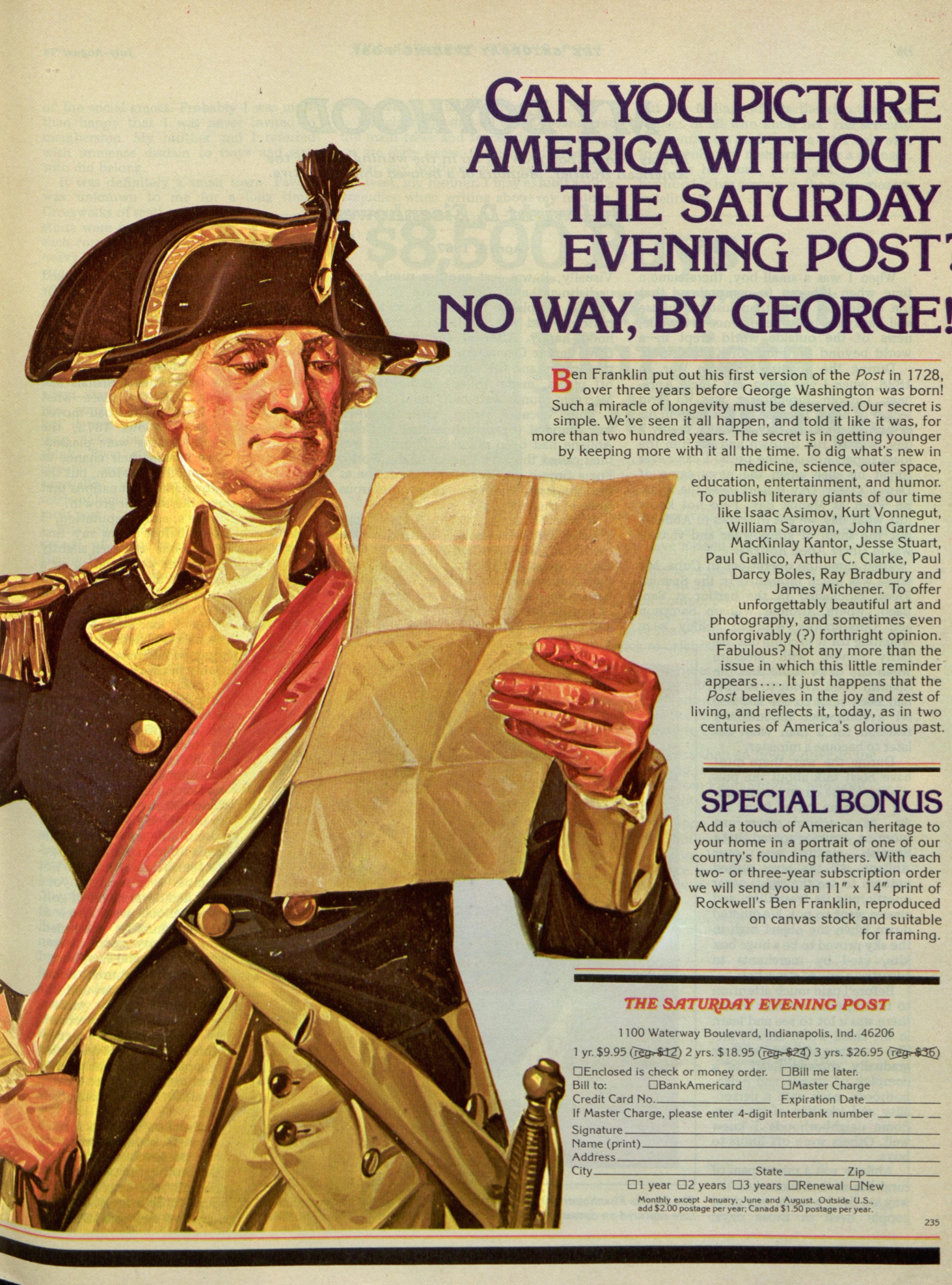
July 1, 1976
“Can you picture American without The Saturday Evening Post? No way, by George!”
Ding, Ding!
There are no seats left at Lobstah!’s bar, so Will and Sandra settle at a high-top. Belle, who already knows what they want, comes out to ask what they want. The car is packed, and they will start the long drive back to suburban Philadelphia right after breakfast the next morning. The journey didn’t seem so burdensome when they first came to Rhode Island, but that was in the years before they began to get tired for no reason at all, before Sandra’s lower back began to ache from sitting in the car for more than a couple of hours, before the glare of the sun and reflections from the asphalt defeated Will’s polarized lenses. All those things will happen. But not until tomorrow.
Tonight they get to have martinis and dinner at Lobstah! They get to watch the waters of Narragansett Bay from their table. Nostalgia used to be considered an illness, and maybe it ought to be once again — grieving for here as they gird themselves for their nostos, their homecoming. They will be happy to be home, they know, but only after the suitcases are put away, the laundry done, the pile of accumulated mail sorted.
Sandra and Will sit in one of their shared silences, the kind that end more times than not with their making simultaneous identical remarks. This is what happens after four decades of marriage. It simplifies communication. Deep comfort, predictability, companionship — rewards for the loss of youth.
Brakes screech outside, and Sandra reflexively twists her neck away from the bay to look out the curtained window. It has gotten much darker since they parked, just a few minutes ago. A woman at the next high-top says, “An animal darted across the road, maybe a fox. The car just missed it.”
“That sounded really bad,” says Sandra.
The woman says, tentatively, “You know, if it’s okay to say this, we were just talking about you.”
Sandra does not know what to expect. Will is now listening.
The woman’s tablemate is a slightly younger woman. They are both dressed in fitted tank tops and jeans and have about them a tired but contented air of uncontrived shabby chic, as though they’d spent the afternoon in their yard sanding a beautiful piece of furniture they found at a consignment shop. The toothpicks of olives in their drinks look like mini shish kebabs.
The woman continues. “We were just saying that you and your husband tick off all the boxes for the cutest couple in the place!”
In martini veritas, apparently, Sandra thinks.
The younger woman adds, “Martinis — ding! Holding hands — ding!” She makes check marks in the air with her forefinger. “Ding for the pocket square. Ding, ding, ding! You win!”
Sandra and Will look at each other. She is touched that this is how the world sees them. Maybe dressing up a little for drinks and dinner doesn’t always evoke inner eye rolls from a generation that wears shorts and flip-flops to all but the most formal restaurants. She is nonplussed, a little embarrassed, that her and Will’s minor PDA broadcasts at full volume.
Sandra and Will start to chat with the two women. They have just moved here, the town where the younger woman was born, leaving city sorts of occupations — investment banking for the one, human relations for the other. (“What was wrong with ‘personnel’?” Will always asks.) The chat ends as Belle brings the women bowls of chowder and then a lobster salad that they share before they have to leave to pick up the son of the younger woman.
Will watches them walk out of the bar before he says, “Well, that was strange. Nice, but strange.”
“Do you realize this means that we are officially geezers?” Sandra says. “I mean, they didn’t intend to insult us, but they were saying that even though we don’t look like the stereotype they expected, we are definitely old. We’re supposed to look … what? Boring? Dead already? Badly dressed? They probably are shocked that I’m not frumpy and that you’re not wearing white patent-leather shoes.”
A geezer and a geezerette; that’s what it’s come to. The next compliment might have included the word spry. Will doesn’t appear to be bothered by the encounter. Sandra is shaken beyond what she might ordinarily brush off as a minor denigration. Her drink is nearly at room temperature, so she adds a few pieces of ice from the little glass of partially melted cubes.
Will anybody tell her if she comes to exude the sour and unclean sillage of aging? She remembers one particular visit to her mother-in-law’s apartment a couple of years before her death. The odor — far exceeding the normal signature aroma of every household — made her gag. She chills at the thought that she has crossed unwittingly into the territory of Old. She takes a swig of martini, and drops of condensation from the glass fall on her leg. Her skirt is a couple of inches above her knee, and it has ridden up over her crossed legs. Is that too short? She’s always thought it unseemly for women past a certain age to show too much leg, even if hers are lean and shapely still.
Belle tells them their table is ready. Will dismounts the barstool and offers Sandra his arm. Her sense of well-being slips away as casually as the napkin does from her lap. By the time she bends to pick it up, it is twisted under the foot of a lithe young man in plaid madras shorts who is beckoning to his girlfriend or wife to take the newly available high-top. She feels self-conscious as she passes under the ceiling spotlights. In certain types of lighting, the natural silver swaths of her hair can appear just gray — flat, dull, distinctly unflattering. That would look ridiculous with her sky-blue silk dress, short and body-skimming, with a floaty hem.
They are seated at their favorite table, next to the bank of picture windows in the far corner of the lounge, orchestra seats to the pas de deux of the sunset and Narragansett Bay. But in the last few minutes, ominous clouds have begun to roll in from Newport, drawing a curtain that obscures the apricot-and-lemon finale — there will be no gazing at the full moon from their favorite spot on the jetty tonight. New whitecaps form atop steel-blue waves, and seagulls resting from their day bob up and down. The natural world will not assist Sandra in quelling her intrusive, depressive thoughts. The number of summers she and Will have together is dwindling.
Their waitress, Anna, offers them another round, which they decline. Will says they don’t need menus: he’ll have the iceberg wedge, Sandra the roasted beet salad, and then they’ll share the grand seafood tower, their traditional last-night-of-vacation feast. And maybe two glasses of the Muscadet.
“No, a bottle,” says Sandra. Will gives her a look but nods yes to Anna, who leaves to put in the order.
Sandra is afraid she’ll drop a beet or some cocktail sauce on her dress without noticing, afraid she will become undignified. She wants her life to be over before she becomes an object of pity, if only in her own eyes. Before she can be cognizant that she has traversed into that territory. “Cute” is a warning: The bus is speeding ahead, and she has forgotten to pull the cord for her stop. How many more times will they be able to get off at the Lobstah! stop before the bus reaches the terminal? Ding, ding — everybody off.
They sit in silence as Frank, the owner, adjusts a small spotlight for the live entertainment — a man at an electronic keyboard and a chanteuse. But the weather suddenly takes center stage, gusts of wind audible indoors and a dramatic spear of lightning visible across the harbor. Frank rushes out to the covered patio and hurriedly lowers plastic curtains to protect what looks like a small wedding party from blowing rain. The seagulls are in disarray. Suddenly several of them fly directly at the picture window and smash into it. A woman shrieks, “Why are they doing this?” One of the gulls, apparently unhurt, retreats a few yards and repeats the collision — the entire room gasps. It then falls to the flagstones. Its beak has left a mark on the glass. Frank hurries over and then suddenly ducks; the bird barely misses his head as it swoops away with its companions to wherever gulls go during a storm. The show is over, but easy chitchat is slow to resume.
Anna brings crusty bread and salt-sprinkled butter with the Muscadet, which she pours into LOBSTAH!–etched wineglasses. Will and Sandra sip and nibble, subdued and silent, as the singer readies the microphone.
“Good evening, everybody! Happy to be with you at Lobstah! tonight.”
They begin with a creditable Van Morrison cover. Frank knows his clientele — stuff from the geezers’ youth that millennials and Gen Z-ers regard as retro classics. The sky is as dark as October now, and there are no stars shining from Sandra’s eyes. Can I just have this one more dance with you, my love?
Will pushes back from the table and extends his hand to Sandra. He sees the doubt in her eyes: Can we do this here? He shrugs, and she understands that nobody is going to kick them out for dancing. They are family at Lobstah! They can treat this as their living room. She can put her self-consciousness aside. She takes his hand, so warm that she believes someday he will reach from his grave to hers to dispel the chill.
There’s enough room between the tables, even though there is no dance floor. They rise together, move in the space between the ancient, rough-hewn wooden posts that separate the lounge from the cherrywood bar. They begin gently — slow, slow, quick-quick — their bodies touching, separating, rejoining more closely than their former instructor would have condoned, but he’s not watching now, and this is not a performance. They smile at each other, and there are matching smiles at the tables and a few handclaps when the song ends.
Before they reach their table and their salads, the next chords begin, accompanying the next command: Shake it up, baby. Half the diners stand, as though a preacher were inviting his congregation to rise in praise. The crowd shakes and spins and twists and shouts. The excitement mirrors the lightning outside, but there is no longer any remnant of a chill in the room.
The band, if that’s what you call a duo, doesn’t know the Roy Orbison song Sandra requests, so instead they do “Pretty Woman,” and Sandra begins to feel like one again. When the song ends, Will glances pointedly across the room at his pale green iceberg wedge dripping with blue cheese, and she relents. With reluctance.
By the time they finish their salads, the band is taking a break. The shellfish tower arrives, and in the haze of enjoyment and regret and wine, the oysters and clams seem endless. Will is happy to be seated; he had not planned on an evening workout after the exertion of carrying suitcases and boxes downstairs and solving the puzzle of fitting them all into the car. When Sandra starts shimmying in her chair as the singer begins the story of meeting a gin-soaked barroom queen in Memphis, Will does not mind at all that a man from two tables away asks him if he may tempt Sandra to dance.
This otherwise unremarkable man an in an almost-Hawaiian shirt is an superb dancer, a skilled leader who whispers cues to Sandra that she struggles to follow because she, too, is gin- and wine-soaked. “On the next turn, run your hand down my back and grab my hand.” But she feels spry enough. This is dancing at a new level — seductive — and it is strange to be in sync, or nearly, with a man who is not Will. But they are smiling at each other as the music ends. He escorts her back to the table, where she discovers that Will has recorded the dance on his phone.
“You looked great,” he says.
They pick all the bits of lobster out of the claws. Anna removes the detritus, and they order decaf cappuccinos. No, they have no room for dessert.
As they sip the last of the wine, the singer begins again to croon: She’s left a good job in the city. Sandra’s body rises, as though with a will of its own, and she joins the women of all ages who also rise to dance in honor of Tina Turner’s death, the week before. Table neighbors, acquainted not at all, slither by one another in the maybe-still-virus-infused-but-screw-it indoor air on this clammy evening. They grasp hands to swing and swirl, reach out for the hand of a stranger, confident that, in communal celebration and mourning, the reach will be returned.
They turn and roll and burn, and their heat pushes the vocalist to new intensity as the song turns from nice and easy to nice and rough and the dancers forget there is anything other than the beat. Anna the waitress deposits two highball glasses on the table that holds the keyboard, and the liquid trembles as though the dancers’ feet are shaking the earth itself. A twentysomething girl in white leather sneakers comes face-to-face with Sandra mid-swirl and says, “You’re so cool,” and on the next rotation Sandra returns, “I’m old enough to be your mother.”
And the girl stops the swirl and begins to twirl Sandra in the opposite direction, fast, fast, and Sandra’s silken dress rises and falls as she moves her hips, and she brushes against that dancing girl, who says, “Your legs are as fabulous as Tina’s!” And Sandra’s blues fade to white-hot relief. She feels cool now, and she is not ready for the grave. Not yet.
News of the Week: New Books, Print vs. Cursive, and Everything You Need to Know About the Toast Sandwich
Read This!
The Last Kings of Hollywood by Paul Fischer. An in-depth look at the careers of Steven Spielberg, Francis Ford Coppola, and George Lucas and “the battle for the soul of American cinema.”
The Epic History of Macaroni and Cheese by Karima Moyer-Nocchi. The title pretty much says it all, as it covers the history from ancient Rome to today. With centuries of recipes!
Nightmare on Nightmare Street by R.L. Stine. The popular author’s latest scary novel was inspired by … an everything bagel.
Infinite Jest: 30th Anniversary Edition by David Foster Wallace. Now the book you bought but didn’t read can now not be read in a brand-new edition!
Felicia’s Favorites by Danielle Steel. Five daughters go to the reading of their mother’s will and are shocked by certain revelations. By the way, this is the third novel by Steel to be released in the past few months (along with The Devil’s Daughter and A Mind of Her Own), but that’s to be expected from someone who works 20 hours a day.
The Write Stuff
We’ve talked about the “print vs. cursive” debate before and how cursive isn’t really taught in most schools these days (though it’s increasing). But this week I bring you an actual debate about the topic, courtesy of The Wall Street Journal.
In this corner, arguing that we should just keep printing and not be too concerned with cursive, is Emma Camp. Arguing for the return of cursive is Mary Julia Koch. And after you read those essays you can watch this video debate between Camp and Koch.
(Needless to say, I’m with Ms. Koch.)
More TV Reboots We Didn’t Ask For
Remember The Rockford Files with James Garner? Perfect show, right? So obviously NBC feels the need to reboot it!
And it’s going to star … David Boreanaz? That’s right, the star of Angel and Bones will take over the role as the trailer-dwelling private eye. I don’t see it, but good luck to him. (Hey, I thought the new Matlock was going to be terrible and it’s quite good, so I’ll hold my opinion for now.)
But wait, there’s more! Fox is bringing back Baywatch. The new lead will be Stephen Amell, who starred on the CW superhero show Arrow. They’re currently holding an open casting call if you think you’d be really good at running on a beach in slow motion.
And if you like to watch your TV reboots on the big screen, they’re doing a new version of Charlie’s Angels. FOR SOME REASON.
Quote of the Week
“We plan to hire an AI rewrite specialist to ingest the reporting by Hannah and others and use AI to convert it into stories.”
– Just one of the irritating lines in this Letter from The Editor at Cleveland.com/The Cleveland Plain Dealer
RIP Jesse Jackson, Robert Duvall, Tom Noonan, Jerry Kennedy, Billy Steinberg, Frederick Wiseman, Jane Baer, Michael Silverblatt, and Lory Patrick
Reverend Jesse Jackson was a civil rights leader and a two-time presidential candidate. He died Tuesday at the age of 84.
Robert Duvall starred in such classic films as The Godfather, To Kill a Mockingbird, M*A*S*H, Tender Mercies (for which he won an Oscar), True Grit, THX 1138, The Natural, and The Great Santini, and appeared on TV shows like The Twilight Zone, Route 66, and the miniseries Lonesome Dove. He died Sunday at the age of 95.
Uploaded to YouTube by The Saturday Evening Post
Tom Noonan was the killer in the great Michael Mann film Manhunter and also appeared in Heat, The Monster Squad, Robocop 2, and Last Action Hero, and TV shows like Damages, 12 Monkeys, Hell on Wheels, and The X-Files. He died Saturday at the age of 74.
Jerry Kennedy played guitar on such songs as “Harper Valley P.T.A.” and “Stand By Your Man” and played on albums by Elvis Presley, Bob Dylan, Ringo Starr, and Kris Kristofferson. He also produced albums by Jerry Lee Lewis, Reba McEntire, and Roger Miller. He died last week at the age of 85.
Billy Steinberg wrote or co-wrote such songs as Madonna’s “Like a Virgin,” Whitney Houston’s “So Emotional,” The Bangles’ “Eternal Flame,” “I’ll Stand By You” by The Pretenders, and “I Drove All Night,” recorded by Roy Orbison, Cyndi Lauper, and others. He died Monday at the age of 75.
Frederick Wiseman was the acclaimed director of such documentaries as Titicut Follies, Law and Order, Hospital, Public Housing, and High School. He died Monday at the age of 96.
Jane Baer was an animator who worked on such Disney films as Sleeping Beauty, The Little Mermaid, The Rescuers, Who Framed Roger Rabbit, The Fox and the Hound, and many others. She died Monday at the age of 91.
Michael Silverblatt was the longtime host of the popular literary KCRW show Bookworm. He died Saturday at the age of 73.
Lory Patrick starred on the 1960s western Tales of Wells Fargo and also appeared on Dr. Kildare and Wagon Train and films like Surf Party and How to Succeed in Business Without Really Trying. She was the widow of Disney actor Dean Jones. She died last month at the age of 92.
This Week in History
The Adventures of Huckleberry Finn Published (February 18, 1885)
Mark Twain’s classic novel was actually released in the UK two months earlier. When the American version was released it was almost instantly controversial.
John Glenn Becomes First American to Orbit Earth (February 20, 1962)
He wasn’t the first American in space – that was Alan Shepard – but he was the first to actually orbit the planet.
This Week in Saturday Evening Post History: Waterman’s Taperite (February 15, 1947)

Whether you write in cursive or print, you need a good pen.
Thursday the 26th Is National Toast Day
I’ve been thinking about how I can possibly list several recipes for toast. Maybe I can give you instructions on the 47 different colors of toast you can make, from “milk white” to “midnight black.”
But I’m going to assume you know how to make toast, so let’s try some recipes that include toast. Like this Super BLT from Allrecipes that adds cream cheese or this Applejack Turkey Sandwich from Midwest Living. And The Kitchn has a Chopped Chicken Club Salad, which is basically a club sandwich only in salad form! (The toast is in the salad.)
Or how about a classic British Toast Sandwich, which is a buttered piece of toast in between two other pieces of toast, with added salt and pepper.
I guess you really have to love toast to eat that.
Next Week’s Holidays and Events
National Tootsie Roll Day (February 23)
The candy was invented by Leo Hirschfield and named after his daughter Clara, whose nickname was “Tootsie.”
State of the Union Address (February 24)
All of the broadcast and cable stations will have the president’s address at 9 p.m. ET.
In a Word: Hockey, Meet Puck
Senior managing editor and logophile Andy Hollandbeck reveals the sometimes surprising roots of common English words and phrases. Remember: Etymology tells us where a word comes from, but not what it means today.
The U.S. women’s hockey team has been running roughshod over their competitors at the Winter Olympics. In six games, they have outscored their opponents an amazing 31 to 1. That’s five shutouts! As I write this, they are preparing for the gold-medal game against Team Canada. Their success — and the notable scoring disparity — is sparking wider interest in the game among fellow Americans.
It’s gotten me interested, too, but in a different way. Why’s the game called hockey?
Though there is some uncertainty about its exact historical evolution, the prevailing thought is that the word hockey is all about the sticks. John George Wood describes the sport in his 1875 book The Modern Playmate: A Book of Games, Sports, and Diversions for Boys of All Ages: “The game is played with a solid india-rubber ball … and the players, each with a hooked stuck or ‘hockey,’ take opposite sides, and try to drive the ball through each other’s goal.”
Hockey probably relates to the French hoquet “shepherd’s crook,” a diminutive of the Old French hoc “hook.” To put it in more common terms, hoc is to hoquet what horse is to horsey, or what towel is to towelette. That Old French hoc is from a Germanic origin, which makes it less surprising that Old English (a Germanic language) also has a word hōc meaning “hook.”
So the sport gets its name from the stick, and the stick got its name because it had a hook in it. (It was a hook-y stick, so to speak.) Early versions of hockey sticks surely resembled a shepherd’s staff more than they do now, but the equipment and the game have had half a millennium to evolve — the first known mention of hockey, as hockie, in English texts is from 1527.
Though the refrigeration technology that would make an artificial ice skating rink possible was an early-20th-century innovation, people took the game to the ice long before that. There are written references to hockey and its precursors as a fun winter game, as well as paintings of people playing some sort of stick-and-ball game on ice, that date to the 16th century!
Modern hockey isn’t hockey, though, without the puck. The first (wooden) pucks — not to mention this sense of the word puck — wouldn’t appear until the 1880s (though other non-spherical items were used on the ice even earlier). Puck was an English dialect word that means “poke, hit,” likely from the Irish verb poc “to butt” — literally a word for a male deer, or buck.
Our Better Nature: Backyard Bird Feeding Offers Cheep Entertainment
In seedy neighborhoods across the U.S., folks are shelling out hard-earned money to feed a habit of near-epidemic proportions: At least 40 percent of American households are addicted to feeding birds. Things are even worse in the UK, where close to 60 percent of all Brits are beset with this malady. I hear it’s a tough habit to crack. While some people in the throes the bird-feeding habit even buy dried fruit, suet, mealworms, and other fancy bird-fare, but most stick with a commercial birdseed mix or plain sunflower seeds.
Watching native songbirds at a backyard feeder is a soothing pastime, especially during winter, and provides “cheep” entertainment. It turns out that when people are able to see feathered friends on a daily basis, or just listen to their songs, they report feeling happier. The greater the diversity of bird species, the more profound this effect seems to be. For children, feeding the birds can help them connect with nature. We now know that being connected with nature has intellectual, physical, and emotional benefits for kids.
During harsh weather like polar vortexes or ice storms, bird feeders can make a real difference in terms of birds’ survival. A Wisconsin study found that even in an average winter, the survival rate of black-capped chickadees increased from 37 percent to 69 percent when they had access to feeders.
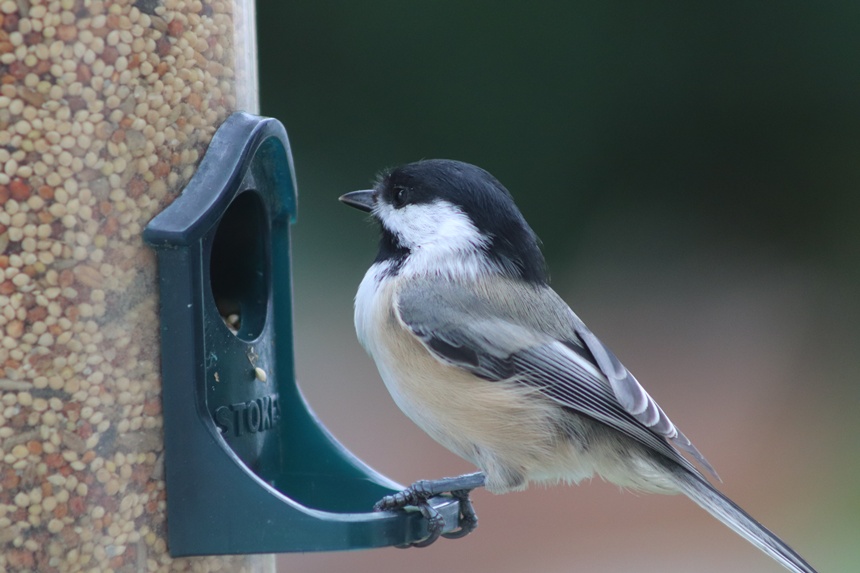
While feeding birds is on the whole beneficial, it can pose hidden risks. Feeders bring together various bird species that would not normally have contact with one another, and may also attract them in high numbers. Under such conditions, pathogens can be readily passed around. Outbreaks of mycoplasmal conjunctivitis, a contagious eye disease, as well as a deadly respiratory illness called trichomoniasis, have killed thousands of songbirds. Aspergillosis and avian flu are other potential dangers.
Fortunately, these risks can be minimized, beginning with basic food-safety standards. I like a free all-you-can-eat buffet as much as the next person, but if no one ever cleaned the salad bar or washed the steam trays for months on end, my enthusiasm would start to wane. The Cornell Laboratory of Ornithology recommends scrubbing bird feeders every two weeks, followed by a 10 percent bleach solution rinse.
A virtue in other contexts, inclusiveness can be a problem in bird feeding. The Audubon Society points out that birdseed mixes often lead to excessive waste and spoilage, a source of contamination. Apparently, it’s best to maintain a separate feeder for each type of seed. Not only does this cut down on waste, it also reduces the number of species at each unit, helping to curb disease transmission.
Black oil sunflower seed is like watermelon at a picnic: universally relished. If you have just one feeder, black oil seed will attract the widest variety of birds. Its popularity can occasionally lead to problems if bullies like blue jays, as well as a number of blackbird species, hog the feeder and kick out other birds. If that’s the case, try switching to striped sunflower seed, which is not as attractive to grackles, starlings ,and cowbirds. The only drawback to the striped seed is that it can be harder for small birds like chickadees and nuthatches to open.
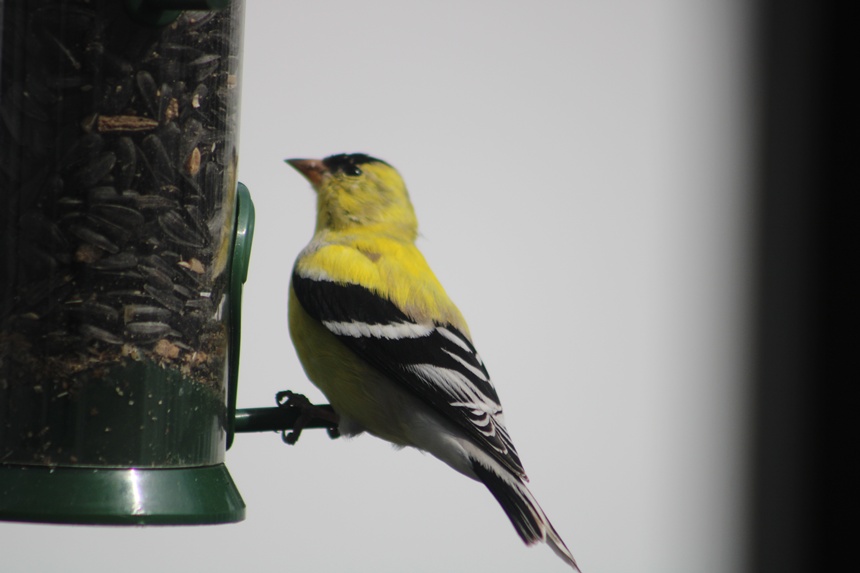
Thistle seed, also called Niger seed, is a tiny oil-rich seed favored by goldfinches, purple finches, redpolls, and pine siskins. Because thistle requires a special feeder that has narrow openings, jays and blackbirds can’t get at it. Don’t worry about having a yard full of thistles, though, as the seeds are heat-treated and can’t sprout.
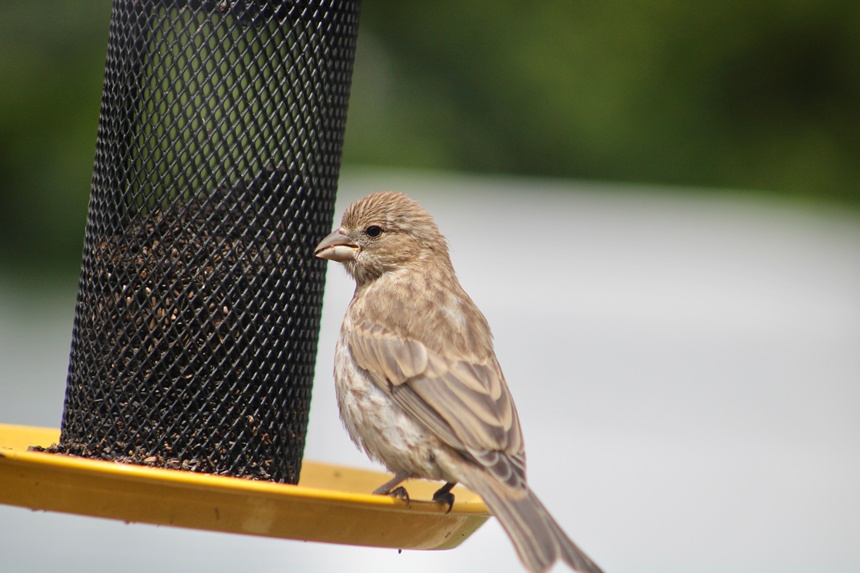
Cardinals and grosbeaks are fans of safflower seed, which has a hard shell and is a bit less attractive to squirrels. Safflower is typically presented in tray-type feeders. White millet is eaten by juncos, cardinals, mourning doves and other ground-feeding birds.
Cracked or whole corn will bring in larger species like grosbeaks, crows, ruffed grouse, and turkeys. Unfortunately, corn is very attractive to deer, raccoons, and bears. The big problem with corn is that it’s the one bird food most likely to be contaminated with aflatoxins, which are fatal to birds even at low levels. To minimize the risk to birds, avoid buying corn sold in plastic bags, and never allow it to get wet. Only offer it in amounts that can be consumed in a day.
I’m all for efficiency, but no one wants to run a combination bird-cat-squirrel feeding station. A recent innovation has made it easy to reduce feline delinquency. Instead of belling the cat, you just give it an ugly collar, or “bib.” Birds are apparently fashion-conscious, and flee from garish colors and clashing patterns. Studies show that colorful cat bibs reduce predation better than collar bells.
As for squirrels, which, by the way, will eat birds if they get a chance, it’s not as simple. There are many styles of squirrel-resistant feeders, but the ones that have worked best for me have a plastic feeder housed inside a metal-mesh cage. I’ve seen a clever squirrel chew through the line holding one of these feeders and then go after the seed that spilled when it hit the ground. That kind of thing is hard to deter, except maybe with a cat. Just make sure it’s wearing an ugly bib.
If you’d like to get involved with birding, you can find the nearest Audubon chapter here.