Senior managing editor and logophile Andy Hollandbeck reveals the sometimes surprising roots of common English words and phrases. Remember: Etymology tells us where a word comes from, but not what it means today.
When young children are taking their first steps toward literacy, early lessons often include connecting individual letters of the alphabet to images of things whose names begin with those letters. A is for APPLE. B is for BALL, or maybe BEAR or BUMBLEBEE. There are always multiple options for every letter — C could be for CAR or CAT or COOKIE, for example — but toward the end of the alphabet, options narrow.
Most often, X is either for X-RAY or XYLOPHONE. This wasn’t the case, however, in the early 19th century, when The Saturday Evening Post first came off the printer. It’s obvious why that’s the case for X-ray — X-rays were discovered in the 1890s — but xylophone had not yet found its way into English either. Though the instrument it names is ancient, the word xylophone, whose earliest known use in English is from 1866, is even younger than the saxophone, which was invented by Adolphe Sax in 1850.
Both xylophone and saxophone end with the modern English descendant of the Greek phōnē “voice, speech, sound.” It’s the same combining form that gives us telephone and, to stick with the musical theme, sousaphone (the wrap-around tuba created in 1893 and named after John Philip Sousa) and sarrusophone (a family of metal instruments designed in the 1850s to replace bassoons and oboes in marching band settings, named after French bandmaster Pierre-Auguste Sarrus).
Unlike those other three instruments, the xylophone isn’t named for its creator or some musical luminary of the time. The xylo- was derived from the Greek xylon, which means “wood,” but especially wood that had been cut or prepared, like beams or lumber or firewood.
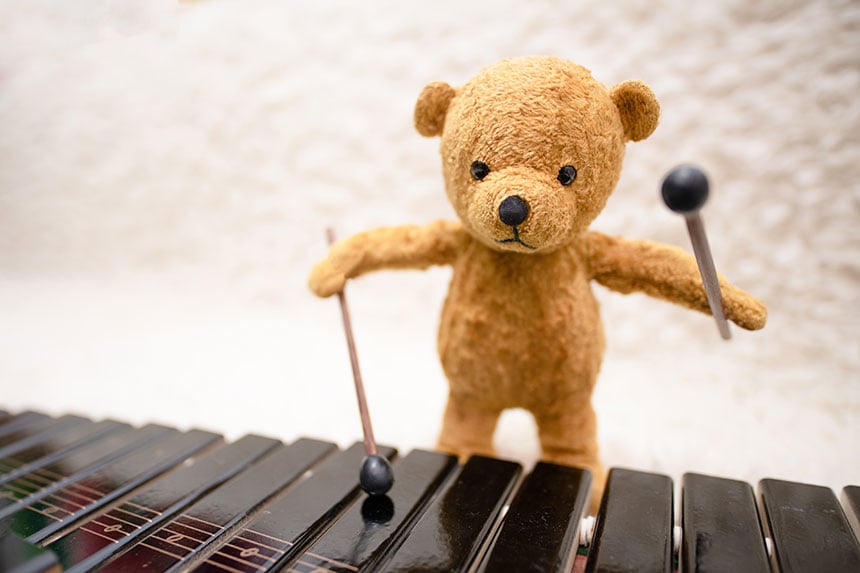
Xylophone, then, reduces to “wood sound,” and that’s exactly what it is: An instrument made of wooden bars of different sizes that are struck with (at least historically) wooden sticks or mallets. Practically every culture into antiquity has learned the trick of hitting wood blocks to create different tones and, thus, music, and every culture gave the instrument its own name. Xylophone, then, can describe both an instrument and a large family of instruments.
The modern Western xylophone usually consists of 42-48 wooden bars (3 1/2 to 4 octaves) in an arrangement that resembles piano keys. A larger and deeper-sounding version of this is called a marimba, an instrument and word of African origin (probably a Bantu language).
Of course, human ingenuity is never content to just stop experimenting with sound and construction. The wooden bars of the xylophone were replaced with metal ones to create the glockenspiel, German for “play of bells.” The glockenspiel (the name was first used for a particular pipe organ stop) is normally smaller than a xylophone — about two octaves — but also louder, because the metal would ring out.
In the 1920s, the glockenspiel was enlarged, resonators — tubes below the bars that increase volume — were added, and an adjustable motor was attached that spun paddles inside those resonators to give it a wavering vibrato, and the vibraphone was born. Lionel Hampton was the king of the vibraphone.
Bonus word: The vibraphone and glockenspiel are both examples of metallophones, and I bet you can guess why they’re called that.
Percussion sections are full of other instruments that derive from the xylophone concept but play around with the sizes, shapes, and materials used, from orchestral chimes, crotales, and temple blocks to the PVC contraptions of The Blue Man Group.
Yet one question remains: When children were learning the alphabet 200 years ago, A was still for APPLE, but what was X for?
Become a Saturday Evening Post member and enjoy unlimited access. Subscribe now



Comments
Had to go to Webster’s but … X is for Xanthippē
These are really information. Thanks.