Senior managing editor and logophile Andy Hollandbeck reveals the sometimes surprising roots of common English words and phrases. Remember: Etymology tells us where a word comes from, but not what it means today.
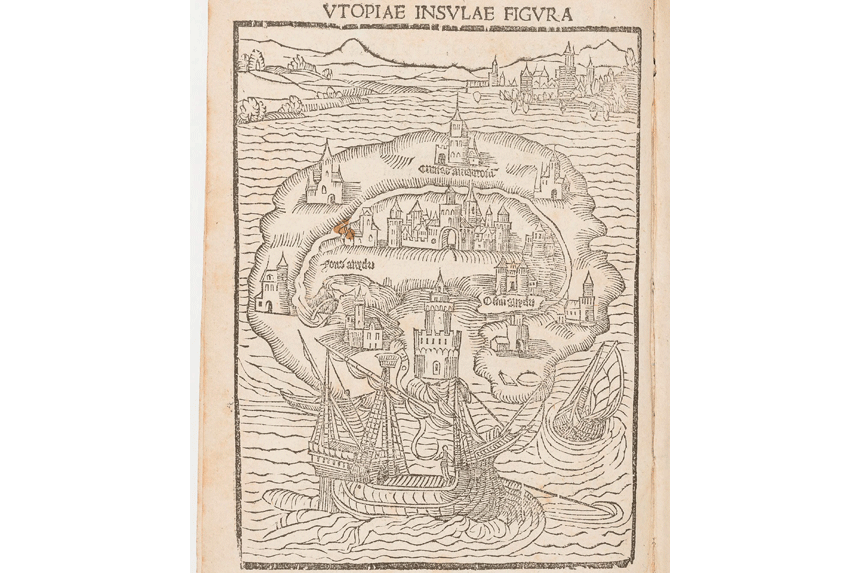
In 1516, Sir Thomas More published (in Latin) a satirical story that takes place on a fictional New World island, which he called Utopia, a name he coined. The word utopia is nothing new to you, of course, because More’s work was and remains well-known, and utopia stuck around and was genericized to refer to any (fictional) place where law, government, and social expectations work in ideal harmony for the good of all.
The opposite of a utopia is normally called a dystopia; some of our literary touchstones are dystopian novels, including Fahrenheit 451, The Handmaid’s Tale, 1984, and Brave New World. That dys- prefix is Greek and means “bad, abnormal.” The -topia comes from the Greek topos “place.” A dystopia, then, is literally a “bad place.”
Words that begin with dys- are commonly paired with opposites that begin with eu-, from the Greek meaning “good or well.” You probably know a few dys-/eu- pairs: dysphonia and euphonia (bad and good sound), dysphoria and euphoria (literally hard or easy to bear), dysphemism and euphemism (an unfavorable or favorable word used instead of another one).
It makes sense, then, that if dystopia and utopia are opposites, that this is just another bad-good pair using the same two prefixes, and that missing e could be attributed to Thomas More’s spelling and the popularity of his book.
But that’s not the case. Sorry, Michael Schur fans, but Utopia is not “The Good Place.”
The first syllable of utopia comes from the Greek ou “not.” The fictional Utopia is literally “no-place” — it doesn’t exist. (Samuel Butler certainly understood this when he created his own literary utopia in 1872 and called it Erewhon, which is basically nowhere spelled in reverse.)
The problem here is that utopia was used as the model when dystopia was coined — the u was lopped off and dys was added — and the two words were used in opposition, which isn’t strictly etymologically accurate. “Bad-place” isn’t the opposite of “no-place.” The Oxford English Dictionary records a speech by John Stuart Mill in 1868 in which he says, in part, “It is, perhaps, too complimentary to call them Utopians, they ought rather to be called dystopians, cacotopians.” (Cacotopian — caco- means “bad or evil” — predated Mill.)
Mill’s 1868 speech is a long way from More’s novel of 1516, and that is indicative of the language as a whole. Though there is some variety in when various publications pinpoint the first use in print of dystopia, dystopian, and dystopic, many of the resources I checked place it somewhere in the 20th century. Merriam-Webster dates the first known use of dystopian as late as 1962; that’s 13 years after 1984 was published.
The point being that dystopia is a much much younger word than utopia, and though they are considered opposites today, that isn’t strictly true etymologically. But, of course, we English speakers get to decide as a group what a word means, regardless of etymology.
Become a Saturday Evening Post member and enjoy unlimited access. Subscribe now



Comments
I had a feeling utopia and dystopia had Greek and Latin roots. The latter is a given most of the time. I’m surprised the former isn’t much older than the 20th century, given the dark shadows of the human condition throughout history, into the present day.
With that in mind, I’ll volunteer to use both words in a sentence. “The gravely-voiced, hook-nosed, greasy moron of a governor took a fairly utopian state, turned it into a dystopian nightmare, and wants to do that nationwide as President!”