If you need a good laugh, check out this pop-country song by Ray Stevens titled “Can He Love You Half As Much As I,” a lament from a country boy whose girlfriend dumps him for a “cultured” urbanite. He argues that he’s just as cultured – for example, he can play the spoons, make music with his armpits, plus he collects glow-in-the-dark Elvis posters. While I can’t play a tune on my armpits, I can relate to the guy in the song, as I have no idea what makes a person cultured.
Ray Stevens – Can He Love You Half as Much as I from “Get Serious” (Uploaded to YouTube by raystevensmusic)
However, I do know what makes foods and beverages cultured: You add bacteria or fungi to them. The thought of spiking our meals with microbes may sound like a bad idea, but these are beneficial bugs, not the germs that our moms made us scrub off our hands before coming to the table. When a food is cultured with a helpful organism, it alters its chemistry through fermentation. The kinds of changes that occur depend on what microbes are used.
We’re most familiar with ethanol fermentation, the process that makes the alcohol that’s safe and fun to drink, at least in moderation (other alcohols such as methanol are toxic in small doses and deadly in large amounts). Ethanol is produced when we add yeast, technically a fungus, to sugary liquids like barley malt if we’re making beer, or grape juice if it’s wine we want.
As yeast cells pig out on sugars, an orgy of frothy reproduction ensues (it’s asexual, in case the thought of fornication in your Frontenac is off-putting). Naturally, yeast cells excrete waste products just as we do. Thankfully, not at all like we do. Their “waste” is ethanol and carbon dioxide, both of which we find useful. We add yeast to bread dough for the carbon dioxide bubbles to make the bread rise in the oven (where the alcohol is driven off). The key thing with ethanol fermentation is that we don’t consume live cultures as we do with all other kinds of fermentation.
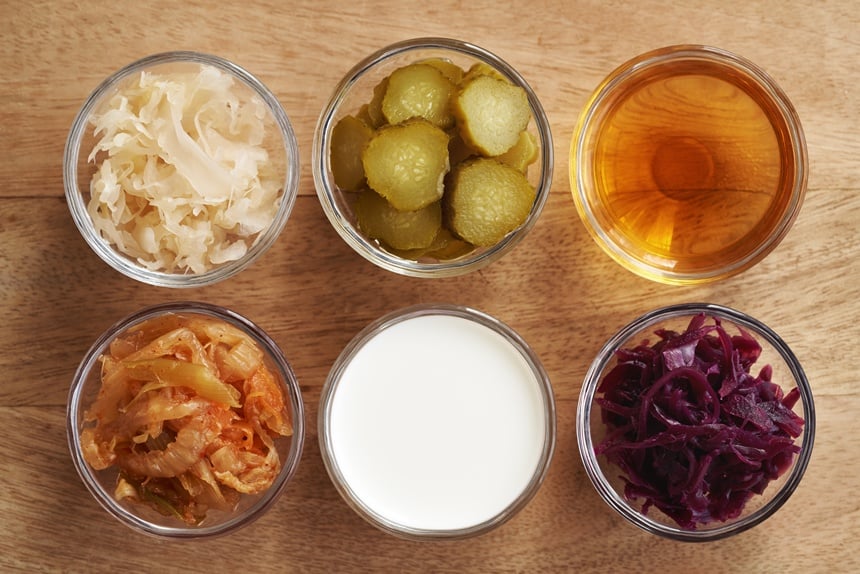
The second main type of fermentation results in lactic acid. Athletes know lactic acid as the stuff that causes “muscle burn” one feels during intense exercise. For centuries, humans have cultured milk with certain bacteria to create yogurt and kefir through lactic acid fermentation. Unlike raw milk, yogurt and kefir resist spoilage at room temperature. This process also gives us kimchi and sauerkraut, and is what makes sourdough bread tangy. I used to make old-fashioned fermented pickles just by submerging cucumbers in salt brine for a few weeks, after which time I packed them into canning jars. Not only does lactic acid fermentation preserve vegetables, eating foods with live cultures boosts our immune systems as well.
Acetic acid fermentation is what gives us vinegar. Where I used to live it was quite common for folks, myself included, to make their own vinegar from home-pressed apple cider in the fall. You need a “vinegar mother,” a slimy disk loaded with acetic acid bacteria that you add to a glass carboy of cider, and then simply wait. Because vinegar keeps almost indefinitely, I often did not need to make it every year.
The only “food” I know of that’s made directly from acetic acid fermentation is kombucha, made from sweetened black tea. This requires a different kind of placenta-like “mother” called a SCOBY, or symbiotic culture of bacteria and yeast. Propionic acid fermentation results from a different set of bacteria, and it’s what creates the holes in Swiss cheese.
In general, it’s good to eat foods cultured with a wide array of beneficial organisms, as a more diverse gut microbial community is linked to stronger immune systems and better digestion. Our gut “flora,” as it’s called, also impacts our mental heath, with higher diversity correlated with reduced symptoms of depression and anxiety.
But there may be limits to how far we’re willing to go to achieve this gut-flora diversity. I recently came across an article on a research team from the University of Copenhagen (which also included American, Spanish and Canadian scientists) who went to Bulgaria to try and recreate ancient methods of food preservation. They found that the gut flora of ants in that region had some of the same Lactobacillus bacteria that we use to make yogurt. They crushed up a few ants and stirred them into jars of fresh milk, which they then buried in anthills overnight to keep them warm enough to ferment. In the morning the jars were full of tasty yogurt. At least they claimed it was tasty. I’m adventurous with foods, but I don’t think I’ll try this unless I’m lost in Bulgaria.
Getting back to the guy with offbeat musical talents, it turns out that we all could benefit from a little more culture when it comes to our underarms. Body odor is largely due to bacteria in the genera Corynebacterium and Staphylococcus. As one authority put it, “…the truth is, body odor is not primarily a hygiene problem. It’s a microbiome problem.”
Our definition of “hygiene” is part of the problem in that too-frequent showers coupled with the use of perfumed soaps and deodorants can backfire, leading to an ongoing imbalance of skin microbial community. A 2022 peer-reviewed study found that people who suffered from excessive body odor to the point that it affected their social and professional lives greatly benefited from applications of yogurt. Well, specifically, Lactobacillus bulgaricus, one of the bacteria frequently used to make yogurt and kefir, lowered underarm pH and crowded out odor-causing bacteria, leading to a long-term reduction of odor. I guess culture is for everyone.
Become a Saturday Evening Post member and enjoy unlimited access. Subscribe now



Comments
Thanks for the comments, Bob. I’m with you about a universal scanning device, like the tricorder they used in Star Trek – no more waiting for blood tests, or an MRI or X-ray.
There’s a lot of good information here, Paul. Good bacteria is very important, such a Bio K for optimum gut health, and bottles of kombucha. The former at Sprouts, and the latter at Grocery Outlet; less expensive there.
The gut flora helps in all kinds of ways. I wasn’t aware of the mental health benefit as such, but am not surprised. Everything seems to be connected or related to everything else, so we have to try and cover all the bases every day, so nothing gets overlooked and to take the guess work out of it. Still, a high-tech scanning device or wand that would do just that would be nice too.