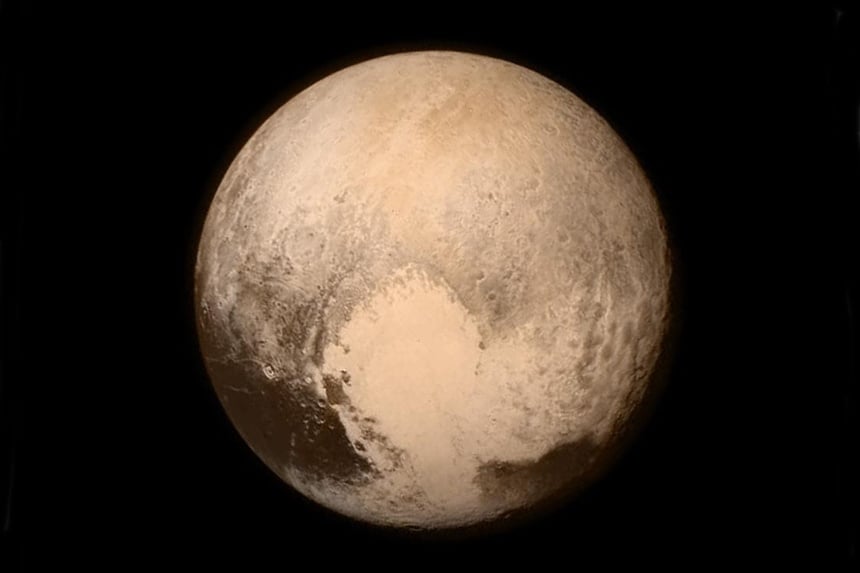
When we think of something as monumental as discovering a planet, we might picture accomplished, scholarly astronomers using gigantic telescopes and other sophisticated instruments to decipher the mysteries of the night sky. What we probably don’t picture is a fresh-off-the-farm 24-year-old balancing telescope time with sweeping floors at Lowell Observatory in Flagstaff. But that’s exactly how Clyde Tombaugh’s story began.
Although Pluto was reclassified as a dwarf planet 20 years ago, on August 24, 2006, the story of the man who discovered it remains remarkable. Tombaugh’s path from a Kansas farm boy to astronomy wunderkind is a story of curiosity and persistence.
The Boy Who Built His Own Telescopes
As a teenager in the 1920s, Tombaugh built his own telescopes in a storm shelter on the family farm near Burdett, Kansas, because he couldn’t afford to buy one. His homemade equipment included an axle from his father’s old Buick, metal tubing from a grain elevator, an outdoor water faucet, and gears from farm machinery. He used the telescopes to make detailed observations of Mars and Jupiter. After a hailstorm destroyed his family’s crops in 1928, Tombaugh had no money for college, so he sent his drawings to V.M. Slipher, director of Lowell Observatory, simply hoping for feedback. “Instead, it got him a job,” says Kevin Schindler, Lowell Observatory’s historian.
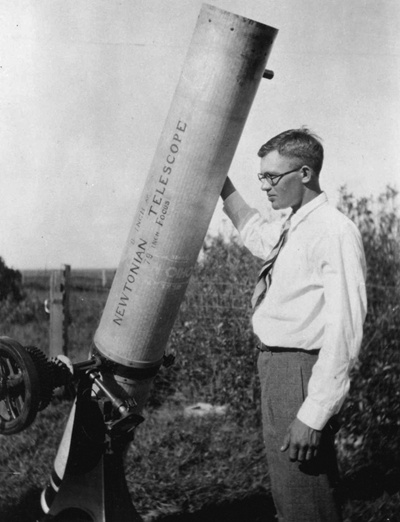
Tombaugh arrived in Flagstaff in January 1929 and was hired specifically to handle the photography for Lowell’s search for Planet X. At first, he photographed the night sky while someone else analyzed the images. Before long, he was doing both. He also had some less glamorous responsibilities as the new guy, including stoking fires and clearing snow from the telescope roof.
The Search for Planet X
The search for Planet X wasn’t based simply on the idea that there might be another planet out there. Astronomers had noticed irregularities in the movements of Uranus, discovered in 1781, that suggested another body might be influencing its orbit. The discovery of Neptune in 1846 explained some of those irregularities, but not all of them, leading scientists to suspect that another body might exist farther out in the solar system.
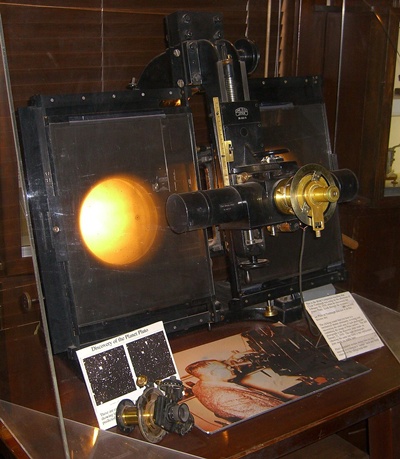
Tombaugh’s work involved photographing the same sections of sky on different nights, then comparing the photographic plates for objects that had moved against the background of distant stars. He used a device called a blink comparator to switch between the images rapidly, making movement easier to detect.
Finding Pluto
In some respects, February 18, 1930, was an ordinary day at Lowell Observatory for Clyde Tombaugh. He walked downtown for breakfast at his favorite restaurant, the Black Cat Cafe, then returned to the observatory and worked in the office. He went to lunch, picked up the mail, and returned to work. At about 4 p.m., he spotted the moving object on the photographic plates.
His boss told him to look at the object through Lowell’s larger telescope, but he had to wait until dark. The night turned out to be too cloudy for the telescope, so Tombaugh went back to the Black Cat Cafe for dinner and then to the movies, where he saw The Virginian with Gary Cooper. The following night, Tombaugh was finally able to use the larger telescope to confirm the object he had spotted on the photographic plates. It was the long-sought Planet X, later named Pluto.
Lowell Observatory waited several weeks before announcing the discovery. Here’s an interesting bit of symmetry: The announcement came on March 13, 1930 — what would have been observatory founder Percival Lowell’s 75th birthday and also the anniversary of Uranus’s discovery in 1781.
What Happened to Clyde Tombaugh?
After the discovery, Tombaugh was offered a full scholarship to the University of Kansas to study astronomy, where he earned his bachelor’s and master’s degrees.
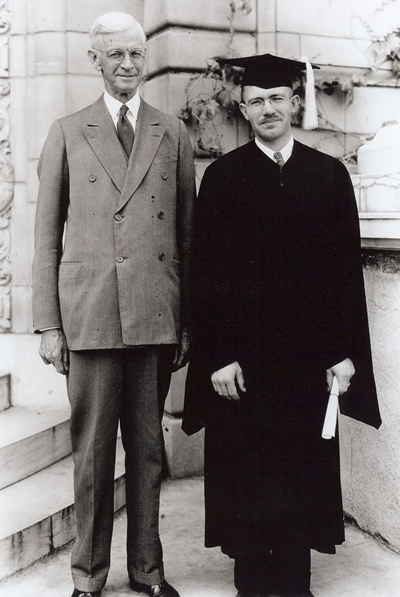
“You discover a planet,” says Schindler, “and people start to notice you. There’s a story about his first day walking into Astronomy 101,” adds the historian. “The professor looked at his class roster, saw the name ‘Clyde Tombaugh’ and told the freshman to get out of his class, the idea being, if you discover a planet, you don’t need Astronomy 101.”
Although discovering Pluto was the biggest moment of his life, Tombaugh’s career continued for decades. He spent 14 years at Lowell Observatory after the discovery before going on to New Mexico State University, where his real passion became teaching and inspiring the next generation of scientists. He retired in 1973 and died in 1997 at age 90.
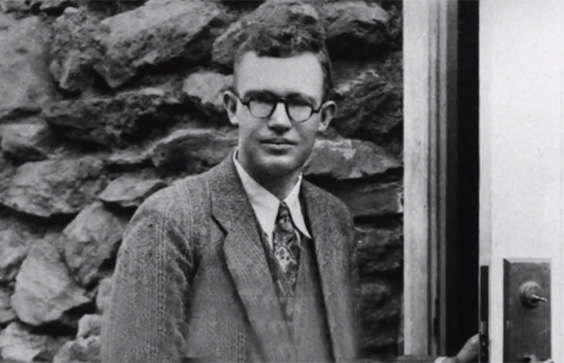
“What sticks with me about Clyde Tombaugh is the example of dedication and not giving up,” Schindler says. “His family didn’t have money for him to study astronomy, so he built a telescope and did it anyway. He was persistent and followed his dream.”
Tombaugh’s connection to Pluto continued after his death. When NASA’s New Horizons spacecraft launched in 2006, it carried a small vial containing some of his ashes. Schindler was in mission control when the spacecraft reached Pluto in 2015, standing with members of the Tombaugh family as they waited for confirmation that the flyby had been successful and for the first images to arrive. He recalls everyone in the room cheering and waving American flags, but for the Tombaughs, it was more than just a spacecraft flying by Pluto.
“It was that Dad made it to Pluto, the planet he discovered,” said his children.
The inscription on the vial also calls Tombaugh a “punster,” a nod to his fondness for corny jokes, particularly puns involving crows. Schindler compared Tombaugh’s sense of humor to the early version of what we might now call dad jokes. One example: What’s a crow’s favorite game? Crow-quet.
A heart-shaped region on Pluto, Tombaugh Regio, was also named in his honor.

Twenty Years Since Pluto Stopped Being a Planet
On August 24, 2006, the International Astronomical Union officially classified Pluto as a dwarf planet, changing the solar system students had memorized for generations from nine planets to eight. Under the new definition, a planet must be large enough to clear the neighborhood around its orbit, meaning it must be large enough to clear most other objects from its orbital path. Pluto doesn’t meet that requirement because it shares its region of the solar system (the Kuiper Belt) with many other objects. The mnemonic, My Very Educated Mother Just Served Us Nine Pizzas, was how many of us put the names and the order of the planets to memory. One modern twist substitutes “Nachos” for “Nine Pizzas,” but most diehard “Pluto is Still a Planet” people will tell you it just isn’t the same.
The decision sparked plenty of debate, and Pluto has remained one of the most talked about objects in our solar system despite its new classification. Twenty years later, the debate over what makes something a planet continues, but the change doesn’t diminish the significance of what happened in Flagstaff in 1930. Whatever we call Pluto today, it was a Kansas farm boy working at Lowell Observatory who first spotted it.
Tombaugh didn’t live to see Pluto’s official reclassification, and it’s hard not to wonder how he would have received that news. Schindler thinks he probably wouldn’t have been surprised by it. There had already been discussion about Pluto’s status in Tombaugh’s lifetime, although Schindler believes he likely would have disagreed with the decision and privately grumbled about it.
Visiting the Place Where Pluto Was Discovered
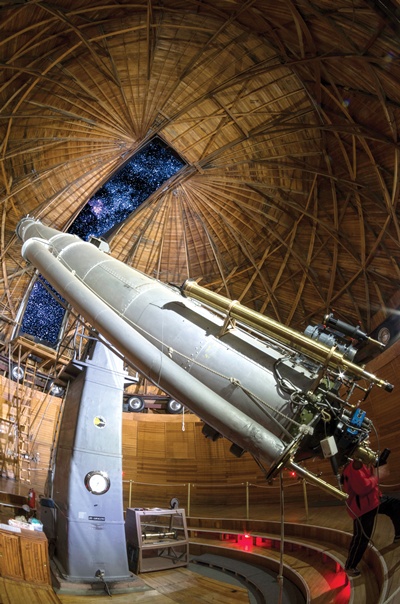
Whether you still think of Pluto as a planet or have accepted its dwarf-planet status, visiting Lowell Observatory offers a chance to see where one of the most famous discoveries in astronomy happened. Notably, Pluto was the only planet discovered in the United States.
Lowell Observatory was founded in 1894 by astronomer Percival Lowell, who established it in Flagstaff in part to study Mars. Flagstaff’s elevation and weather conditions make it a conducive environment for studying planets. The city was an early adopter of lighting restrictions and was actually the first designated International Dark Sky City. Lowell’s interest in finding another planet beyond Neptune eventually led to the search that Tombaugh would take up after Lowell’s death. The observatory has since grown into a mix of a historic astronomy site and a modern science center. Among the historic objects on display is Tombaugh’s original homemade telescope — the “Frankenstein” instrument he built from farm machinery and used to make the observations that ultimately got him noticed by Lowell Observatory.
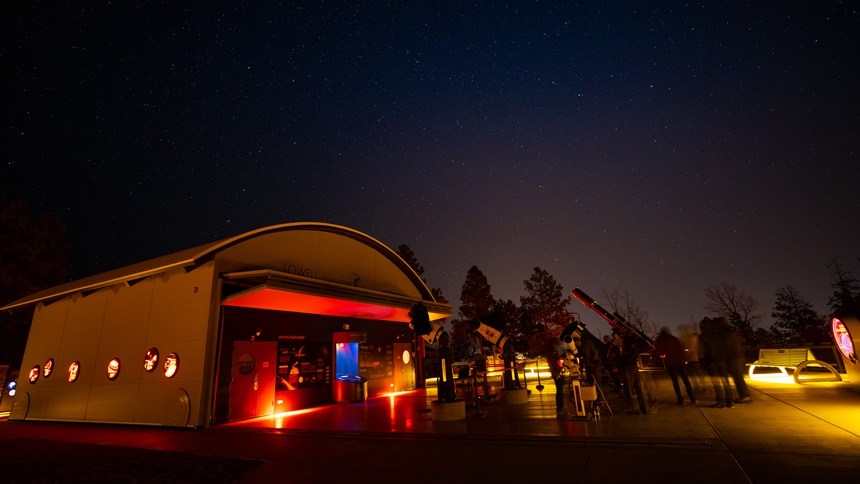
The newer Astronomy Discovery Center has interactive exhibits, including the Orbits Curiosity Zone, a hands-on area designed for children but entertaining for anyone who wants to play, and the Stardust Lab Astronomy Gallery. There’s also the Lowell Universe Theater, where a 160-degree, multi-story LED screen presents immersive astronomy films. The experience is a lot more high-tech than the historic telescope domes elsewhere on the hill.
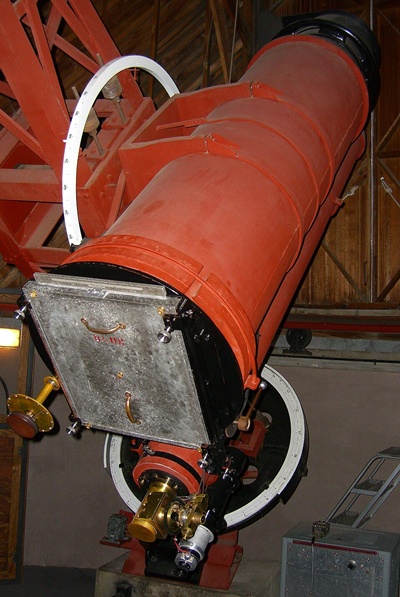
Then there’s the historic side of the campus. Inside the Pluto Discovery Dome is the 13-inch astrograph Tombaugh used to photograph the night sky during his search for Planet X. Visitors can also see the historic Clark Telescope and the Rotunda Museum, while the Giovale Open Deck Observatory has six modern telescopes for public viewing. There’s a definite shift in aesthetics as you move from the newer buildings to the historic part of the observatory, and it’s a fun juxtaposition between where astronomy is headed and the observatory’s roots.
Lowell Observatory is also close to Flagstaff’s Historic Route 66 corridor, making it easy to pair a visit with the city’s classic Route 66 shops, restaurants, and neon signs. If you have more time, Walnut Canyon National Monument is another nearby stop that puts you back in the landscape that makes northern Arizona such a distinctive setting for a place devoted to looking beyond Earth.
Become a Saturday Evening Post member and enjoy unlimited access. Subscribe now





Comments
Dear Editor:
I have often wondered who cose the name for the Planet, after all, Diseny’s “Pluto” name didn’t come from a much later time.
Unboutedly, I jopin a very, very long list of folks who were much disappointed and very annoyed about its demotion, though I understand the specifications, sort of.
But, in this case; is it really, really necessary to be so hardened to those rules.
What exactly damage can be done by demoting it ?
That part I can’t quite get,
Sincerely.
Gord Young – Peterboro ON [still not in the 51st state]
I have always thought Pluto got a bum rap in its “demotion.” A planet is a planet, regardless of its size. Period.