
Forks are so commonplace that most of us rarely think about them. They spend their lives tucked away in a drawer until it’s time to eat, have a fleeting moment in the spotlight when we’re choosing a flatware pattern for a wedding registry, or become the object of our frustration when every clean one is somehow still in the dishwasher and we’re standing in the kitchen holding a salad.
But forks weren’t always commonplace. Recently, I was watching an episode of Outlander (a period drama set in eighteenth-century Scotland), and noticed that instead of using forks, the characters were cutting off pieces of meat and bringing them directly to their mouths on the tips of their knives. It made me realize I’d never really thought about when forks became part of everyday life — or why they weren’t always a part of the dinner table.
So how did the ubiquitous fork get here?
The answer turns out to be about much more than a utensil that helps us eat. The fork’s journey is a story of innovation, shifting social norms, religion, design, and even national identity.
From Luxury Item to Household Essential
Watching that episode of Outlander where everyone was eating with knives, I found myself wondering who decided forks were a good idea in the first place. Surely there had to be an answer.
As it turns out, there probably isn’t.
“It’s funny how obsessed we are with origins,” says etiquette expert Nick Leighton, cohost of the Were You Raised By Wolves? podcast. “Some things just arrive. They weren’t necessarily invented. They just oozed through history. It isn’t always linear.”
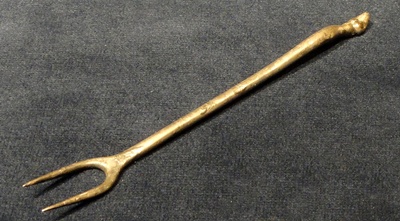
Historians generally trace the modern table fork to the Byzantine Empire, where small two-pronged forks were likely used by the elite before making their way west through Italy. Even then, forks weren’t everyday tableware but more of a luxury item, even though it seems strange today to think of a fork as a luxury. For everyone else, the knife remained the primary eating utensil, while spoons handled soups and stews and fingers did much of the rest.
Stories from the period suggest the fork was sometimes viewed with suspicion, even as something evil or sinful. In medieval art, demons and the devil were often depicted carrying pitchfork-like implements while tormenting the damned, creating an unsettling association between forked prongs and evil. Against that backdrop, it’s easier to understand why some people viewed forks with suspicion.

One oft-repeated tale involves a Byzantine princess whose use of a golden fork horrified dinner guests. After she later died of the plague, some religious leaders reportedly concluded the fork was to blame, arguing that God had already provided humanity with perfectly good utensils: their fingers.
That story has multiple versions, reinforcing Leighton’s point that history isn’t always as tidy as we’d like it to be. While it’s easy to dismiss the supposed connection between a gold fork and the princess’s death today, the story reflects a time when religious belief, superstition, and everyday life were deeply intertwined, making such conclusions seem far more plausible than they do now.
Did Catherine de’ Medici really Bring the Fork to France?

If you go down the “Where did forks come from?” rabbit hole, one of the first names you’ll run into is Catherine de’ Medici, an Italian noblewoman who married into the French royal family and eventually became queen of France.
The popular version of the story credits Catherine with introducing forks to France when she married the future King Henry II in the 16th century. While she almost certainly influenced French court dining and helped popularize Italian customs, giving her sole credit for bringing forks to France may oversimplify.
“Was she really that influential?” Leighton asks. “It was unlikely that the people in the French court had never seen a fork before. People were traveling and were aware of customs in faraway places.”
That’s often how history works. It’s tempting to pin sweeping cultural changes on one famous person because it makes for a cleaner story. In reality, ideas tend to spread gradually as people travel, trade, marry, and borrow customs from one another. Catherine de’ Medici may have accelerated the fork’s acceptance, but she was likely part of a much larger story rather than the entire story.
When One Fork Became Four
Even today, an elaborate place setting can make otherwise confident diners pause. Which fork do you use? Do you work from the outside in or the inside out? Leighton says etiquette isn’t meant to be a booby trap designed to embarrass people. Instead, it’s a collection of customs that developed over time to help meals run smoothly — and like the fork itself, those customs have evolved right alongside society.
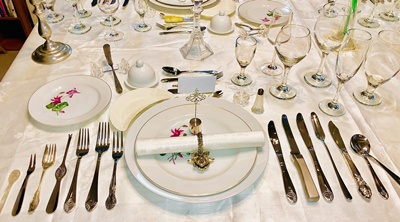
As Europe’s middle class grew, owning beautiful flatware became a way to signal refinement and prosperity. Families who couldn’t inherit generations of sterling silver could purchase matching services of their own, and manufacturers were more than happy to oblige with an ever-growing assortment of specialized utensils.
Suddenly, one fork per place setting wasn’t enough. Why have one fork when you can have three, four, or more?
There were forks for fish, oysters, desserts, salads, and just about every imaginable course. Leighton says the Victorian fish fork tells a surprisingly revealing story. Old-money families inherited silver services that predated specialized fish forks, while the rising middle class bought new ones with every fashionable addition. A table set with fish forks marked you as what Victorians might have considered “fish fork people” — the sort of family buying new silver rather than inheriting old silver. It’s the classic old-money versus nouveau-riche faceoff.
Eventually, the Industrial Revolution made those once-exclusive place settings accessible to ordinary households. Improvements in manufacturing, followed later by the use of stainless steel, transformed flatware from a luxury reserved for the wealthy into something almost every family could afford.
The fork had completed its long journey from curiosity to kitchen drawer.
The Art and Design of the Fork
By the beginning of the twentieth century, the fork had largely settled into the familiar form we recognize today. But that didn’t mean its evolution stopped. As dining habits became more casual and manufacturing techniques improved, designers began rethinking not just how flatware worked but what it could look like.
Those changes are the focus of Knife Fork Spoon: Everyday Tools, Extraordinary Design, on view at the Denver Art Museum. Rather than tracing the fork’s medieval origins, the exhibition explores how flatware evolved throughout the twentieth century as changing lifestyles, new materials, and industrial design reshaped one of the most familiar objects on the table.
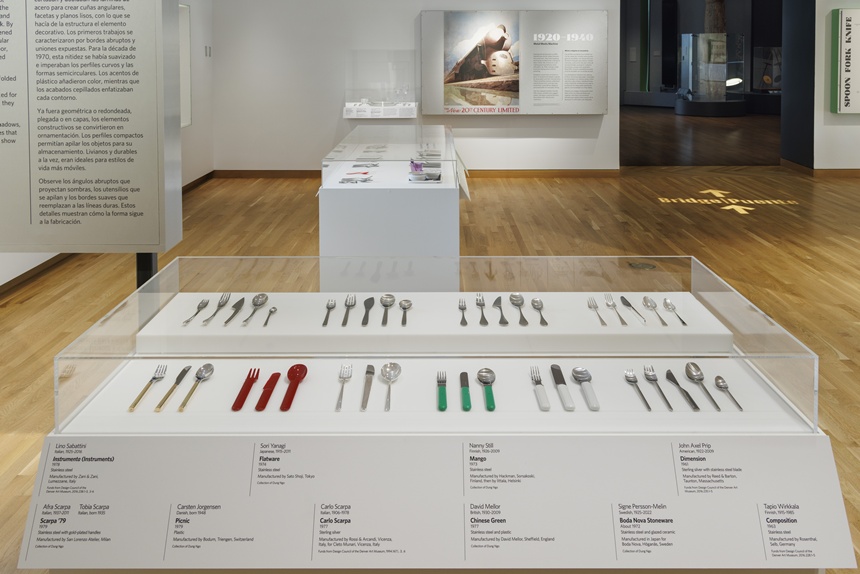
“After 1900, flatware became much more streamlined,” says Darrin Alfred, curator of architecture and design at the Denver Art Museum. “It was less ornate and less about these huge place settings. You really see that shift in the postwar era when dining habits changed significantly.”
The shift wasn’t just aesthetic. As families moved away from formal dining rooms toward eat-in kitchens, patios, and television trays, elaborate place settings gave way to simpler, more practical flatware. The rise of stainless steel in the 1930s and 1940s also made flatware less expensive, easier to maintain, and dishwasher safe, helping transform it from a symbol of status into an everyday household staple.
That didn’t stop designers from continuing to experiment. One section of the exhibition explores the resurgence of expressive flatware during the 1980s and 1990s, when the rise of celebrity chefs and gourmet dining inspired playful new forms. Animal-shaped utensils, historical references, and even contemporary artists’ interpretations demonstrate that a fork can be both a functional tool and a work of design.
“Utensils are something we engage with every day. We put them in our mouths. We handle them. We live with them,” Alfred says. “I hope people leave thinking about the design of everyday objects and how ordinary things can be extraordinary and beautiful.”
The earliest forks looked very little like the ones sitting beside our plates today. Over centuries, the number of tines changed, handles became more ergonomic, new materials replaced old ones, and mass production made flatware more affordable and consistent. Along the way, the fork evolved from a simple eating utensil into an object that reflected culture around it.
Become a Saturday Evening Post member and enjoy unlimited access. Subscribe now





Comments
A fascinating look at the all-important eating utensil I honestly did not know the history of, Jill. The fact they were a luxury item in the beginning makes sense when you know the story. There are many instances where this is true throughout history, with things ‘trickling down’ from the rich to us regular folks.
In this case it’s the fork, and the museum exhibition sounds neat. Seeing fancy ones to the utilitarian. I wonder if the unpopular ‘spork’ is included? The Post did a feature on those last year.