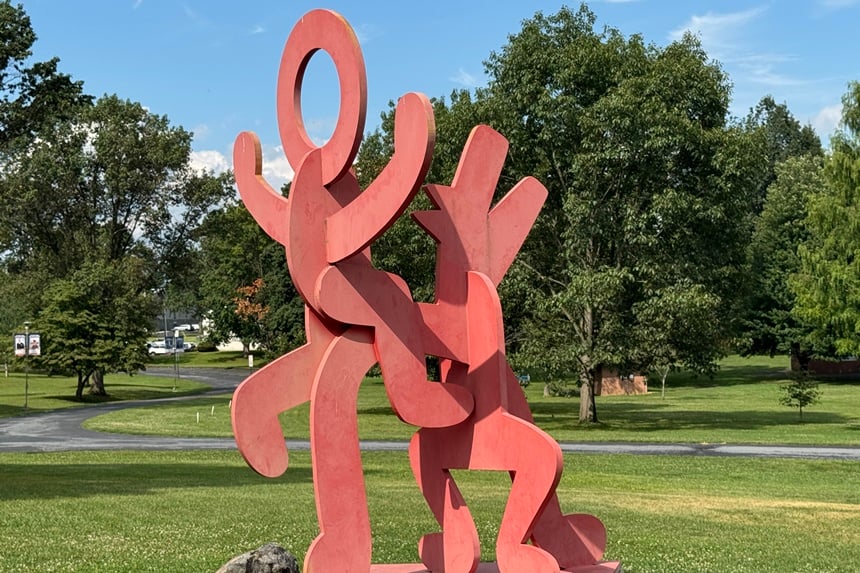
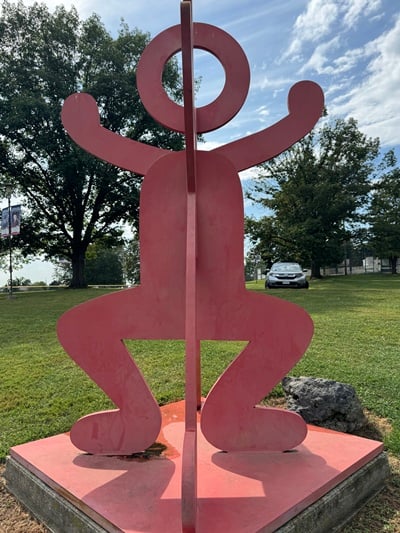
Walking through the small-town park, I was startled by a steel sculpture topping the hill ahead: a 10-foot orange figure throwing its hands joyfully toward the heavens while a stylized dog barks in delight. At its base a plaque reads “Keith Haring, Kutztown Native.”
It seems an unlikely place to encounter an artist who first made his name scrawling chalk graffiti across subway stations in gritty 1980s New York. Haring would later paint towering street murals in Paris and Tokyo, and his work would go on to grace museums across the globe. A fixture in New York’s edgy art scene, he hung out with folks like Madonna, Yoko Ono, and Andy Warhol.

But through it all, Haring never forgot his roots – and even 36 years after his death, Kutztown, Pennsylvania, hasn’t forgotten him.
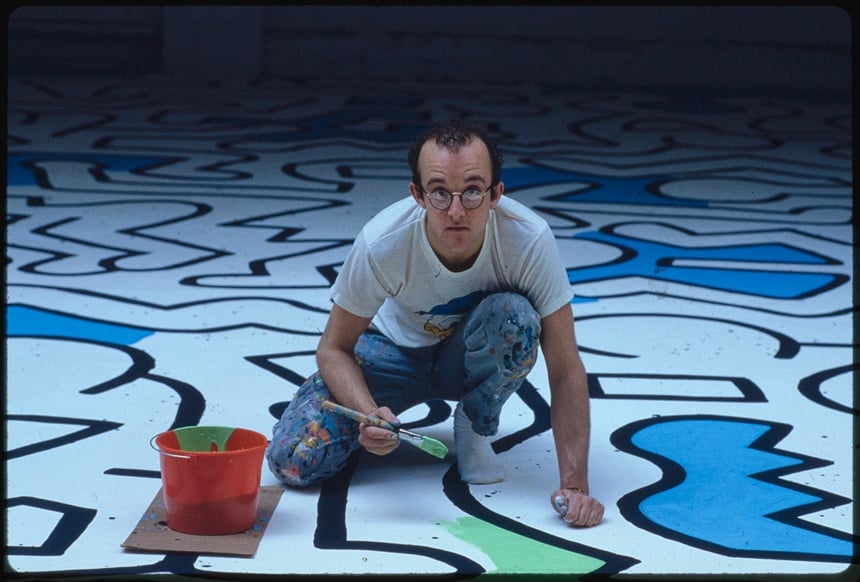
“He is still taught every year in the art classes all through the schools here,” says his sister Karen DeLong, who serves as president of the Kutztown Area Historical Society. “Every child is familiar with his art and knows that he came from Kutztown.”
Haring started drawing as a young child with his father, she says. The two would play a game where they would each start a sketch, exchange papers, and continue drawing in their own style. His familiar pop culture style grew from Dr. Seuss books and Walt Disney movies and cartoons. Encouraged by Kutztown teachers, he attended art school first in Pittsburgh and later in Manhattan.
Today in the village of 4,200, visitors can also find his work in a former classroom, at his family’s church, and on a workout court on a local college campus.
Haring died of AIDS in 1990, devoting his final years to raising awareness of the disease that ravaged the gay community. He created campaigns to promote safe sex and supported hospitals and clinics in the years when government officials still resisted even saying the word AIDS.
While his work has endured over the decades, the artist has seen a recent resurgence.
Just this year Haring has been the subject of exhibitions across the country from Mobile, Alabama, to the recently expanded Crystal Bridges, a major museum in Bentonville, Arkansas. Guests at the new Faena New York hotel will find a sweeping Haring mural, while his 2024 award-winning biography, Radiant, has been optioned for television.
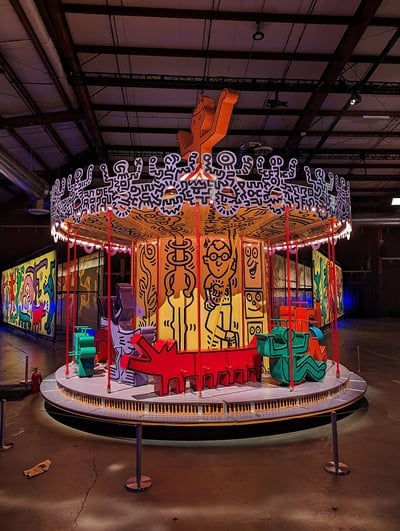
In the last two years, thousands of new fans have discovered his painted carousel at the blockbuster Luna Luna art amusement park installation in Los Angeles and New York. And his dancing figures remain ubiquitous, appearing on Lego sets, Swatch watches and Uniqlo t-shirts.
“It’s immediately recognizable,” says Brendan Strasser, an archivist with the historical society, who wrote his doctoral thesis on Haring. “We all sort of relate to Keith’s art as if we’re still kids. There’s these clear, bold lines and primary colors.”
The artist would introduce himself as “Keith from Kutztown,” and traces of his work remain scattered across his hometown, two hours west of New York City. “We get a number of people doing their own Keith Haring tours,” says his sister.
The first stop is often that bright orange sculpture, called Untitled (Figure Balancing on Dog). It was cast in 1986 and later donated by the Haring Foundation and his New York art dealer, Tony Shafrazi. It’s one of the only places to see his sculpture in a rural public setting. But that’s just the start.
The Kutztown Area Historical Society is also a must-see. Housed in the 1892 brick building where Haring attended elementary and middle school, the site has an official Pennsylvania historic marker. Dedicated on National Coming Out Day in 2024, it recognizes his pioneering art style, along with his gay rights advocacy.
Inside the Kutztown Historical Society (Video courtesy of the Kutztown Historical Society)
Though the historical society has limited hours, it can be visited by appointment. Inside a classroom, you can see blackboards Haring covered with scribbled drawings in 1982 when he returned to town for a holiday art fair at the start of his career.
Although the artist first found fame through illegal graffiti tags, he respected his hometown norms and requested permission to make the chalk drawings. Luckily, the historical society recognized Haring’s growing fame and quickly preserved the images with plexiglass. Other rooms display memorabilia, books, posters, and an assembled 32,000-piece jigsaw puzzle of Haring images.
The building stands directly across the street from his childhood home, the site of a remarkable discovery. During a remodel, the current owners uncovered a radiant baby image scribbled in gold marker on the artist’s bedroom wall. Previous residents had nearly painted it over, but the five-inch fragment of sheetrock eventually fetched $143,750 at auction.
A few blocks away, more Haring history graces St. John’s Reformed Church, where he was baptized, his family worshiped and his parents were married. His best friend‘s mother once worked there, and the two boys used to hang out in the hallway, a church employee told me.
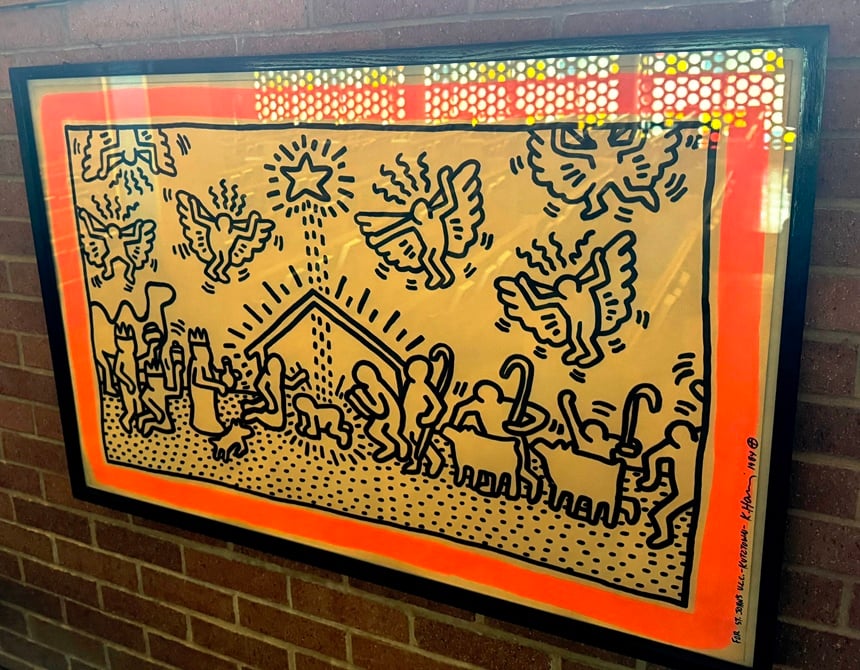
Later when he found global fame, the artist donated a nativity scene. It’s a surprising mix of street art style and religious imagery, but unmistakably Haring. The silkscreen features hovering angels, dancing shepherds, a camel, and farm animals, all topped by the Star of Bethlehem and centered on a crawling baby radiating light. The painting bears his signature and a dedication to the church.
Another Haring artifact awaits on Kutztown University’s campus: an 1,120-square-foot outdoor fitness court festooned with his colorful dancing images. It’s a public art gallery that makes you want to move, an outdoor gym with squat, core and lunge stations, along with pull-up and push-up bars.
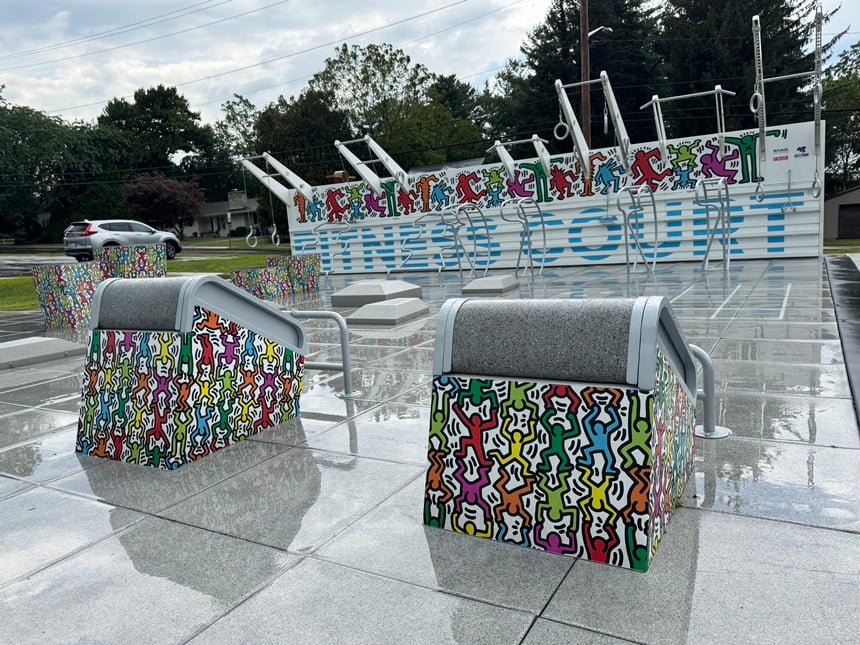
While the National Fitness Campaign and the Haring Foundation had planned to install the courts in major cities, tiny Kutztown got one due to its Haring connection. Located a few blocks from Haring’s home, at the corner of Baldy Street and Normal Avenue, it was dedicated in 2022.
While he was alive, the artist’s work rankled some critics because of its wide commercial popularity. At one point Haring lamented that his work was easy to find in the New York’s Museum of Modern Art’s gift shop, but not its galleries. Now the artist’s works are part of the museum’s permanent collection.
Haring famously sold t-shirts, posters, magnets and pins at his Pop Shop store in New York’s SoHo neighborhood, saying he was deliberately trying to democratize art, making it available to everyone. He often worked with children, inviting hundreds at a time to join him on large-scale art projects, like a 10-story vinyl banner honoring the Statue of Liberty centennial.
Over the span of his career, Haring worked in many forms from graffiti and murals to paintings and prints. Not far from Kutztown, his work hangs in museums in nearby Allentown and Reading. But the largest public installation in the region stands at Kutztown Park, his celebratory orange sculpture.
DeLong says that joy carried through nearly all of her brother’s work. “The images were just kind of universal. They’re bright, they’re colorful. They speak to everyone.”
Become a Saturday Evening Post member and enjoy unlimited access. Subscribe now

Comments
While eating dinner last night in a friend’s Sukkah, I spoke about what a beautiful job your Mom used to do coordinating all the religious school classes to produce the most beautiful decorations ever! My second grade class strung garlands of cranberries and popcorn. Happy fall holidays to you!