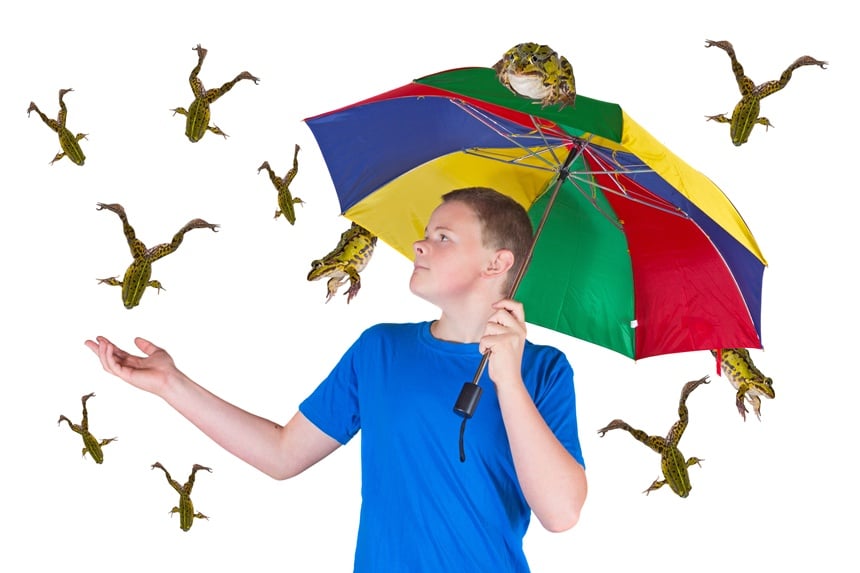
We know microbiology is the study of microbes, and sociology is the study of social relationships, and yet meteorology is not the study of meteors. Likely a good thing, since meteors by definition turn to gas in the sky and disappear (space rocks and dust that do make it to Earth are called meteorites). The Greek philosopher Aristotle, who wrote a four-volume book called Meteorologica around 340 BCE, is said to have coined the term meteorology. To the ancient Greeks, who gave us the suffix “-logia,” meaning “the study of,” their word “meteoron” referred to anything high in the air, including rain, snow, and clouds. And meteors.
Today, meteorology means the study of Earth’s atmosphere and all the factors that impact weather changes, as well as weather forecasting. It’s an essential discipline that warns us when violent storms are approaching, lets us know what temperatures and wind speeds to expect over the next few days, and gives us a heads-up about what form of water might fall from the sky in the near future. However, snow, ice, rain, and sleet (plus the odd meteorite now and then) aren’t the only things that tumble from the heavens.
Since 1978, the National Atmospheric Deposition Program (NADP), which is hosted at the University of Wisconsin at Madison, has tracked stuff that falls from the sky that is not some form of water. Among other things, they measure dry particulates that settle to Earth, keep tabs on toxic metals like mercury, and measure human-sourced ammonia and other forms of nitrogen dissolved in rain and snow, which can be beneficial up to a point, but harmful in excess. I have to wonder what the NADP would make of the large life-forms that sail down from storm clouds every so often.
We’ve all heard the phrase “raining cats and dogs,” but I’m pretty sure neither of these animals has been involved in animal precipitation events. And as far as I can tell, the 1982 song “It’s Raining Men,” featured on the soundtrack of the 2001 blockbuster film Bridget Jones’ Diary, is fiction as well. Critters coming from clouds has been used as a plot device in a number of films and TV series, like in the 1999 Oscar-nominated film Magnolia, where frogs pelted down in biblical proportions, or in season 1 of Fargo, which had fish in the forecast.
Far from being the stuff of fiction, animal rain is a real and well-documented, albeit rare, meteorological event. Not to be confused with Rain of Animals, a Scottish-Australian bluegrass band, or the French film Reign of Animals, animal rain happens when critters that don’t normally fly get swept up into storm clouds and later fall to Earth along with rain or hail. Accounts date back thousands of years. Pliny the Elder, a Roman scientist and military commander who lived in the first century CE, wrote about frog and fish rain in his exhaustive six-volume Natural History.
In a curious twist, some 19th-century Europeans used frogs to predict the weather. Tree-frogs were kept in glass jars equipped with small ladders. If a frog climbed the ladder, fair conditions were in the offing, but when a frog went to the bottom and hid, wet weather was coming. I don’t know what they did when frog rain was expected.
Around the world, fish and frogs are the number one and two most commonly reported flavors of animal rain, respectively. Many reports come from southeast Asia, Central America, and Mexico. Apparently, fish rain has become a fairly regular occurrence in the last 30 years in Yoro, Honduras, where residents have been holding an annual fish-rain festival since 1998. But we have plenty of examples close to home.
The southern U.S. seems to get more than its fair share of animal rain compared to other regions. In late December 2021, it was rainy with a brief flurry of fish in Texarkana, Texas. Over in Louisiana, fish from two to nine inches long tumbled into the town of Marksville one October morning in 1947, and on June 28, 1957, thousands of fish, frogs, and crawdads fell on the town of Thomasville, Alabama. And out West, a school in the California town of Oroville was pelted with fish on June 23, 2107. Other animals come out of the clouds from time to time as well. The city of Jennings, Louisiana had wormy weather on July 12, 2007, with gobs of wriggling worms splashing down.
The main cause of animal rain is violent weather, especially waterspouts, which are tornadoes that form over water. Apparently, these are capable of picking up aquatic organisms and transporting them onto land. While camping in the Thousand Islands region of New York State in 1981, I saw a “family” of four waterspouts between Cape Vincent, New York and Wolf Island, Ontario, Canada. It happened as a violent thunderstorm approached. I took shelter in my car until the high winds and heavy rain subsided, but there were no fish or frogs to be seen on the ground afterwards.
Waterspouts on Lake Michigan (Uploaded to YouTube by CBS News)
It’s believed that in some cases, powerful wind gusts can sweep small amphibians overland like tumbleweeds for short distances, making it seem like they fell with the rain when people find them in odd places after storms. Bats and birds can get overtaken by storms and caught in strong updrafts, ascending wind currents in thunderclouds, which occasionally can force dazed avians to the ground.
Given today’s high food prices, a cloudburst of crawdads and fish could be considered a boon. Maybe I’ll invest in a deep-fryer.
Become a Saturday Evening Post member and enjoy unlimited access. Subscribe now

Comments
I share links to these essays on a local community forum, which today prompted a humorous exchange with a reader, as follows:
“I always enjoy reading your essays in The Saturday Evening Post that you generously share in the Low Down email news. You have a great sense of humour and unique material well researched. So is this date a future prediction or just a typo? ‘And out West, a school in the California town of Oroville was pelted with fish on June 23, 2107.'”
My reply:
“It may well be that I’m prescient, but alas, I won’t live long enough to confirm it. For sure it’s my typo. Thanks for the laugh!”
Hope you get the rain you need, Midnight Rider! Never ate frogs’ legs myself, but would happily consume them if offered to me.
Deep fried frog legs are great! We actually could use a little rain now where I am, and cooler weather as well.