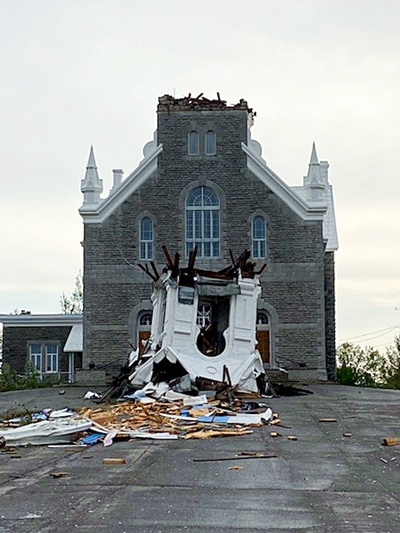
There’s no question that extreme weather events are getting more severe and that they’re whacking us at an increased rate as compared to historical averages. When we think of violent storms, tornadoes and hurricanes probably come to mind, and rightfully so. There are lesser-known phenomena like wind shears, which are highly destructive but very localized, and derechos, straight-line winds that cause widespread damage. A derecho hit my area in May 2022, bringing sustained winds of up to 120 mph across a swath nearly 1,000 miles long. We were five days without power, but for some it was a matter of weeks.
And obscure terms for crazy weather are getting more common these days, such as atmospheric river. This was a new one on me a few years ago. Apparently, these systems can drop 15 to 25 inches of rain in the course of just a couple of days. A recent study found the majority of extreme floods – up to 90 percent – are associated with atmospheric rivers. Then there’s the polar vortex, a normally stable, Frisbee-like air mass that spins over the polar regions. Every so often, potent high-pressure systems in the Pacific nudge this frozen Frisbee off the North Pole and slide it southward, resulting in frozen pipes and blizzards all the way to the Gulf states.
.gif#/media/File:GOES_West_Monitors_Atmospheric_River_and_%22Bomb_Cyclone%22_(NESDIS_2024-11-20_20241119000021-20241120160021_g18_fd_air-mass_longer-loop-PNW-AR_labels-optimize).gif)
Video of a powerful mid-latitude cyclone and accompanying atmospheric river impacting northern California, the Pacific Northwest, and British Columbia Nov. 19–20, 2024 (Wikimedia Commons)
When extreme weather hits, we often lose power, in some cases for days. To better prepare for storm-caused outages, the American Red Cross advises every household, especially those within mapped flood-prone areas or in so-called “Tornado Alley,” to build a survival kit. It includes a two-week water supply – one gallon per person per day – a two-week supply of non-perishable food, flashlights, emergency blankets, a first-aid kit, and a battery-operated radio. Based on my derecho experience, I’d add a lightweight camp stove with spare fuel bottles. And don’t forget extra batteries.
You might need a twelve-month supply of batteries, though, to ride out a bad geomagnetic, or solar, storm like the tempest that slammed into Earth in 1859. Known as the Carrington Event after the astronomer who first saw it brewing on the surface of the Sun, it was an unusually powerful solar storm that rained down charged particles onto the northern hemisphere for two days. As a result, the aurora borealis or northern lights were visible as far south as Panama, and they lit up the night sky so brightly that people in the U.S. reported getting ready for work at 1:00 AM, assuming the sun was up.
While dramatic, the Carrington Event caused little harm to infrastructure, because there wasn’t much to speak of back then. Charged particles from the storm energized telegraph wires through electromagnetic induction, making wires and telegraph machines throw sparks, which burned down some telegraph stations.
Although solar storms happen all the time, few of them hit our planet, and the ones that do are usually mild – they’re what make the ghostly, ethereal northern (and southern) lights. But the next time a Carrington-size solar storm hits North America, our network of transmission lines, electrical substations, and cell towers will be supercharged with free but unwanted current from the Sun. Many communications satellites will be damaged or destroyed. Experts say that depending on where the storm hits and how strong it is, it could take from a few months to as long as a decade to fully recover.
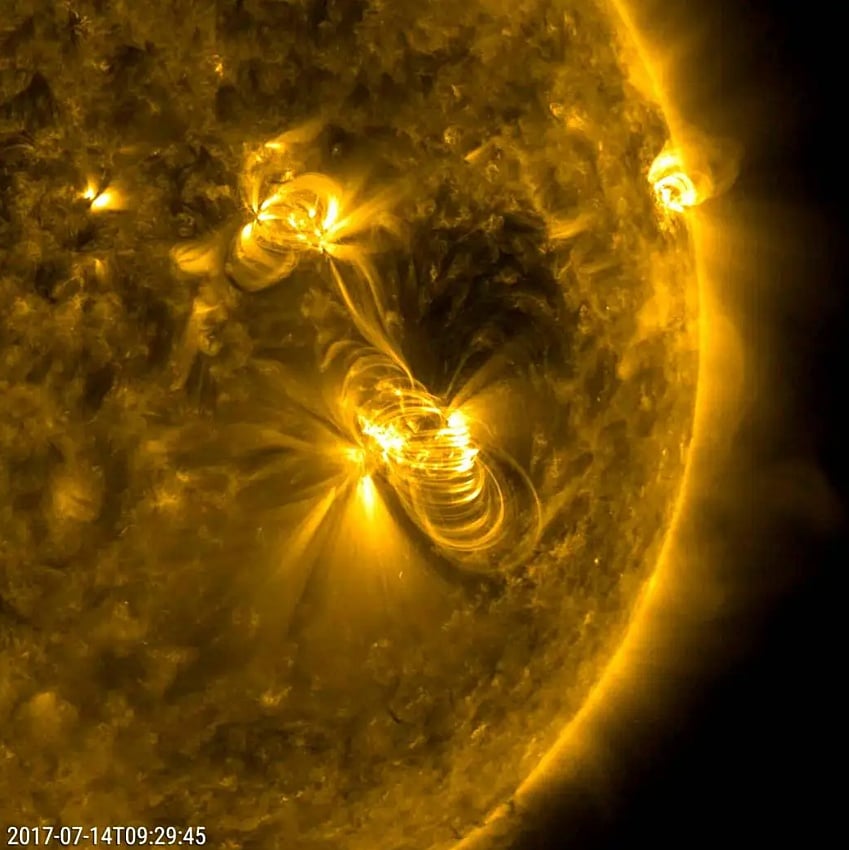
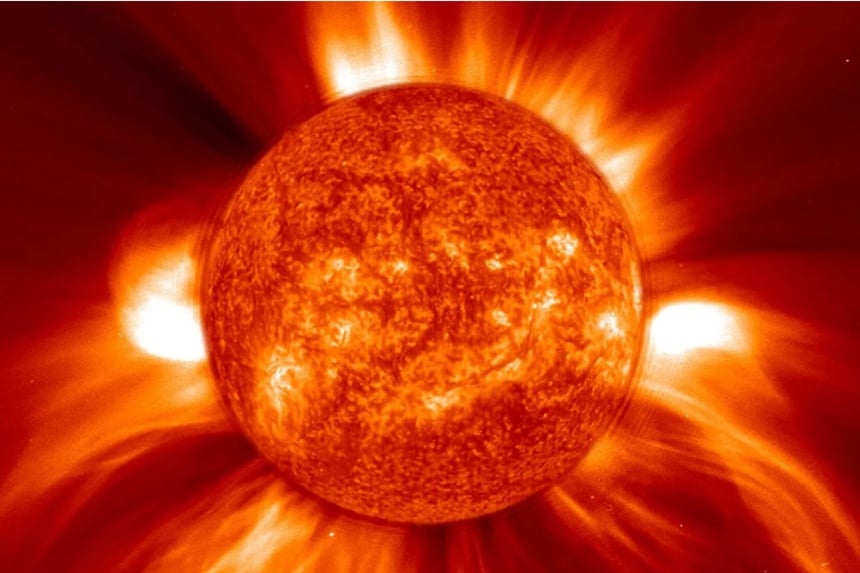
To get a handle on how solar storms work, think of the Sun as a colossal nuclear reactor that throws off deadly radiation, and Earth as a giant magnet that creates an energy barrier that shields us from lethal rays. In the Sun’s core, hydrogen molecules smash into each other and fuse into helium, giving off loads of energy in the process. This is why the surface of the Sun is like 10,000 degrees Fahrenheit in the shade, and why radiation (including visible light) and electrically charged gases continually stream away in what’s known as solar wind.
Every so often, the Sun “burps” an immense jet of charged particles in a particular direction, something called a coronal mass ejection. Given that our planet is a wee target 93 million miles away, it’s no wonder that we rarely get struck by one of these burps.
It’s weird to think that the only reason we don’t get burned to a crisp from gamma radiation is because our planet has a gooey layer near its center. Earth’s mantle, the part we live on, surrounds an outer core of highly conductive molten iron and nickel (there’s also a solid inner core whose composition is not entirely known). Earth’s molten core spins at a different rate than the solid mantle. The difference in spin rates is what makes Earth’s magnetic field that deflects nearly all harmful solar radiation. It’s not perfect, obviously, as the Carrington Event proves, but it makes daily life possible.
A simple visualization of Earth’s magnetosphere (Uploaded to YouTube by NASA Climate Change)
Even weak solar storms can disrupt radio signals or GPS systems for a few hours. The last time Earth received a glancing blow from a medium-strong geomagnetic storm was in March 1989. While geographically limited, it still plunged the entire province of Quebec into darkness just nine seconds after hitting. You can sign up for space-weather forecasts and alerts with the National Oceanic and Atmospheric Administration (NOAA). If a large coronal mass ejection aimed toward our planet is recorded, you’ll have a 15-hour to three-day advance notice before the storm hits, based on the speed of the particle cloud.
2012 was a movie that depicted a (possibly unrealistic) scenario of what would happen if a solar flare heated the Earth’s core. (Uploaded to YouTube by nickbtube)
Because a strong geomagnetic storm can induce current surges so big that they can bypass surge protectors, it’s best to unplug computers, routers, and other appliances in advance of the storm. You can further protect handheld GPS units and other electronics by putting them in a homemade Faraday cage like a metal box or trash can, or even the fridge.
Become a Saturday Evening Post member and enjoy unlimited access. Subscribe now




.gif)

Comments
‘Atmospheric river’ was coined in 1994 not to be sensational, but to better describe an atypically narrow and long (3-7 day) system. Before that it was ‘pineapple express,’ a term sometimes still used today.
You’re correct that such events can be mild, but that’s because they’re rated on a scale of 1 to 5. Classes 1-3 are normal rain events but for their length and small regional impact. Class 5 atmospheric rivers can dump up to 20 inches of rain in 3 days.
A lot of the use of various weather terms can be traced back to the media’s hunger for sensationalized news. In particular, the term atmospheric river is being used to describe every rain storm that has the potential to drop a few inches of rain. In the Pacific Northwest we get light rain spread over long periods of time which can drop 4-5″ over a week. The national news reports frequently say we’re in an atmospheric river but it’s just a normal winter event.
I sometimes wonder just how bad some of the storms that are being reported really are. The last one that hit the East Coast reported waves of 12′ and winds of 50-60 mph. For surfers, 12′ is fun and exciting and those wind speeds are common here on the coast in the winter. Two years ago the buoys reported swells of 42 feet at 21 seconds and it didn’t make the news other than a beach hazards statement by NOAA. Those waves were HUGE.