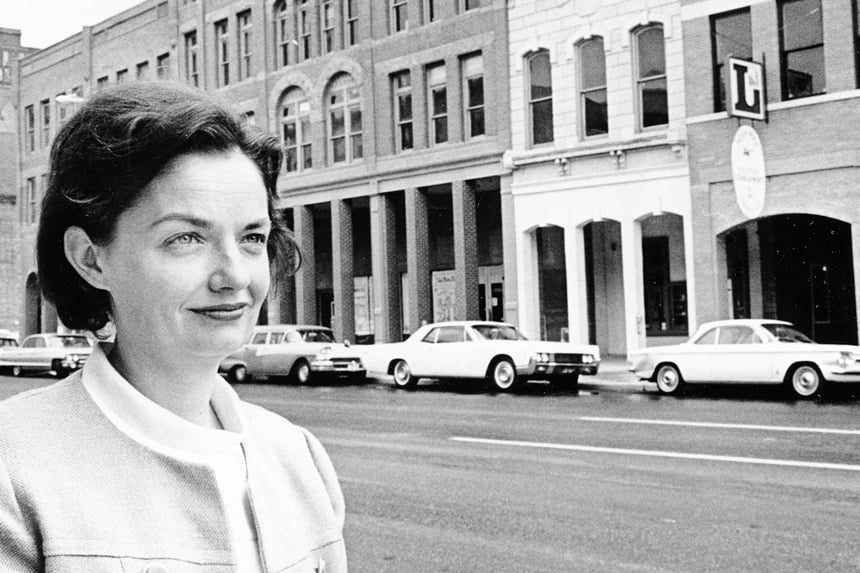
You may not know the name Dana Hudkins Crawford, but there’s a good chance she’s had an impact on your community. From the early 1960s until her death in January 2025, she helped transform over 1 million square feet of Denver’s most neglected neighborhoods and sparked a national interest in historic preservation. Some argue that without Crawford’s intervention, America might have lost the heart and soul of its downtowns.
A Love for Historic Places
Although Crawford grew up in Salinas, Kansas, her mother took her every summer to visit family in Ohio. In a Rocky Mountain PBS documentary on her life, Crawford credits these trips with instilling her with a love of “old buildings and historic stories.” That love deepened when she attended graduate school at Radcliffe College in Boston, a city with buildings that pre-date the nation.
Enamored with Boston, she intended to stay after graduation until her roommate-to-be decided to get married. Crawford changed course and moved to Denver for a career in public relations. There, she met and married petroleum engineer John Crawford in 1954, and they had four sons. While raising them, she continued public relations work out of a home office but became increasingly aware of the plight of Denver’s historic buildings, many of which were slated for demolition.
Steve Turner, director of the Dana Crawford Preservation Program at the University of Colorado Denver, explains that when soldiers returned following World War II, they married and moved into new homes in the suburbs, abandoning the America’s inner cities. The buildings they left behind eventually fell into disrepair. At the same time, the nation’s economy boomed, and the federal government saw an opportunity to modernize.
In 1949, Congress passed the Housing Act, authorizing $1 billion in federal loans to help cities acquire blighted neighborhoods for redevelopment. Denver took full advantage by creating the Denver Urban Renewal Authority, or DURA, and selecting block after block for demolition. Crawford watched as open lots replaced brick buildings, and she knew someone had to do something before it was too late.
“My passion was to find an area that I thought would work from a historic building perspective and also be a place where generations could come together and celebrate their city,” she explained in the documentary.
Larimer Square
Then, in 1964 while shopping for Oriental rugs at a nearby Goodwill store, her car broke down along the 1400 block of Larimer Street. At the time, Larimer Street was Denver’s skid row with “66 schlocky bars” and “drunks lying on the sidewalk,” according to Crawford in a 2014 interview. But as two men helped her with her car, she realized Larimer Street was one of the first in Denver. This was the place she’d been looking for.
On the surface, her plan was simple — purchase the buildings, renovate them, and invite one-of-a-kind businesses to lease them — but she faced several hurdles. First, Turner recalls, she couldn’t get a loan. Prior to the Equal Credit Opportunity Act of 1974, banks required women to have a male co-signer for loans and credit cards, so Crawford had to bring her husband with her. His presence didn’t matter — the banks didn’t understand her vision and denied her request.
Not one to let that stop her, she asked their friends to loan her the money. Turner said she secured between 20 and 30 loans, the largest of which was only $10,000, to finance the project. As soon as she had enough money, she began purchasing buildings.
But another obstacle stood in her way. Since the 1400 block of Larimer Street was already slated for demolition, Crawford had to convince Denver’s mayor, Tom Currigan, the area was worth saving, and he, in turn, had to convince the city’s urban renewal authority to postpone demolition. They reluctantly agreed to at least delay it.
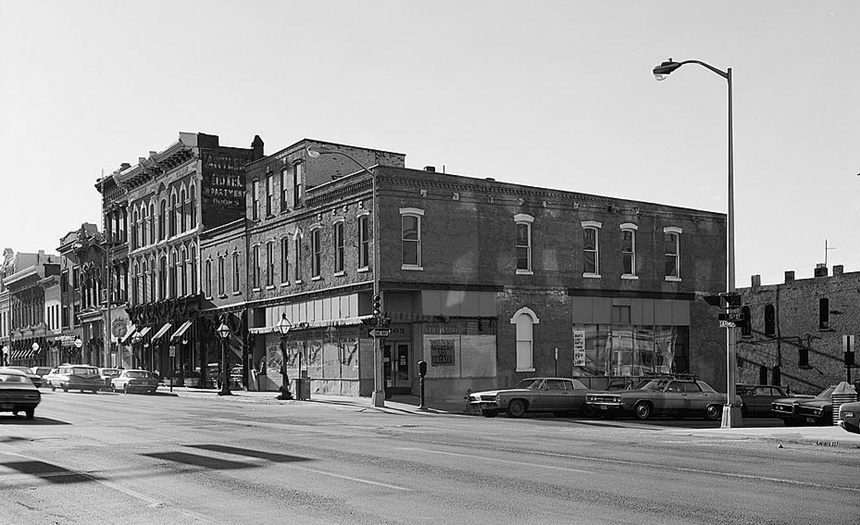
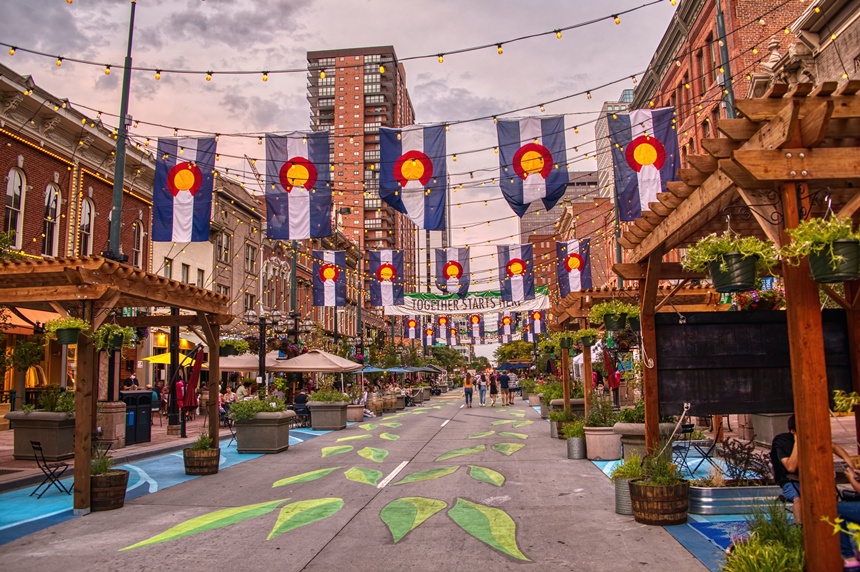
Today, Larimer Square is lined with boutiques, upscale restaurants, a coffee shop, bookstore, and comedy club. The street where Crawford broke down allows only pedestrian traffic and hosts festivals, movie nights, and Dana Day to commemorate her contributions to Denver.
The Oxford and LoDo
The success of Larimer Square spurred Crawford on. In 1970, she joined a group working to save Titanic survivor Molly Brown’s house, and in the process, she founded Historic Denver, an organization dedicated to protecting and promoting the city’s historic places. She eyed other historic buildings for preservation, too, including The Oxford Hotel.
Built in 1891, The Oxford Hotel operated as a grand hotel for more than 50 years, but by the 1970s, it had become a skid row flop house. Crawford purchased the Art Deco building, renovated it, and reopened it as a boutique hotel, but she didn’t have experience managing a hotel and had to file Chapter 11 twice (). She eventually partnered with Sage Hospitality Group, and The Oxford Hotel has since become one of the city’s premier luxury hotels.
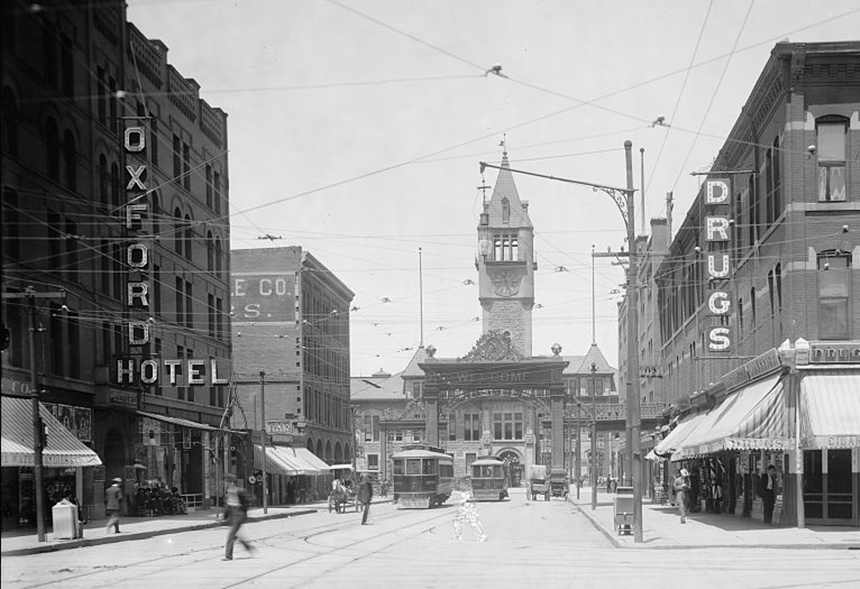
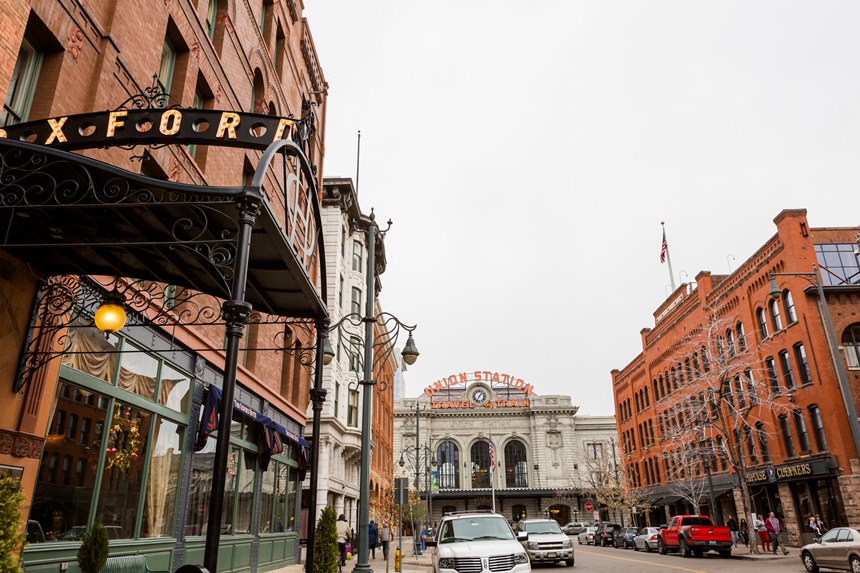
Even as she struggled with The Oxford Hotel, she pursued other projects, including converting many of the area’s abandoned brick warehouses into lofts. Over time, Crawford transformed Denver’s Lower Downtown (LoDo) into one the city’s most vibrant neighborhoods. Turner says LoDo is evidence that she truly had the gift of recognizing a building’s potential.
“A lot of people see a ratty old building,” he explains. “Dana would go into that old building, and she could see it being used. She didn’t see a building falling down. She saw what it could be.”
That was certainly the case with Union Station, her most ambitious project.
Union Station, Denver’s Living Room
Ed Blair, who served as The Oxford Hotel’s general manager from 2004 to 2012, says before Crawford redeveloped Union Station, he used to rush through the Beaux-Arts style building whenever he took the bus because the ceiling looked like it might cave in on him. Crawford would go there and just sit inside it, planning its future.
“Union Station was a longtime dream of hers, long before anyone started talking about it,” Blair says.
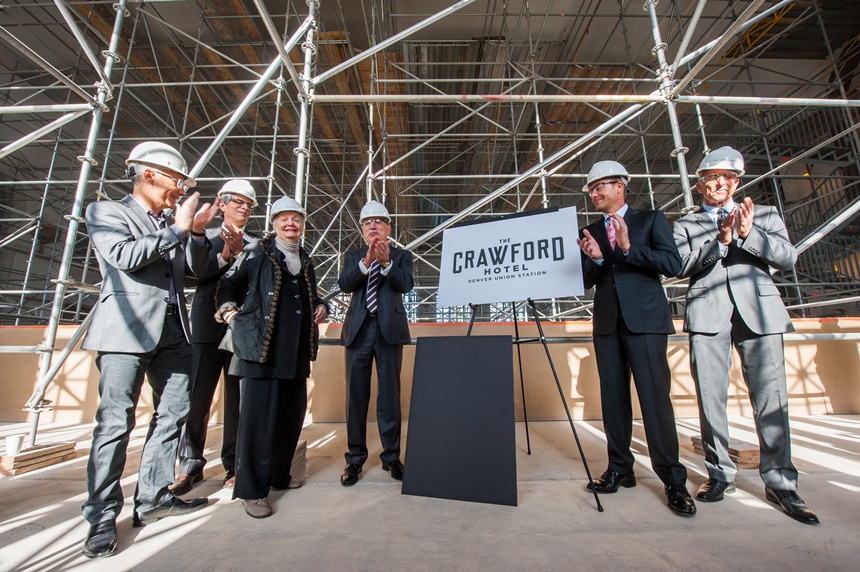
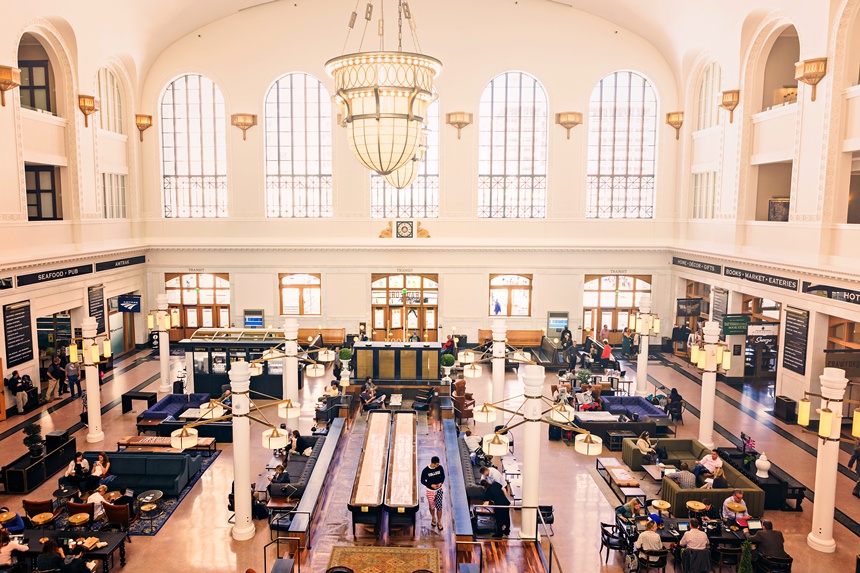
Following a 1-year-and-7-month, $54 million overhaul spearheaded by Crawford, a reimagined Union Station opened in 2014 featuring chef-driven restaurants, specialty shops, and enough comfortable seating to earn it the nickname “Denver’s living room.” The redesign also introduced the project’s anchor, The Crawford, a 112-room luxury hotel.
Blair says Crawford did not want the hotel named after her, but her partners insisted.
In 2021, Sage Hospitality Group promoted Blair to Area General Manager overseeing The Crawford Hotel, Denver Union Station, The Oxford Hotel, and The Oxford Club, Spa & Salon, a role that allows him to sometimes lead property tours. People’s reactions never disappoint —
their eyes almost always widen as they enter Union Station’s grand hall and take in its marble walls, massive chandelier, and details like the interior ticket windows.
As much as he enjoys watching people’s reactions, Crawford enjoyed it more. She would stake a spot in Copper Lounge overlooking Union Station’s grand hall to watch people interact with each other and with history. Blair says it’s through Crawford that he learned to appreciate the historic value of places.
“History is something you can’t create,” he explains. “We own something at Union Station that can’t be created. We’re harnessing a story that is over 100 years old.”
A Legacy Beyond Denver
Later in her career, Crawford tackled projects outside Denver, preserving buildings in Trinidad, Pueblo, and Leadville, Colorado. She also created a hotel, restaurant, and hillside residential community around the abandoned Argo Gold Mine in Idaho Springs and worked as a consultant for other cities. Her call to action became, “Take me to your pigeons and pensioners.”
Even 12 years after Union Station opened, cities from across the country still tour it for inspiration. Blair says these delegations want to know three things: what it took to get the project done, what the challenges were, and how Union Station operates on a daily basis.
Turner contends historic preservation is what it is today because of Crawford. Although there were a few preservation projects before Larimer Square — people often point to Ghirardelli Square in San Francisco — Crawford turned multiple buildings, all in various states of disrepair, into restaurants, boutiques, and a destination that attracted the community. She pioneered historic preservation as we know it today.
In addition to founding Historic Denver, Crawford served on the board of the National Trust for Historic Preservation for nine years, six of which she spent on the executive committee. She was also president of Preservation Action, a nonprofit group that lobbies for preservation-friendly federal policies, and a board member of the Project for Public Spaces.

Yet, Turner notes that when he asked her what he wanted people to know about her for a University of Colorado exhibit he was organizing, her answer surprised him.
“She said, ‘I want them to know I had four wonderful children.’”
Family aside, Denver — and other cities whose histories has been saved thanks to Crawford’s historic preservation work — would look different without her. Turner says, “She ended up leaving a Denver people could really love and care about.”
Become a Saturday Evening Post member and enjoy unlimited access. Subscribe now

Comments
Thank you Ms. Bitler for doing this marvelous feature on this incredible woman, for the Post. Dana Hudkins Crawford was born with the desire to preserve what she knew was of historical importance, with her trips as a child seeing such buildings only solidifying it.
She had obstacles, and her overcoming them to preserve these buildings should be inspiring to everyone who’s reading this. Her efforts went beyond Denver, and even if they hadn’t, her successes there stand on their own.
I truly wish there were more people and organizations (not that there aren’t any) that could have this kind of success across the nation preserving the buildings and/or repurposing them, keeping what made them special and worth saving.
Los Angeles is a sad example of overdevelopment of overdevelopment and complete corporate homogenization to the point of near complete suffocation of its identity. Once home to beautiful art deco buildings from before World War II, to the Googie architecture of the late ’40s to the ’60s. Atomic Space Age Ships Coffee Shops, Tiny Naylor’s. Restaurants with rooflines like a ’59 Buick’s fins!
All gone from “developers”. The state’s ruination otherwise from the horrible people in power in more recent times I’m separating (only) for the purpose of keeping the focus on the buildings. But yes, it’s like looking at the ‘evolution’ of Pete Burns face and what happened. Don’t look!!