
On September 25, 1926, Henry Ford announced his employees would now work an eight-hour day for five days a week.
Ford believed workers would return from two-day weekends refreshed and ready to put their minds and hands to the job. He had also determined that the extra time off would make workers more productive. So he ended his company’s work hours on Saturday.
The move had first been discussed years earlier, when Ford’s son Edsel told the New York Times, “Every man needs more than one day a week for rest and recreation….we believe that in order to live properly every man should have more time to spend with his family.”
Ford started a trend; several business owners followed his lead to a five-day week.
At the time, the average work week was around 45 hours, with many employees putting in 50 hours or more. The average remained in the low 40s, but fell even further in the 1930s when the Depression forced businesses to reduce on their labor costs.
In 1933, the government asked businesses to reduce their average employees’ weeks to 35 hours in order to spread payable hours among more workers.
Then, in 1938, President Roosevelt signed the Fair Labor Standards Act. It was intended to stop the business practice of continually reducing pay and increasing work hours to stay competitive. The new law applied to only a limited number of businesses; combined they accounted for only 20 percent of workers.
It outlawed oppressive child labor, established a minimum hourly wage at 25 cents, and set the maximum work week at 44 hours. Two years later, the government dropped the weekly maximum to 40 hours.
One hundred years later, five days has remained America’s standard work week.
Apparently, this length enables workers to achieve their highest productivity. In fact, if we are to believe empirical evidence, productivity has steadily increased since 1947.
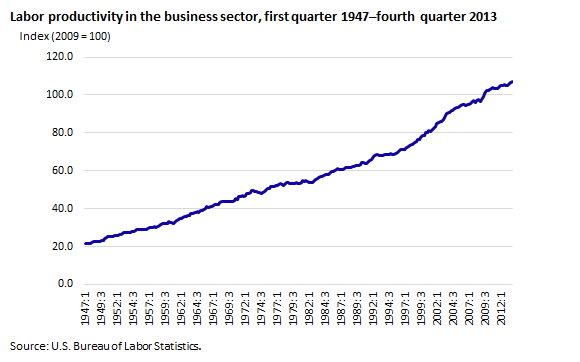
Just between 1973 and 2015, the typical American worker’s output had risen 72 percent. However, their hourly wages have increased only 9 percent. Recently, legislators have argued for a 32-hour week, claiming the extra time off would let workers share in some of the greater earnings made possible by their increased productivity.
Two approaches to abbreviating the week have been proposed: lowering productivity goals or working harder to achieve five days of productivity in four days.
One approach would involve the 100-80-100 model, where workers would receive 100 percent of their current pay to work 80 percent of their old schedule while achieving 100 percent of current productivity levels.
The 4 Day Week Global organization has worked with researchers to study the effects of a shortened week. Studies have been conducted at 200 companies. While the results still need substantiating, it seems the shorter week results in higher worker satisfaction, better health physically and mentally, less fatigue, and less burnout. Just as significant, managers saw benefits with the 32 hour week: improvements in retention, recruitment, sick time, and profitability. Most companies who tried the four-day week continued it after the test period.
A Forbes magazine review of 75 studies of shortened weeks found notably higher health and well-being, improved performance, and positive results for turnover, retention, and sick leave.
But a shorter work week comes with complications. Scheduling becomes difficult. Workers need to change the way they work in order to meet deadlines and quotas. It’s not clear whether the early benefits fade with time. And most importantly, companies may find that not enough work is getting done in an abbreviated week, as one company did.
At least researchers have exhaustive data on one work-week model: 100 years of 40-hour weeks.
Become a Saturday Evening Post member and enjoy unlimited access. Subscribe now




Comments
Given the productivity enhancements technology & Super Intelligence (AI) brings to the table nowadays, I can see that the length of the work week and not necessarily days needs to be revisited. Business needs to be able to be accomplished five days a week, excluding holidays of course. However the worker/employee should not have to work any more than seven hours a day (excluding lunch hour) in a five day work week or nine hours a day (again excluding the lunch hour) in a four day work week. So for example in a five day work week you start each day at 8 or 9 AM and end at 4 or 5 PM or for a four day work week you might start at 7 or 8 AM and end your day at 5 or 6 PM. If I were not retired I would be happy to have either of these options to choose from.