Movies for the Rest of Us with Bill Newcott: Movie Romance
See all Movies for the Rest of Us.
Review: Come to Daddy — Movies for the Rest of Us with Bill Newcott
Come to Daddy
⭐ ⭐ ⭐
Rating: R
Run time: 1 hour 33 minutes
Stars: Elijah Wood, Stephen McHattie, Martin Donovan, Michael Smiley
Writers: Toby Harvard, Ant Timpson
Director: Ant Timpson
Admittedly, the directorial debut of idiosyncratic New Zealand film producer Ant Timpson (The Greasy Strangler) will not be everybody’s cup of tea. But if you like your cinematic tea served with a dash of arsenic and a teaspoon of bile, this gleefully twisted tale of intergenerational angst might be the sip you’ve been waiting for.
From the start, Come to Daddy parachutes us into a world of ominous peril. We meet Norval (Elijah Wood), a 30-something man-child, as a bus drops him off in the middle of a dense forest. From there, following a hand-drawn map, he picks his way to a rustic but dramatic seaside house that seems a cross between The Cabin In The Woods and Dr. No’s volcano lair.
Tentatively, he knocks on the door. It swings open to reveal a gaunt, bearded, clearly agitated old man.
“Dad?” the young man blurts — and we’re off to the races. Needless to say, this is no Hallmark Channel reunion: There’s quite a bit of blood, gratuitous violence, and squirm-inducing gore in the offing.
To say much more about the plot would spoil the many wild 90-degree turns Come to Daddy negotiates, each more outlandish than the last — yet each surprisingly acceptable in Timpson’s narrative universe. Central to the film’s success is Wood as a man who is clearly damaged, yet who even as all Hell breaks loose remains determined to forge some sort of relationship with the man who abandoned him at age five (it’s no accident that more than one character comments on his wide, blue, innocent eyes).
Amidst all the mayhem, Come to Daddy never loses its off-kilter sense of humor. The characters, each stamped with their own defining quirk, speak in a sort of formalized prose that brings operatic gravity to their conversations, both mundane and threatening. Most importantly, the film remains at heart a father-son story; a blood-spattered meditation on the human bonds that can’t be snapped, no matter how hard we tug.
Come to Daddy ends with a written tribute to director Timpson’s own father, a pithy text that goes some distance to explaining what we’ve just seen. By that point, even seasoned thriller fans will have given up trying to predict what will happen next and surrender to the film’s fever dream narrative. It’s the kind of thriller where, even as the most horrendous events unfold, you get the distinct feeling that everyone involved is having a wonderful time.
Featured image: Elijah Wood in Come to Daddy (Saban Films / Tango Entertainment)
Patton: Five Facts on the Film at 50
They say the very act of putting a story on film, however true its source material may be, immediately mythologizes it. But what does it do when the figure it represents is already a kind of mythic enigma? That’s part of the intrigue surrounding Patton, the 1970 classic about General George S. Patton, the heavily decorated commander that cut such an important figure in World War II. Here’s a closer look at the celebrated film, which arrived in theaters 50 years ago today.
1. Coppola Got Fired Before Winning an Oscar.
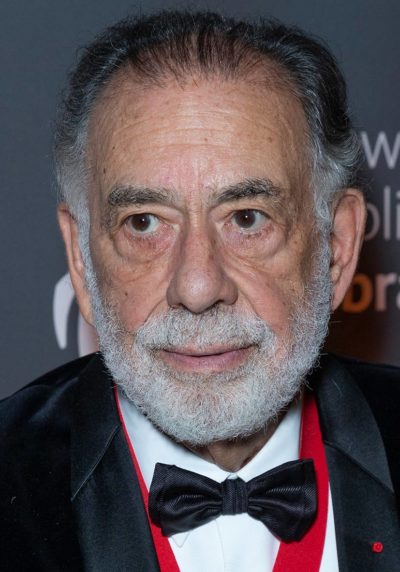
Francis Ford Coppola has a sterling reputation in film, but he hadn’t been around too long when he co-wrote the screenplay for Patton with Edmund H. North. Still, he was seen as an up-and-comer whose films like The Rain People were drawing notice. Nevertheless, the studio wasn’t wild about his concept for an incredibly stylized opening featuring Patton addressing unseen troops while standing in front of a massive American flag. Coppola’s refusal to compromise on the approach led to his dismissal; however, star George C. Scott said he wouldn’t play the title role unless they used the Coppola-North draft. It turned out to be a good call for everyone involved, as the screenplay ended up winning an Oscar.
2. The Opening Became an Instant Classic.
The opening scene of Patton. (Uploaded to YouTube by Movieclips)
Speaking of that opening, that no-nonsense speech set the tone for Scott’s no-nonsense portrayal and got audiences talking. Since that time, it’s been quoted and parodied in everything from sitcoms to animation. There is one line that hit’s close to home, as Patton takes a moment to rail against generals that celebrate the individuality of troops in The Saturday Evening Post. To the best of our understanding, the real Patton took umbrage with a profile from the magazine, possibly one of the “These Are the Generals” series of profiles that ran in 1943. We couldn’t find the exact segment that might have aroused the general’s ire, but it’s a line that’s nevertheless immortalized onscreen.
3. The Film Won a Battlefield’s Worth of Awards.
The film follows Patton from 1943 to 1945, starting with his assumption of command in North Africa to the rebuilding process in Germany. Scott plays Patton with steely conviction and an unwillingness to compromise that put the real general through a cycle of losing and regaining various commands. Patton proves himself repeatedly, particularly during The Battle of the Bulge at Bastogne. The epic approach and Scott’s performance powered the film to 10 Academy Award nominations. It took seven, including Best Original Screenplay, Best Actor (for Scott), Best Director (for Franklin J. Schaffner), Best Film Editing, Best Sound, Best Art Direction, and Best Picture.
4. George C. Scott Didn’t Accept.
Despite the fact that Scott won Best Actor, he refused to accept it. The declination was a matter of principle for the performer, as he had no love for either the voting process nor the entire notion of competitive prizes for acting. However, Scott did accept his acting recognition from the New York Film Critics Circle; according to the book Inside Oscar by Mason Wiley and Damien Bona, Scott’s wife at the time, actress Colleen Dewhurst, said, “George thinks this is the only film award worth having.”
5. There Was a TV Sequel.

While the film continues to be regarded as a classic piece of cinema, many fans don’t realize that Scott actually returned to the role in a made-for-TV film in 1986. The Last Days of Patton, quite literally, covers the last days of Patton. On December 9, 1945, one day before he was set to return to the U.S. from Germany, Patton was in a car accident that paralyzed him. The film covered various moments of his life in flashback. He died in his sleep on December 21, and was interred at the Luxembourg American Cemetery and Memorial. Patton himself had chosen the cemetery, as he wanted to be buried alongside the men he’d commanded while leading the U.S. Third Army.
Featured image: TopFoto / Alamy Stock Photo
Movies for the Rest of Us with Bill Newcott: Second to Nun
See all Movies for the Rest of Us.
Featured image: Whoopi Goldberg, Kathy Najimy, Ellen Albertini Dow, Edith Diaz, and Mary Wickes in Sister Act (Touchstone Pictures)
Five Things You Didn’t Know About the 4077th (M*A*S*H)
In today’s entertainment climate, everyone is familiar with (at least the idea of) the multimedia property. A single piece of entertainment can blossom into a micro-industry that generates spin-offs and seemingly endless merchandise. Of course, that’s not a new practice at all. Fifty years ago this week, MASH: A Novel About Three Army Doctors made the jump to film as the award-winning M*A*S*H. The film led to the classic TV series, which in turn led to an entire series of novels, two other TV series (in a way), and even a line of action figures. Here’s the story of how one man’s reflections on Korea became a comedy classic.
1. The Author Wasn’t Really a Hooker.
The original novel by “Richard Hooker” is actually a pseudonym used by Hiester Richard Hornberger Jr., a graduate of Cornell Medical School who served in Korea. He was assigned to the 8055 Mobile Army Surgical Hospital (which is, of course, what MASH stands for). After the war, Hornberger went into private practice and worked off and on with the material for 11 years. Following a round of rejections from publishers, he recruited sportswriter W.C. Heinz to help him. They sold it soon after; the book was a hit upon its 1968 publication.
2. The Movie Struck Gold in More Than One Way.
The trailer for the film version of M*A*S*H (uploaded to YouTube by Movieclips Classic Trailers)
Ring Lardner Jr. adapted the novel into screenplay form, and Robert Altman sat in the director’s chair. The cast included a number of familiar faces, like Elliot Gould, Donald Sutherland, Tom Skerritt, Robert Duvall, and Sally Kellerman. Gary Burghoff played Radar O’Reilly, a role he would reprise in the TV series. The film earned plaudits right out of the gate; in addition to being financially successful, it racked up an impressive run of awards. The film earned the Grand Prix du International du Film (now called the Palme d’Or) at Cannes in 1970. It took the Golden Globe in the Musical or Comedy Category, and it was nominated for five Oscars, including Best Picture, winning for Best Adapted Screenplay. Ironically, whereas M*A*S*H was a film that looked at the horror of war through the lens of comedy, it lost most of those Oscar nominations to the very serious Patton. Though the film took pains to establish that it was indeed set in Korea, the audience could certainly sense the undercurrents that paralleled the contemporaneous Vietnam War.
3. The TV Series Lost Two Major Movie Characters.
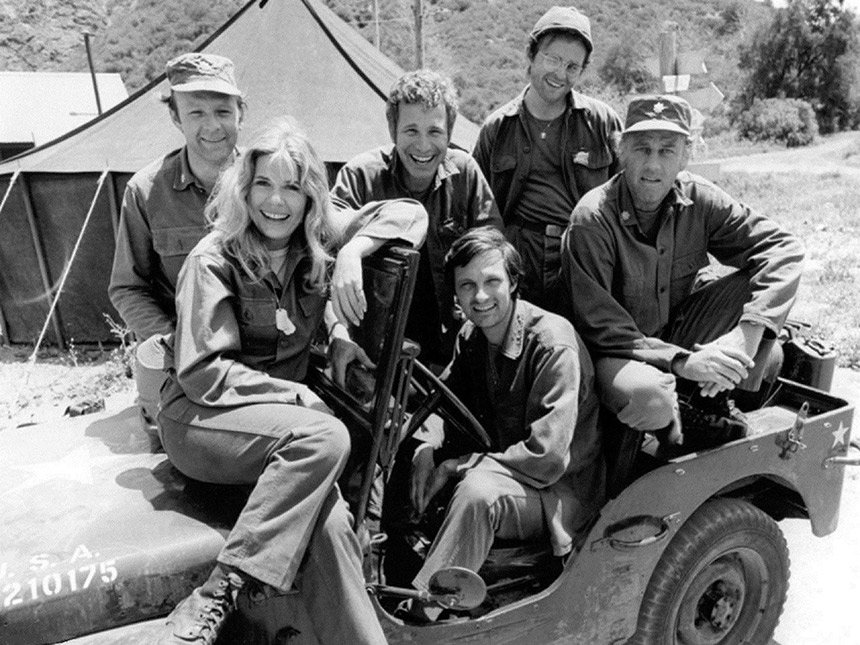
Fans of the film will remember Duke Forrest as a major character; he’s right there alongside Hawkeye and Trapper John. However, he’s completely absent from the TV series. That’s because the producers offered Skerritt the chance to take the character to TV, and he declined; with that, they decided not to include Forrest at all, save for a throwaway line in Season 3 that indicated someone named Forrest had shipped back home two years prior. As mentioned, Gary Burghoff was the only actor to move from the film version to the TV show. One character that did make the transition to the small screen, but didn’t stick around was the indelicately nicknamed Captain Oliver Harmon “Spearchucker” Jones. Jones was both a book and film character, played in the movie by Fred Williamson. Timothy Brown played him in the first few episodes of the series, but he was phased out over the writers concerns about dividing the focus from Hawkeye and Trapper and an inaccurate perception that there weren’t black surgeons in the army during Korea (there, in fact, were).
4. The TV Show Got a Huge Send-Off.
M*A*S*H wound up being a huge hit on the tube, covering 256 episodes and 11 seasons, with nine of those seasons spent in the ratings’ Top Ten. When it came time to wrap it up, it did so with a 2-1/2 hour finale that was watched by more than 125 million viewers in 1983. It remains the most-watched single episode and most-finale of a TV series. You can watch it today on a variety of streaming platforms.
5. The Book Series Went On, TV Spin-Offs Came and Went, and Other MASHendizing.

M*A*S*H Goes to Maine, the first sequel to the novel, was released in 1972, the same year the TV series debuted. It detailed the lives of the original cast after the Korean War. William E. Butterworth came on as Hooker/Hornberger’s co-writer, and they released 12 more novels up through 1977. That year, Hooker wrote one final, solo novel in the series, M*A*S*H Mania. The post-war years (though vastly different than the books) were followed up in the short-lived spin-off AfterMASH and the aborted pilot W*A*L*T*E*R, which would have focused on Radar’s life as a police officer. One non-canonical spin-off that had a long life was the series Trapper John, M.D. A quirk of the rights to the franchise allowed for the character to be spun off from the film, rather than the TV series; the modern-day set show featured Pernell Roberts in the lead and ran for seven seasons from 1979 to 1986.
Despite the relative lack of success for follow-up TV shows, M*A*S*H merchandise of various kinds has sold well over the years. In addition to the obvious books sales and various home video releases, MASH and 4077th hats and t-shirts remain available in a variety of styles. Perhaps the two most curious additions to the M*A*S*H mythos would be the 1983 Atari 2600 video game and the Tri-Star toy line. In the Atari game, you fly a helicopter to rescue soldiers in the field and then operate on them. While Durham did put out two nine-inch figures in 1975 (intended to be Hawkeye and Hot Lips), the real line that collectors remember hit stores and catalogs in 1982. Made in the popular 3-3/4” scale (like original Star Wars figures), the line included eight figures; Klinger was represented in both his fatigues and in one of his drag outfits. There was also an ambulance, jeep, helicopter, and 4077th base playset.
Featured image: Entertainment Pictures / Alamy Stock Photo
After 100 Years, Fellini’s Dreams Still Resonate
Every summer, a handful of tourists in Rome — sometimes naked and usually drunk — take a dip in the shallow waters of the Trevi Fountain. Because the Baroque landmark is guarded constantly by Roman police officers, the misguided swimmers are often caught and fined (400 euros and up).
Whether or not they are aware of it, their illicit bathing is an homage to Anita Ekberg’s iconic swim in Fellini’s 1960 film La Dolce Vita. Her character Sylvia, a bodacious actress, wades into the fountain at night, swaying underneath the waterfall issuing from the giant Oceanus statue in the center. She beckons Marcello, a tabloid journalist, to join her before baptizing him in the water. Soon, he awakens behind the wheel of his Triumph TR3.
Such dreamlike scenes are customary in the films of Italian director Federico Fellini. Throughout his career, spanning postwar Italy to the 1980s, Fellini became one of the most famous movie makers in the world with his expressionist romps that explored fame, fidelity, and the human subconscious. Today is the 100th anniversary of his birth.
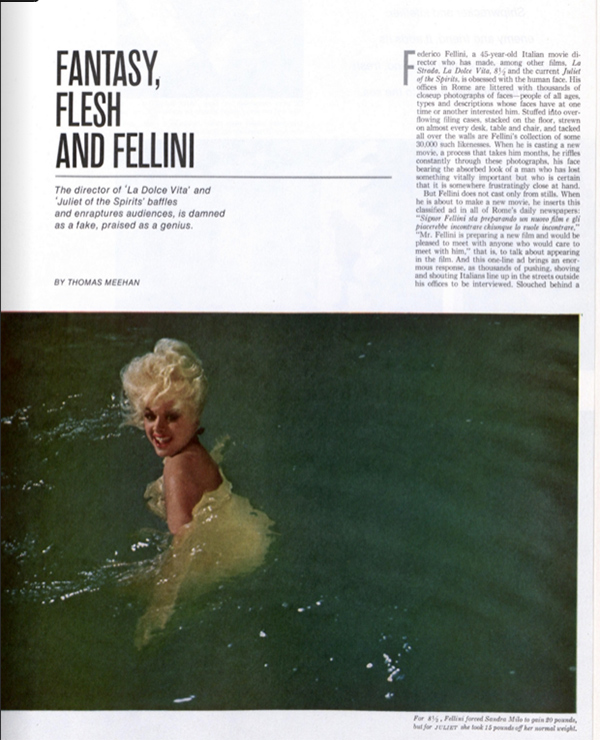
In the 1960s, Fellini was gaining momentum with one blockbuster success after another. Although his films were making a fortune, the director wasn’t seeing much of the money due to some poor financial decisions. In 1966, the Post published a profile of the Italian auteur called “Fantasy, Flesh, and Fellini.” The story paints Fellini as a larger-than-life artist, claiming he worked ungodly hours and followed a rigorous casting regimen, meeting thousands of everyday Italians before choosing the faces to put in his movies.
Fellini had a reputation, corroborated by the Post’s profile, for being extremely eccentric, bordering on narcissistic, and all for the sake of uncompromising artistic vision. Just as his fans may have imagined, writer Thomas Meehan claimed he pored over characters and scenarios for months before improvising entire film shoots, and he manipulated actors with his charm and punishment to elicit perfect performances.
His films were largely autobiographical, with his wife Giulietta Masina often playing a lead role (and sometimes portraying herself). Their rocky marriage, and his womanizing inclinations, were on display in his back-to-back films 8 ½ and Juliet of the Spirits. Amid the fantastical and supernatural happenings in both movies are two separate stories of the inner strife and sexuality of Fellini and Masina, told, respectively, from each point of view.
“I set about creating films perhaps in the way that Marco Polo sailed for the Orient,” Fellini told Meehan, “not knowing really what may happen along the journey or where the end may lie — on a voyage of discovery.” It isn’t beyond belief that Fellini would direct this way, to watch his films. Scenes from films like Roma, La Dolce Vita, and City of Women often feel as guided by large-scale contrivances as they are by natural improvisation.
Although Fellini won four Oscars for Best Foreign Language Film, he never took home the award for Best Director.
His meditations on honesty, infidelity, sensuality, and — especially — the vacuousness of fame were novel in the 1960s and ’70s, but they remain as relevant as ever. Regardless of whether or not Fellini would actually act out each scene in full for his performers before shooting or work himself into a violent rage over an unsatisfying performance, his movies speak for themselves.
At the Trevi Fountain, Fellini’s La Dolce Vita, with its portrayal of people in a vapid race for fame and fortune, resounds during the daytime as sunhatted tourists battle for the perfect selfie spot. After midnight, when the crowd has thinned and the sound of Oceanus’s waterfall echoes around the cobblestone streets, Fellini’s dreams seem a little closer to reality.
My Top Ten Fellini Films:
- Juliet of the Spirits
- La Strada
- Amarcord
- Satyricon
- La Dolce Vita
- I Vitelloni
- 8 ½
- Nights of Cabiria
- Roma
- City of Women
Featured image: Marcello Mastroianni in 8 1/2 (Wikimedia Commons / public domain)

Review: Just Mercy — Movies for the Rest of Us with Bill Newcott
Just Mercy
⭐ ⭐ ⭐ ⭐ ⭐
Rating: PG-13
Run Time: 2 hours 16 minutes
Stars: Michael B. Jordan, Jamie Foxx, Brie Larson
Writers: Destin Daniel Cretton, Andrew Lanham, based on Bryan Stevenson’s book
Director: Destin Daniel Cretton
Not all good-for-you movies are actually all that good. Just Mercy, populated by monumental performances and powered by a story of uncommon courage, is by every measure a great film.
For more than 30 years, civil rights lawyer Bryan Stevenson has been toiling to rescue wrongly accused or unfairly sentenced death row inmates — the overwhelming majority of them African American — from execution. Just Mercy the book covers decades of outrageous and tragic cases nationwide, but Just Mercy the movie focuses on Stevenson’s earliest: Three men facing the electric chair in Alabama during the 1980s.
As Stevenson, Michael B. Jordan (Creed, Black Panther) bristles with indignant compassion. More importantly, his performance traces the young lawyer’s exodus from an idealistic neophyte who sees himself as the principled outsider/savior of these men to a profoundly changed, intimate participant in their personal tragedies. Jamie Foxx plays an innocent man wrongly placed on Louisiana’s Death Row, and here he reclaims his place as one of the screen’s most thoughtful actors. Hollow-eyed, physically and emotionally depleted, Foxx brings harrowing immediacy to the role of a man who has relinquished all hope of escaping his date with the chair — and who at first views Stevenson with justified skepticism.
The richness of Just Mercy’s tapestry is enhanced by some wonderfully defined supporting performances. Rob Morgan is heartbreaking as Herb, a PTSD-afflicted client who mournfully admits he did, indeed, plant the bomb that has landed him on Death Row. His final scenes, as a man torn between accepting his punishment and rejecting the inhumanity of the process that brought him to this moment, bring stark reality to the awful finality of the death penalty. O’Shea Jackson Jr. brings unexpected warmth to the role of Anthony, another client whose assigned punishment far outstrips his offense — the victim of a culture that considers black lives dispensable in the service of making a point. As Stevenson’s assistant, Brie Larson (Room) serves as our stand-in, sharing our growing exasperation as the racist underpinnings of the justice system throw one roadblock after another in her boss’s path. And Tim Blake Nelson — most memorable as one of George Clooney’s fellow escapees in Oh Brother, Where Art Thou? — turns the thankless role of Ralph Myers, a semi-repentant jailhouse snitch, into a thing of wonder. Squirming in the witness chair, all twitches and grumbles, Nelson’s backwoods bigot drags himself, kicking and screaming, to defying the institutional racism that has until this moment defined his life.
Likewise, a word must be said for the essential, if minor, character of a prison guard played by Hayes Mercure. We barely notice the guy at first — he’s just another white-faced keeper in a human warehouse — but with marvelous subtlety and measured authenticity, Mercure’s guard grows to understand that these men are far more human than the mere animals he’s been trained to see. His shift toward the light is, admittedly, little more than an emergence from the darkest of shadows, but with few lines and just a little screen time, Mercure provides us with a spark of hope; the possibility that people can change.
Movies like Just Mercy inevitably find themselves tagged as “Oscar Bait,” a derogatory term in an industry that too often casts a cynical eye on big-name dramas that explore social injustice through closely observed personal stories. But that attitude does Just Mercy a criminal injustice: co-writer/director Destin Daniel Cretton (Short Term 12) never goes for cheap sentiment. His characters face difficult choices, and don’t always make the right ones. Like the real-life hero at its center, Just Mercy sees what is happening in America’s legal system and asks the question: “How can you not take this personally?”
Featured image: Michael B. Jordan as Bryan Stevenson and Jamie Foxx as Walter McMillian in Warner Bros. Pictures drama, Just Mercy, a Warner Bros. Pictures release. Copyright: © 2019 WARNER BROS. ENTERTAINMENT INC. Photo Credit: Jake Giles Netter
Seriously Good Films for January 2020
Just Mercy (January 10)
Blood, sweat, and tears stain every frame of this screen rendition of civil rights lawyer Bryan Stevenson’s book, a scathing indictment of America’s legal system. The book covers more than three decades of outrageous cases of wrongly accused or unfairly sentenced death row inmates — the majority of them African American — but the movie focuses on Stevenson’s earliest case: A pair of men facing Alabama’s electric chair in the ’80s. This superstar cast, including Michael B. Jordan, Jamie Foxx, Brie Larson, Rob Morgan, and Tim Blake Nelson, could well form an impromptu parade on Oscar night.
Uncut Gems (December 13)
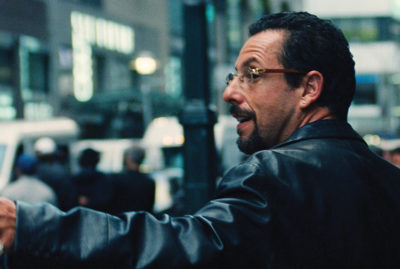
Adam Sandler has played straight drama before, but nothing like this adrenaline-pumped film. Director brothers Benny and Josh Safdie’s (Good Time) manic camera work, overlapping dialogue, and in-your-face style are made all the more disorienting by Sandler’s Howard Ratner, a jittery Manhattan jeweler who is always on the lookout for a quick buck. Up to his neck in gambling debt, Howard finds himself in possession of an opal-embedded rock he’s convinced will enable him to finally pay everyone off. But it’s not that easy. Everybody hates Howard, including his wife and his girlfriend, but like a black hole, he draws everyone, including us, into his self-destructive event horizon.
Truth Be Told (Streaming on Apple+)
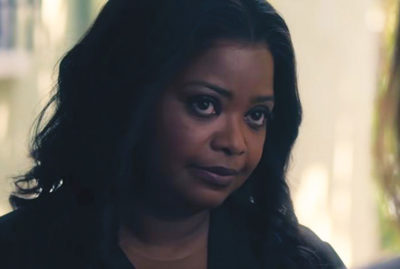
Making a huge splash with its new streaming service, Apple snared Oscar winner Octavia Spencer to star in this series as Poppy Parnell, a San Francisco true-crime podcaster trying to free a man wrongly convicted of murder (Breaking Bad’s Aaron Paul). The twist: It was Poppy’s newspaper reporting that helped put the accused 16-year-old behind bars for life 19 years earlier. Elizabeth Perkins is powerful as the accused’s mother, stricken with terminal cancer but pursuing her son’s exoneration with steely resolve. And then there’s Poppy and her serene authority, patiently unraveling new clues that seem to pile up by the minute.
For biweekly video reviews of the latest films, go to saturdayeveningpost.com/movies or check out Bill Newcott’s website, moviesfortherestofus.com.
This article is featured in the January/February 2020 issue of The Saturday Evening Post. Subscribe to the magazine for more art, inspiring stories, fiction, humor, and features from our archives.
Featured image: Courtesy Warner Bros.
Movies for the Rest of Us with Bill Newcott: Classic Cat Movies
See all Movies for the Rest of Us.
Hallmark’s Formula for a Very Sappy Christmas
In the new Hallmark movie Holiday Date, Brooke has been dumped just before Christmas by her sleek, professional beau — he’s “going to be really busy with this project” — and her English-accented boss poo-poos her classic clothing designs in favor of more “cutting edge” fashion. Joel is an actor up for a big role playing a small-town hero, and their friends think it’s a good idea for Brooke to take him back to her hometown, Whispering Pines, for the holidays to pose as her boyfriend. “I can’t believe we’re doing this,” Brooke says as they cruise across the wintry landscape in a baby blue Mini Cooper. He lets out a fake boyfriend chuckle: “I know, it’s crazy, isn’t it?”
It’s not that crazy, though.
At least, not in the Hallmark cinematic universe. The phony boyfriend or girlfriend plot device also appears in Holiday Engagement, The Mistletoe Promise, Hitched for the Holidays, A December Bride, Snow Bride, and A Christmas for the Books, to name a few.
By now, Hallmark is a well-known holiday movie machine. This year is the 10th anniversary of Hallmark Channel’s “Countdown to Christmas,” a two-month-long nonstop marathon of garland-wrapped, hot cocoa-fueled, gentle holiday romance. The greeting card company — through their subsidiary Crown Media — has effectively cornered the market on Christmas cable programming for younger and middle-aged women, and this year they’ve released 40 new Christmas-themed made-for-TV movies between their networks Hallmark Channel and Hallmark Movies & Mysteries.
This past summer, I visited my parents, strolling into my childhood home and beholding — on their new flat screen TV — a cheesy Christmas movie. In July! I accosted my mother, wondering how she could live with herself watching Hallmark Christmas movies during tomato season. But they were running a special marathon, “Christmas in July,” and she wasn’t alone in cozying up to holiday movies with the air conditioner running. What could possibly be the appeal of these movies? I thought to myself as we sat through the third one in a row.
“If you’ve seen one, you’ve seen them all” was never more applicable than to the Hallmark oeuvre. (2014’s A Cookie Cutter Christmas displayed an eerily self-aware title.) Any fan of the franchise is well aware of the formula: a man and woman meet under awkward circumstances, stumble slowly toward romance, and finally share a brisk kiss under the glow of a thousand Christmas lights. There are recurring themes, like the virtues of slower, small-town life over the cold, hectic city, or the importance of listening to your heart and following where it leads (incidentally, it leads an inordinate segment of Hallmark characters to stake out their lives in pastry bakeries and tree farms). The most important virtue, however, is the love of Christmas and belief in its fateful magic.
The company has fashioned its own film genre out of wealthy suburban culture and happy endings, but it didn’t always used to be that way.
In fact, the last decade or so of Hallmark’s television programming is a departure from their media legacy. Since the dawn of broadcasting, the company has been known for culturally significant, acclaimed drama. Their pivot to feel-good seasonal romance says as much about the Hallmark brand as it does about us, the viewers, and what we hope to gain from watching them.
In the 1930s and ’40s, after a few decades of success selling greeting cards and wrapping paper, the Hall brothers of Hallmark decided to get into the radio game. They began by sponsoring shows like Tony’s Scrapbook, a folksy poetry program that a 1932 Time magazine review claimed was “regarded by a shuddering minority as the most offensive broadcaster on the air” for the host’s sentimental, rustic demeanor. Hallmark also sponsored Meet Your Navy and Radio Reader’s Digest as the company navigated national growth.
Then, in 1948, Hallmark went off on its own with Hallmark Playhouse, a radio drama program to replace their partnership with Reader’s Digest. Hallmark Playhouse was to be a new kind of show, one that delved into the annals of literature to find worthy, sometimes obscure authors and titles for dramatic readings, with author James Hilton, and later Lionel Barrymore, as the host. Hallmark Playhouse broadcast readings of Edna Ferber, Carl Sandburg, and Ring Lardner with stars like Irene Dunne, Bob Hope, and Gregory Peck lending their voices. Stephen Vincent Benét’s “The Devil and Daniel Webster” and Rose Wilder Lane’s Free Land (both found in the pages of The Saturday Evening Post) were also dramatized on Hallmark’s acclaimed anthology show.
On December 22, 1949, “The Story of Silent Night” aired, dramatizing the origin of the Christmas song, with a children’s choir, sound effects, and original music by Lyn Murray. Media scholar John V. Pavlik wrote about how the episode underscored “the extraordinary resources, intellectual capital, and pure talent that went into creating a program such as the Hallmark Playhouse, a program that consistently produced the highest levels of production quality and value.”
Two years later, in August 1951, founder J.C. Hall excitedly announced to the company that Hallmark would “try our hand at television.” Corporate sponsorships of television dramas were common. In Texaco Star Theater, Milton Berle was hosting an unpredictable hour of comedy and music, and Goodyear (or Philco) Television Playhouse brought original drama to the screen from up-and-coming writers and actors. The first Hallmark Television Playhouse broadcast was on NBC on Christmas Eve, 1951, and it was unlike anything seen on American television before. Amahl and the Night Visitors was a live opera, composed for television by Pulitzer winner Gian Carlo Menotti, telling the story of the three wise men from the point of view of a young peasant boy.
Hallmark Television Playhouse (and later Hallmark Hall of Fame) aired weekly for several years, before scaling back to monthly, then seasonal, episodes. Throughout the ’50s and ’60s, the series became a unique television event, bringing classic stories and big actors to the small screen. Maurice Evans played Richard II, Judith Anderson played Lady Macbeth, and Christopher Plummer and Julie Harris starred in A Doll’s House. Hallmark claims that more people tuned in for the 1953 broadcast of Hamlet than had cumulatively seen the play performed on stage in 350 years.
Although many programs from the “Golden Age of Television” disappeared, Hallmark Hall of Fame held strong. The format and content changed, but the series continued to present classic stories and problem dramas on primetime TV with big-name actors. In 1986, James Garner and James Woods starred in Promise, a drama depicting the arduous task of caring for a sibling suffering from schizophrenia. Far from saccharine, Promise holds up as a sensitive portrayal of the toll of mental illness on relationships. The film got a DVD release, but you won’t find it, or virtually any other Hall of Fame movies, on any streaming service.
In a 2009 CBS story on the enduring legacy of Hallmark Hall of Fame, Ron Simon, of the Paley Center, said “Hallmark has been around almost the entire history of American broadcasting, it’s one of the few institutions that sort of remain unchanged from postwar America into 21st-century America.” The Hall of Fame series has won 81 Emmys, the most recent of which was 2009’s The Courageous Heart of Irena Sendler.
Their ratings began to falter however, and in 2011, CBS dropped the program. Hall of Fame found little success at ABC, and, eventually, Hallmark moved the franchise over to their own cable channel, where they’d already been experimenting with a new strategy for made-for-TV movies that didn’t require period costumes, classic scripts, or much dramatic conflict at all.
The most recent Hallmark Hall of Fame release is called A Christmas Love Story. Starring Kristin Chenoweth and Scott Wolf, the story follows an ex-Broadway star who finds love, and inspiration for a new song, while teaching a children’s choir in New York City. Aside from some long-lost-parent drama, the film is nearly indistinguishable from Hallmark’s other holiday fare, with all of the same Christmas glitz and cloying courtship as A Shoe Addict’s Christmas or Two Turtle Doves.
Michelle Vicary, the executive vice president of programming for Crown Media, recently told Parade magazine that “People need to feel good and they need comfort, so, it’s an honor to bring that to people.”
Even though we’re familiar with all of the actors, we can predict the plot, and we might even recognize that gazebo in the final scene that’s lit up like an oversized tanning bed, we keep watching, year after year. And Hallmark knows it. They hope to capture the hearts of 100 million viewers this year over last year’s 85 million.
Hallmark has expanded its holiday offerings, and last year they released the Hallmark Movie Checklist App to help viewers keep track of the listings. This year, Hallmark sponsored the first Christmas Con in Edison, New Jersey, where fans could meet some of their favorite Hallmark stars and bask in some curated Christmas cheer.
Online, Facebook groups, numbering in the tens of thousands, are filled with Hallmark fans — mostly women — posting about their favorite movies. Many of their interactions muse on the movies’ similarities or the attractiveness of male leads. Others share photos of their decorated Christmas trees or a serendipitous snowfall right before the holidays.
I talked to Jennifer, 36, from Durham, North Carolina who moderates a subreddit group dedicated to Hallmark Movie fans. “I used to like watching Lifetime movies,” she says, “but they started to get a little too ridiculous and dramatic, so I had to walk away. I started watching Hallmark Hall of Fame movies at night when I couldn’t sleep, and they just made me feel at home, no matter how depressed or sad I was.”
Jennifer was orphaned at a young age, so she says she enjoys watching a family in a Hallmark movie having a nice holiday. Also, her 12-year-old son is autistic, and she says the movies inspire her to make Christmas special for him by doing things like baking cookies and decorating a tree. “I just love how sappy Hallmark movies are,” she says. “Everything is always alright at the end, which is just the opposite of real life.”
For Hallmark, the promise of comfort might be increasingly more difficult to keep.
Hallmark has faced criticism about the lack of diversity in their casting, and, just recently, they came under fire for taking down ads that featured two women kissing (Hallmark has since reinstated the ads and apologized). In the most current incarnation of Hallmark’s made-for-TV world, divisive politics don’t exist, along with poverty, mental illness, or war. The worst fate a Hallmark character could succumb to is working late on Christmas. Hallmark’s preoccupation with manicured small towns and contrived joy begs the question of whether they’re selling nostalgia or fantasy.
In Holiday Date, when Brooke’s pretentious European boss tells her she should design edgier clothing, the winsome blonde snaps back: “You know, the history of fashion shouldn’t be ignored. There’s a lot to be learned from the past and how it shapes who we are.”
“Of course that’s true! But you’re only inventing a past that comforts you!” I shouted at the television. And my mom told me to shut up and enjoy the movie.
Featured image: Shutterstock
The OTHER Classic Christmas Movies
You know It’s a Wonderful Life and Miracle on 34th Street; you know A Christmas Story and Meet Me in St. Louis.” There’s certainly an authentic canon of Christmas and holiday films in the American library of classics. However, in recent years, other films that take place at Christmas has become something of an ongoing cocktail party discussion. Here are 10 Other Christmas Classics.
10. The French Connection (1971)
The trailer for The French Connection. (Uploaded to YouTube by Movieclips Classic Trailers)
Your first thoughts of The French Connection are probably “that car chase” or the boatload of awards it won (which included Oscars for Best Picture, Director, Actor for Gene Hackman, Editing, and Adapted Screenplay). But if you recall the opening, it features Hackman’s Popeye Doyle getting involved in a police action while wearing a seasonally appropriate stakeout disguise: a Santa Claus suit.
9. Edward Scissorhands (1990)
The trailer for Edward Scissorhands. (Uploaded to YouTube by Movieclips Classic Trailers)
The first of eight (and counting) collaborations between director Tim Burton and actor Johnny Depp, Edward Scissorhands is another of Burton’s dark outsider fables. The titular Edward was built by an elderly inventor (Vincent Price, in his final role) who gave him his special hands for utilitarian purposes; unfortunately, the old man dies before he can give Edward regular hands. Discovered by Peg Boggs (Dianne Wiest), he’s brought to live in the Boggs home where he falls in love with their daughter, Kim (Winona Ryder). Much of the movie is a satire of suburbia and conformity, but things that a turn for the Gothic during a fateful Christmas season. The amalgam of tragic circumstances, the Frankenstein-esque reaction of the neighborhood, and Burton’s visuals tie this off as a dark parable that’s inextricably bound to the holiday.
8. Better Off Dead (1985)
The trailer for Better Off Dead. (Uploaded to YouTube by HD Retro Trailers)
This one belongs in the class of “Movies That Probably Wouldn’t Get Made Today.” It certainly has a controversial premise; after aspiring skier Lane Myer (John Cusack) is dumped by his girlfriend for the captain of the ski team, he makes numerous attempts to kill himself before realizing that there’s more to life than his ex. Of course, the approach of the movie is so off-the-wall and Lane’s “attempts” so patently absurd that it stays deeply in the comedy pocket, even with an incredibly serious issue underneath. One of the comic highlights is the extended, and painful, Christmas celebration at the Meyer home wherein Lane’s mom (Kim Darby) sports a bizarre reindeer suit and passes out gifts like frozen dinners.
7. The Harry Potter Series (2001-2011)
The trailer for Harry Potter and the Sorcerer’s Stone. (Uploaded to YouTube by Movieclips Classic Trailers)
You might be taken aback by two things here, but yes, it HAS been eight years since the last of the original series, and yes, it fits the parameters. Why? With the exception of Harry Potter and the Deathly Hallows Part 2, which takes place in the latter half of what would have been Harry’s seventh school year at Hogwart’s, each film (like the novels) devotes a not-insignificant section of time to Christmas. The fact that Harry gets any presents at all is a big deal in the first movie, and we later see him spending time with the Weasleys over the holidays as well. The series uses Christmas as a focal point to drive home the idea that Harry has managed to assemble a “found family” and an extensive band of allies.
6. Trading Places (1983)
The trailer for Trading Places. (Uploaded to YouTube by Movieclips Classic Trailers)
Who can forget the sight of a drunken Dan Aykroyd in his filthy Santa suit? SNL alum Aykroyd and then-cast member Eddie Murphy powered this socially-aware comedy to box office gold in 1983. And while the plot turns mostly on scheming in the commodities trades and the disruptions caused by Murphy and Aykroyd’s life exchanges, the holiday piece plays a part, particularly in Louis’s (Aykroyd’s) spiral into depression.
5. Gremlins (1984)
The trailer for Gremlins. (Uploaded to YouTube by Movieclips Classic Trailers)
One in a class of horror films that’s inextricably linked to Christmas, but doesn’t abjectly state it (as opposed to the various versions of Black Christmas or the inexplicably-became-a-franchise Silent Night, Deadly Night movies), Gremlins turns on the notion of a bumbling inventor dad getting a last-minute gift for his adult son that turns out to be the adorable Mogwai named Gizmo. Of course, rules are broken and Gremlins are created to the backdrop of well-used holiday tunes and settings, including a Christmas tree ambush. The story could certainly be set at another time of year, but it would lack the resonance of things like the playing of “Do You Hear What I Hear?” leading up to the immortal kitchen battle.
4. Eyes Wide Shut (1999)
The trailer for Eyes Wide Shut. (Uploaded to YouTube by Movieclips Classic Trailers)
Stanley Kubrick’s final film, a rumination on faith, faithlessness, and the secrets that couples keep from one another, is set against the backdrop of Christmas. The yuletide trappings add despondence to the whole affair, but also provide the elements for a somewhat hopeful final scene. Most of the press for the film centered on the fact that it was a sort of erotic thriller starring the then-married Tom Cruise and Nicole Kidman, but it’s more of a psychological experiment; in fact, the story was based on the Austrian book Traumnovelle, which literally means “Dream Story.”
3. Iron Man 3 (2013)
Trailer for Iron Man 3. (Uploaded to YouTube by Marvel Entertainment)
Much like Tim Burton, writer/director Shane Black loves the holidays. Like, really, REALLY loves the holidays. He’s made Christmas central to Lethal Weapon, Edge, The Long Kiss Goodnight, and Kiss Kiss Bang Bang, and he does so in Iron Man 3 as well. Black’s film is, in part, an extended commentary on PTSD; Tony Stark (Robert Downey Jr.) is suffering in the aftermath of the Battle of New York from Avengers, and, like many sad feelings, the holiday only seems to make it worse. Along the way, Christmas music and decorations play ongoing roles, and Stark finds himself in snowy Tennessee for chunk of the film. Thematically, we also see how Stark’s constant attempts at overcompensating (his obsession with upgrading his armors, the giant plush he gets Pepper) highlight his own blind spots at dealing with his issues. He does get in a lovely gift note near the end of the film, when Stark leaves young tech fan Harley Kenner (Ty Simpkins) a roomful of gadgets and gear.
2. Batman Returns (1992)
(Uploaded to YouTube by DC)
The first three Batman films of the Tim Burton/Joel Schumacher era all involved some kind of celebration; Batman had the Gotham Centennial and Batman Forever had Halloween, but Batman Returns claims Christmas. Anyone who’s paid attention to Burton’s work knows that he’s returned more than once to the melancholy notes of the season (which we’ll get to a bit later), but that is well and truly layered throughout this film. Part of the emphasis on winter in Gotham is due to the role of the Penguin, but other themes, like the sexism that surrounds the life of Selina Kyle/Catwoman, work into the narrative; Burton manages to combine them in the final conversation between Alfred and Bruce Wayne. When Alfred wishes the hero a Merry Christmas, Wayne, pondering the events of the film, replies, “Merry Christmas, Alfred. Good will toward men . . . and women.”
1. Die Hard (1988)
The original trailer for Die Hard. (Uploaded to YouTube by Movieclips Classic Trailers.)
Die Hard is, was, and always will be the standard-bearer for non-Christmas Christmas movies. Ostensibly, it’s an action film, with New York cop John McClane (Bruce Willis) trying to save his wife and her fellow hostages from a band of well-armed thieves led by Hans Gruber (Alan Rickman) in Nakatomi Tower (really Fox Plaza) in L.A. From the music over the opening and closing of the film, from the fact that the action centers around a Christmas Eve party, and for dozens of other tiny reasons, this is most certainly a Christmas movie. The final line of dialogue even emphasizes the fact, with Argyle the limo driver speculating on what a McClane New Year’s celebration must be like. And how can you forget one of the most iconic “bad guy kills” in movies: “Now I have a machine gun, too. Ho Ho Ho.”
Featured image: (20th Century Fox; Atlaspix / Alamy Stock Photo)
5 Fun Facts About National Lampoon’s Christmas Vacation
It might seem impossible to believe, but it’s been 30 years since the Griswolds first celebrated Christmas on the big screen. Opening on December 1, 1989, National Lampoon’s Christmas Vacation, where Chevy Chase’s Clark Griswold tries to put together the perfect Christmas at home despite an increasingly large number of houseguests and an ongoing series of disasters, went on to be the highest grossing film in the original Vacation series. It has become a modern holiday classic, earning multiple home video re-releases and special editions while remaining a perennially popular television attraction. Here’s a look behind the extremely bright lights at some of the fun facts behind the film.
1. Don’t You (Forget About John Hughes)
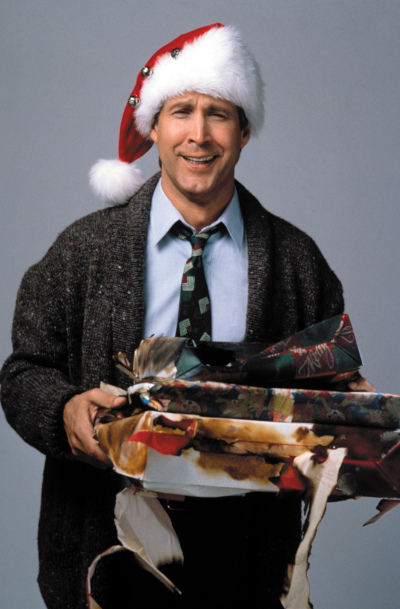
Though he’s held up as the paragon of ’80s teen films, writer/director John Hughes created a number of other films for a variety of audiences, including Mr. Mom and the pirate action film Nate and Hayes. After a start in advertising, Hughes caught on as a writer for the humor magazine National Lampoon, which would soon break into film-producing success with 1979’s National Lampoon’s Animal House. Hughes’s first story for the magazine was “Vacation ’58.” That tale of a family trip became the basis for the first Vacation film, which he wrote. He co-wrote European Vacation with Robert Klane, and then handled the screenplay for Christmas on his own. Like the original film, Christmas Vacation was based on a Hughes/Lampoon piece, “Christmas ’59.”
2. Honey, Who Are the Kids?
The Griswolds are, of course, the central family of the Vacation films. Dad Clark and long-suffering wife Ellen have been played by Chevy Chase and Beverly D’Angelo since the beginning. However, son Rusty and daughter Audrey were played by different actors in each of the five theatrical films. The original Vacation featured Anthony Michael Hall and Dana Barron in the roles. They were followed by, respectively, Jason Lively and Dana Hill in European Vacation, Johnny Galecki and Juliette Lewis in Christmas Vacation, and Ethan Embry and Marisol Nichols in Vegas Vacation. In the 2015 reboot, simply titled Vacation, adult Rusty is played by Ed Helms and adult Audrey is played by Leslie Mann; however, in a great sight gag, all of the other previous actors appear in childhood photos. Barron did play Audrey again in the 2003 made-for-TV film National Lampoon’s Christmas Vacation 2: Cousin Eddie’s Island Adventure, and yes, that really happened.
3. The Music Is Missing (on CD)
Mele Kalikimaka by Bing Crosby (Uploaded to YouTube by Bing Crosby / Universal Music Group)
Two oddities surround the soundtrack and music used in the film. The first is that no soundtrack album was ever released, which is strange when you consider that holiday soundtracks can be perennial sellers regardless of the success or failure of a film; no one’s quite sure why, although a limited edition CD pressing was sold in the 1990s at Six Flags Magic Mountain (which was used as Wally World in the first film) and those discs fetch more than $100 online today. The other is that Christmas is the sole film in the franchise to not use an iteration of Lindsey Buckingham’s “Holiday Road.” A replacement theme, “Christmas Vacation,” was written by Barry Mann and Cynthia Weil, and performed by Mavis Staples. Other prominently featured songs include “Mele Kalikimaka (Hawaiian Christmas Song)” by Bing Crosby and The Andrews Sisters, “The Spirit of Christmas” by Ray Charles, and “Here Comes Santa Claus” by Gene Autry. The instrumental score was done by Angelo Badalamenti, the prolific composing legend most known for his work with director David Lynch.
4. Scene Stealing, the Quaid Way
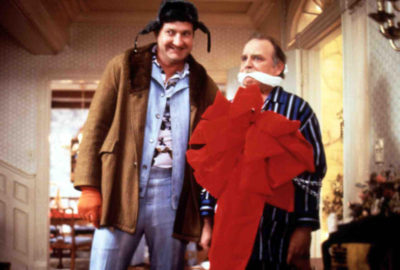
Randy Quaid’s Cousin Eddie is only in the first Vacation film for a few minutes, but he made a deep impression. After missing the first sequel, Eddie and Catherine (Miriam Flynn) came back, and Eddie in particular provided a number of memorable moments. In an oral history of the film conducted by Rolling Stone, Flynn recounted how she and Quaid got into character; she said, “Randy and I always said that all you have to do is put those clothes on us and we were ready to go. Once I remember the costume person said to me, “Randy thinks it’d be funny to have his underwear show through his white pants. What if you did that too?” And I went, “Um, no. That will be just Randy.” In the same article, Chase said, “I loved working with Randy on all of the Vacation movies . . . He just gets right into it. When we’re in the grocery store and he gets that huge 100 pound bag of dog food and slams it down. I don’t think anybody wrote that. That was just Randy reaching out and grabbing it.” Quaid’s Eddie is so iconic of a comedy role that he inspired an exclusive Build-A-Bear Workshop plush of his character this year, complete with signature hat and robe.
5. He’s Chevy Chase, and She’s Not
Of course, the whole franchise doesn’t work without Chevy Chase and Beverly D’Angelo. The duo’s effortless chemistry comes with a real-life friendship that’s been on display not just in films, but in numerous interviews and D’Angelo’s appearance at The Comedy Central Roast of Chevy Chase. Chase was the first of the original SNL cast members to break out in film, putting together a string of comedy successes that included Foul Play, Caddyshack, and Fletch. In fact, the Vacation series would go on to include a number of past and future SNL players (as well as Second City and SCTV alums); in addition to Chase and Quaid, there’s Anthony Michael Hall (who became the youngest cast member ever two years after Vacation), John Candy, Eugene Levy, Brian Doyle-Murray, Julia Louis-Dreyfus, Julia Sweeney, and Fred Willard. Chase has continued to work in comedy for decades, including more recent successes like Community and the Hot Tub Time Machine movies.
D’Angelo has had an amazingly diverse career. After working as an artist for the Hanna-Barbera Studios and singing back-up with The Hawks (before they became The Band), she worked on both Broadway and television before breaking into film with a part in Annie Hall. She’s worked practically non-stop in film and television, appearing in series like Entourage and Insatiable. D’Angelo also has CMA Award for Album of the Year, as she both portrayed and sang as Patsy Cline in the 1980 film Coal Miner’s Daughter.
It’s hard to define what makes a classic, or at least beloved, film. The Vacation movies thrive because they work on simple, relatable premise: families like to spend time together, but it can still be a chore. You can also add Murphy’s Law: if anything can go wrong, it will. Chase imbues his Clark Griswold with a fanatic, almost hopeless, optimism that he’s going to make everyone have fun, even if it kills him. Chase’s genius at physical comedy and unhinged line deliveries play terrifically off of D’Angelo and everyone else around them. What results are outrageous situations that still carry an element of truth. Viewers can say, “That could be my family,” and mean it. It can make the most hardened cynic want to gather around the tree and sing carols (provided of course that the tree is squirrel-free and not, well, on fire).
Featured image: PictureLux / The Hollywood Archive / Alamy Stock Photo
Friday the 13th, or, How to Start a Franchise with an Ad
This is the story of a boy and his mother, and how the mother came to murder a bunch of camp counselors before the boy came back from the bottom of a lake to take over for Mom while wearing a burlap sack over his head, later deciding that a hockey mask was the better look for him. It’s also the story of two guys with a crazy idea, and how they turned an ad into a film series that spans decades.
Of course, we’re talking about the Friday the 13th movie franchise.
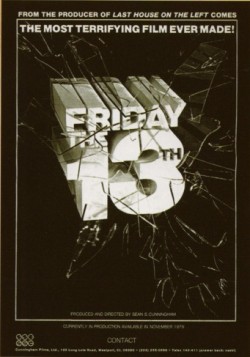
The genesis of Friday came from producer-director Sean S. Cunningham and writer Victor Miller. Cunningham had prior experience in horror, having produced Wes Craven’s The Last House on the Left in 1972. Miller had a varied writing background, which included advertising, television, prose, and film; he wrote two sports comedies in the late ’70s that Cunningham directed. Inspired by the indie success of Halloween in 1978, the two began working from a story that was originally called A Long Night at Camp Blood. However, Cunningham saw the cache of tying the story to a similarly sinister date, and that’s when the unfinished screenplay became Friday the 13th.
Cunningham went one step further. Wishing to stake a claim to the name, he commissioned an ad and placed it in International Variety. The ad, with the stylized title breaking through glass, ran in the spring of 1979, even before Miller finished the screenplay. By fall, the movie was filming; the predominantly young cast included Kevin Bacon, while the pivotal role of Mrs. Voorhees went to Hollywood veteran Betsy Palmer (remember, Jason’s mom is the killer in the first film, with Jason not appearing until the final jump-scare in the lake). As a result of the buzz around the ad and the desire to get in on what could be the next Halloween, several studios contended for the right to release the picture. Paramount bought the rights for $1.5 million, which would turn out to be quite the bargain.
Friday the 13th opened on May 9, 1980, and it was reviled by critics. Audiences, on the other hand, voted with their wallets. The film turned into a huge hit for Paramount — it was the third highest moneymaker for them that year, trailing only Airplane! and Urban Cowboy. It struck financial gold in international release, pulling in another $20 million. The film’s $59 million total haul would have been worth roughly $178 million in 2017 dollars.
The studio knew they needed a sequel. Though Cunningham was more interested in the anthology route, producer Phil Scuderi thought they should continue the story and have Jason be the new killer. Associate producer Steve Miner agreed, and he ended up directing the sequel; it saw a grown-up Jason, wearing a burlap sack over his head, kill the original film’s final girl and go a new murder spree. Miner also directed Friday the 13th Part III (aka Friday the 13th 3D), which owns the twin distinctions of being in 3D and being the film wherein Jason begins wearing his signature hockey mask.
Between 1980 and 2003, ten Friday films and one crossover (Freddy vs. Jason) were produced. A syndicated TV series, cleverly titled Friday the 13th – The Series, launched from Paramount in 1987; though it was overseen by frequent series producer Frank Mancuso, Jr., it had no other connection to the Jason films aside from the name. The action focused on characters trying to retrieve a series of cursed objects; the show did well in its first year and ran three seasons. In theaters, Jason continued on his merry murderous way, but the eighth film, subtitled Jason Takes Manhattan, showed seriously diminishing box office returns.
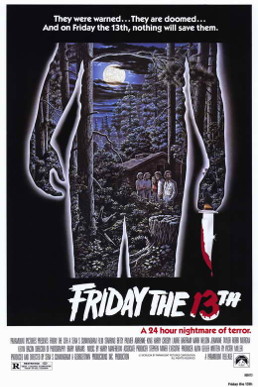
Cunningham got involved again in the late ’80s, helping New Line acquire the rights from Paramount after the eighth film. When Platinum Dunes took over the franchise in the late 2000s, Paramount and New Line remained partners (due to owning particular pieces of the franchise) and Cunningham continued as a producer; that group oversaw the 2009 reboot, Friday the 13th. Since then, the promise of new films has been bogged down in various stages in a legal morass, with ownership and copyright issues abounding. New players, like the production company of NBA superstar LeBron James, have also gotten involved. It seems that everyone wants there to be another film, but no one is quite sure who owns what to what degree, from the screenplay (whose copyright reclamation by Miller has been contested) to various pieces of the lore, each of which may belong to the studio under which each particular film was made. While screenplays have been written and filming plans have been made and scrapped, nothing is certain at this moment.
What is certain is that Jason Voorhees will inevitably return. That is, after all, his thing. From a simple idea to a claim-staking ad, Jason emerged as one of the horror icons of the 1980s. Whereas the 1930s saw Dracula, Frankenstein, and the Wolf Man step up as horror heroes, the ’70s and ’80s inducted Leatherface, Michael, Freddy, and Jason into the pantheon. The hockey mask went from simple sporting protection to an outright symbol of the horror genre.
So we won’t count Jason out. Even if we don’t know which studio or creative team will make the next Friday, we know they’ll make a killing.
Featured image: Shutterstock.com
Review: Linda Ronstadt: The Sound of My Voice — Movies for the Rest of Us with Bill Newcott
Linda Ronstadt: The Sound of My Voice
⭐ ⭐ ⭐ ⭐
Rating: PG-13
Run Time: 1 hour 35 minutes
Stars: Linda Ronstadt, Dolly Parton, Bonnie Raitt, Emmylou Harris, Aaron Neville
Directors: Rob Epstein, Jeffrey Friedman
For 35 precious years, the world reveled in the lilt of Linda Ronstadt’s voice — and then it was gone. This tuneful, sometimes melancholy documentary is packed with classic performances, adoring testimonies, and intimate home movie moments, but you can’t walk away without the sense that although Ronstadt’s career ended too soon, no amount of success would have given the infinitely insecure singer peace of mind.
The saddest list in modern music is that of those whose voices were stilled too soon by death: Buddy Holly, Harry Chapin, Janis Joplin, Otis Redding, and the rest. Nearly as sobering is the chronicle of voices robbed from still-living performers in their prime: Harry Nilsson, Julie Andrews…and Ronstadt, who has not performed in more than a decade due to Parkinson’s disease.
Although she can’t sing anymore, Ronstadt provides a spirited narrative to this documentary following her childhood, early struggles, and skyrocket to fame.
The singer’s insights — and those of many of her collaborators and friends including Dolly Parton, Bonnie Raitt, Emmylou Harris and Aaron Neville — are incisive and revealing. But happily, directors Rob Epstein and Jeffrey Friedman wisely let Ronstadt’s music do most of the talking, offering generous portions of performances rare and immortal.
You don’t reach the level of stardom Ronstadt did without a white-hot fire of blind ambition, and although the film paints a portrait of an artist hell-bent on success, it’s also clear she was also forever doubtful of her own abilities.
Not that she ever backed off from taking a chance. The rock-and-roll diva astonished Broadway audiences when she trilled her way through Gilbert and Sullivan’s Pirates of Penzance. And recording industry bigwigs warned she’d be throwing her career away if she insisted on releasing an album of classic Mexican songs. Ronstadt, whose father was part Mexican, did it anyway. The resulting double-platinum album became the biggest-selling non-English language album in U.S. history.
Telling the story of her darkest days, Ronstadt recalls the bewilderment she felt when, in the early 2000s, she started losing her voice. In 2011 she was diagnosed with Parkinson’s. As a result, she said, “I cannot sing a note.”
As if offering us a small reward for sticking with her through the story of her highs and lows, in a profoundly moving coda Ronstadt joins a nephew and cousin — a bit haltingly but beautifully, still — in singing a Mexican folk song.
“This isn’t really singing,” she protests softly. But there’s more to singing than hitting the notes.
Featured image: Photo Courtesy of Greenwich Entertainment
The Upcoming Cats Movie Looks Absolutely Terrible and I Can’t Wait to See It
In the decades to come, our children’s children will doubtlessly ask us, “What were you doing when the strangest movie trailer of all time was released?”
If you haven’t yet experienced the simultaneously whimsical and nightmarish preview for the long-awaited film adaptation of Andrew Lloyd Webber’s hit stage musical, Cats, do that now. For non-musical theater types and the uninitiated, the upcoming movie appears to present a confusing collage of A-list celebrities, horrifying CGI, and dancing anthropomorphic pets. For those of us well-accustomed to the stage show, it appears the exact same way.
Like a threatening suggestion, the trailer promises, “THIS HOLIDAY SEASON, YOU WILL BELIEVE,” and it beckons the question: Which holiday? Halloween? April Fools’? I want to believe in this bonkers musical adaptation, but there are too many unanswered questions.
Namely, is this actually the best use of our capabilities with computer-generated imagery? And, can the weirdness of an abstract — albeit insanely successful — theatrical production ever again translate seamlessly into a cinema box office hit?
In a behind-the-scenes preview released by Universal Pictures on Wednesday, director Tom Hooper said, “We’ve used digital fur technology to create the most perfect covering of fur,” and many people, including myself, wondered what exactly that would entail. To find out in this (literally) stunning trailer is to question if we all share the same definition of the word “perfect.” Sure, the realism is there, to an extent, but so is an undeniable cognitive dissonance. The much-memed line from Jurassic Park is applicable: “Your scientists were so preoccupied with whether or not they could, they didn’t stop to think if they should.”
A more palatable example of the pitfalls of CGI came with the release of Disney’s “live action” remake of The Lion King. Many reviewers, including NPR’s Justin Chang, lamented the lost emotion from the film’s characters bound up in its display of 21st-century technological prowess. While the hand-drawn animations of the 1994 version gave way to wild and adorable imagery, this new one is, perhaps, “so realistic-looking that, paradoxically, you can’t believe a moment of it.” When Cats opened on Broadway in 1982 (the same year as the release of the sexy, animal horror film Cat People — coincidence?), the players didn’t look exactly like cats. They wore tights and leg warmers and big, new wave hairdos. They understood that the power of suggestion in creating a world was more convincing than photorealism.
That isn’t to say that Cats hasn’t always been an oddity. In its 18-year Broadway run, it mystified many with its shockingly successful combination of plotless poetry, an eclectic musical score, and some sort of alien spaceship ending.
I saw a touring production of Cats in junior high, and afterwards my friend and I waited outside the theater to meet some of the performers. While we waited, we met a middle-aged couple wearing fabric cat ears and tails who “followed” the show. In fact, it had been their hundredth-odd time experiencing the musical. These people are weird, I thought. But that’s exactly who the show is made for. I wasn’t sporting any furry accessories that night, but I was weird too because I willingly attended a deranged, ambiguously sexual, kitty sing-a-long.
Can the new Cats movie exude the same energy? Attract the same cult following? The incredible star power (along with the power of morbid curiosity) assures that it will make money at the box office. Sure, the trailer showcases a load of aesthetic incongruities that forces us to reconcile our relationship with reality, but maybe it’s the musical we deserve. Maybe we’re entering a new cinematic age.
One thing is for sure: we all now have a present that we can’t open until Christmas. An oddly-shaped one with psychedelic wrapping paper.
Featured image: Cats (2019), Universal Pictures
The First Virtual Reality
Our desire to fully immerse ourselves into another world has given way to strides both spectacular and peculiar in the realm of virtual reality.
In 1981, John Waters’s film Polyester was shown in theaters accompanied by scratch-and-sniff cards that included scents like model airplane glue, roses, and dirty shoes to give the audience a more complete sensory experience of his regressive cinema. In 2016, an episode of the eerie tech-drama Black Mirror depicted two lovers shedding their physical selves and uploading their consciousnesses permanently into a digital simulation of a 1987 beach town.
At the dawn of virtual reality, a multi-sensory experience was presented as a means for teaching, if nothing else.
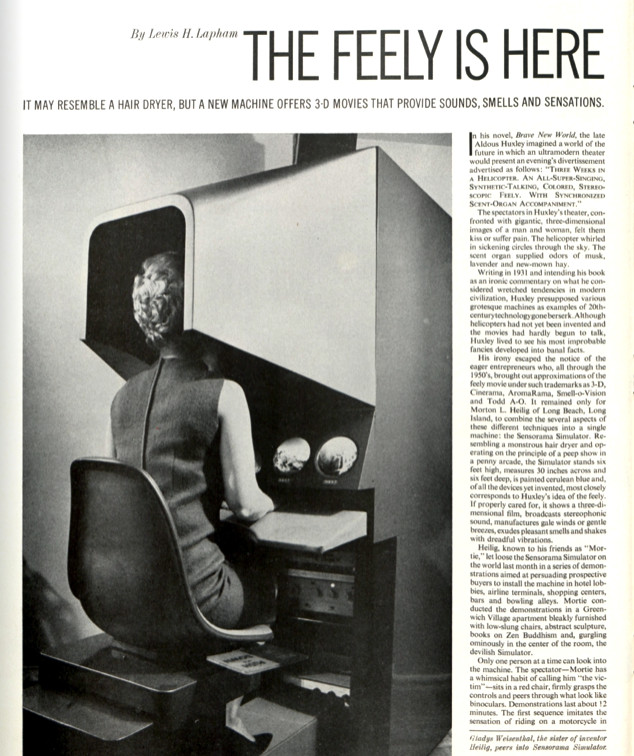
“A basic concept in teaching is that a person will have a greater efficiency of learning if he can actually experience a situation as compared with merely reading about it or listening to a lecture.” That was the reasoning that Morton Heilig gave for inventing the Sensorama Simulator in 1962. His machine resembled a hair dryer from a space age salon, but it was actually an early incarnation of virtual reality technology. After an initial buzz of excitement around Heilig’s invention, the world promptly forgot about him and his innovations.
Heilig’s prototype showed movies that mostly adhered to his instructional vision for the Sensorama, but he needed to make it sexy, too. Literally. One video that he showed in demonstrations featured an exotic belly dancer performing an intimate dance for the viewer. As the spectator watched the three-dimensional video, perfume wafted from the Sensorama any time the dancer gyrated close to the camera. Another video showed a high-speed motorcycle ride through the streets of New York City, complete with wind and diesel smells. Although it wasn’t necessarily functional at training anyone to be a motorcyclist, the experience succeeded at freaking people out.
In 1964, this magazine covered Heilig’s invention, comparing it to the “feely” theater of Aldous Huxley’s Brave New World. The term “virtual reality” would not have been recognizable at the time, so the mysterious futurism of Huxley’s dystopian novel had to suffice to impart the peculiarity of the Sensorama Simulator to Post readers. “Resembling a monstrous hair dryer and operating on the principle of a peep show in a penny arcade, the Simulator stands six feet high, measures 30 inches across and six feet deep, is painted cerulean blue and, of all the devices yet invented, most closely corresponds to Huxley’s idea of the feely,” Lewis Lapham wrote.
The possibilities for the invention, from Heilig’s perspective, were endless. It could be used to train pilots, sell beach vacations, test drive new cars, or just sit at an amusement park, collecting quarters. At the time of the Post’s report, Heilig had attracted the attention of an investor who gave him the ears of executives and entertainment insiders. His Sensorama made it into Universal Studios, Santa Monica pier, and Times Square as an attraction. “3-D, Wide Vision, Stereo Sound, Aromas, Wind, Vibrations” the machine advertised on its front. Thousands of people must have sat in the bucket seat and felt the simulated wind of the Sensorama during its nationwide tour. Unfortunately, the money from a big-time investor never came, and Heilig’s sensory vending machine became a lost oddity.
In 1984, Heilig was interviewed with his invention, and he described the Sensorama’s capabilities proudly, saying, “this was 30 years ago, and now today, there still is nothing as complete as this.” Before Heilig died, in 1997, moves toward virtual reality began to take place, with gaming companies like Sega and Nintendo beginning to release VR systems. Then, “4-D” movies became hit attractions at parks like Six Flags and Disney World. Shows like “Honey, I Shrunk the Audience” and “It’s Tough to Be a Bug!” combined three-dimensional video with animatronics, scents, winds, and other effects to wow audiences and terrify children.
Heilig had worked as a consultant with Disney, supposedly sparking the company’s interest in 3-D video. The technology has been used mostly (even in its 4-D incarnations) to incite thrills and chills, but Heilig had always hoped for more. Speaking to Lewis Lapham for the Post in 1964, Heilig said, “It’s an empathy machine, and if we can develop it right, maybe we can get it to inject feelings of warmth and love.”
These kinds of ambitious results for his high hopes for virtual reality remain to be seen (or smelled).
Featured Image: I.C. Rapoport, 1964