A Lofty Assignment: Modeling for Norman Rockwell
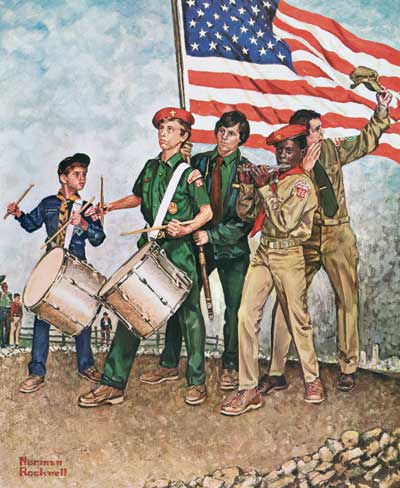
© Brown & Bigelow, Inc., St. Paul, Minnesota/Courtesy Boy Scouts of America
I was 10 years old when Dad made me jump into the station wagon with a bunch of Boy Scouts for a five-hour trip from New Jersey to Norman Rockwell’s studio in Stockbridge, Massachusetts.
I didn’t want to go.
When we arrived, there was half an inch of snow on the ground. So I looked for pigeon-toed footprints in the snow leading to the red carriage house studio — having heard the story of the artist’s famously awkward feet — and found them.
Inside, I marveled at the African masks and spears on the walls and the replica of Ben Franklin’s printing press. On his easel sat a large horizontal painting of Abraham Lincoln having his photograph taken. On a low shelf, I saw a skull wearing a German spiked helmet. Springs attached to the jaw made it snap shut when you spread it.
Dad told me to stop touching stuff.
Rockwell and photographer Louie Lamone arranged the Scouts and Scoutmaster, my uncle Byron, in a line as if marching in a parade. My cousin Byron, in Scout uniform, carried a drum. An older boy held an American flag on a pole.
“It needs to fly,” Rockwell said as he tied a string to the top corner of the flag and turned to me. “Jeff, take this and climb up to the loft,” he said, sounding as if he had marbles in his mouth. I obeyed. It was hot up there. The flag rose in the simulated wind and the shot was snapped.
Rockwell gave me a check for $25 for the job. I cashed it when I got home and bought a Joe Namath football. The football’s long gone, but Dad was wise to make a copy of the check, which I now have framed, proof of the tiny role I played in Norman Rockwell’s last Boy Scout painting.
—
To read more about the author’s father, artist Joseph Csatari, read “The Illustrator’s Apprentice.”
‘A Very Private Moment’
Something new for you.
I recently discovered this Saturday Evening Post cover by my grandfather Norman Rockwell from March 19, 1949: Prom Dress. It has become one of my new favorites. Perhaps because it reminds me of myself as a teenager.
It is a very private moment in a young woman’s life. She stands on that imperceptible precipice between childhood and becoming a woman. It’s her first prom. She has thought of this moment for years — what will it be like, who will she go with, how will she feel? Her nervous, slightly tentative excitement is palpable as she gingerly holds up the dress in front of the full-length mirror. This mirror has reflected her back to herself for years — it has been a silent witness to each unfolding year of her childhood.
The purity, delicacy, and appeal of the new dress contrasts with the lived-in, worn-out room. From the looks of the elegant dress box it seems she went to the Big City, perhaps saved her money over time and got the dress of her dreams. Rockwell chose to paint the walls a yellowed ivory to emphasize the untouched white of the dress. You wouldn’t know how drab the walls are without the crisp, clean white gown — the two representing where she has come from and where she is going.
The see-through chiffon layers with sparkles are reminiscent of a delicate confection. A Cinderella dress. With gold shoes like ballet slippers waiting to be danced in. From the other side of the room, the faded pink wallpaper with a subtle feminine design frames her reflected face, and there is a hint of the wallpaper to the left of the closet door — hidden touches of pink where you don’t expect them.
Her old clothes hang neglected in the closet. My grandfather didn’t want you to miss this — he illumined the contents with the light from a closet window. A tired petticoat pops its way out of the rack, asking to be remembered. Her pajamas and ice skates hang in disarray on the door. All the remnants of the childhood she is leaving behind.
In his autobiography My Adventures as an Illustrator, Norman Rockwell remembers a vivid moment from his own childhood:
“I can remember walking into a room in a friend’s house during a swimming party one summer afternoon when I was ten or twelve years old. … All around the room, lying in disorder on chairs, tables, the windowsills, were girls’ underthings. … I stopped, utterly thrilled by the sense of femininity. … The pink ribbons on a bodice stirred in the breeze. I felt I had penetrated into the strange, secret world of girls, which had heretofore been closed to me. I could hardly breathe, the sense of it was so strong. The delicate, frilled underthings … seemed suddenly, for the first time in my life, to show me what girls were. They weren’t just annoying creatures who threw a baseball awkwardly. … Girls were different.”
She has always been a country girl, living far from the sophistication of the city. But a new world, a new identity awaits her. Is she ready?
Her rolled-up baggy jeans, drooping socks, and worn shoes are familiar, comfortable, and safe. She stands slightly pigeon-toed. This is a girl who knows hard work, has never been scared of it. She puts her hair up quickly with a clip and looks in the mirror with quiet intensity. Who is this woman who stares back at her? A very pretty, determined face emerges from the tomboy inside.
In Rockwell’s paintings the magic and mystery are in the details. The textured rug reminds us of a country lawn; the old, dark Victorian stool is an outdated symbol from another time; the soft, comfy pink blanket has been on her bed for years; papers carelessly stuffed into shelves; and yet we notice the delicate string falling from the dress box, a new chapter has been opened.
Four years after World War II the country was beginning to recover from its dark period and awaken to the idea of new possibility and a fresh beginning.
My grandfather’s art reminds us that no matter what transition we are facing, or how trepidatious we may feel, everything will turn out all right. He leaves you with the anticipation of a happy ending. And isn’t that what we all secretly want? To know that in the end, all will be well, we will be safe, loved, and cared for.
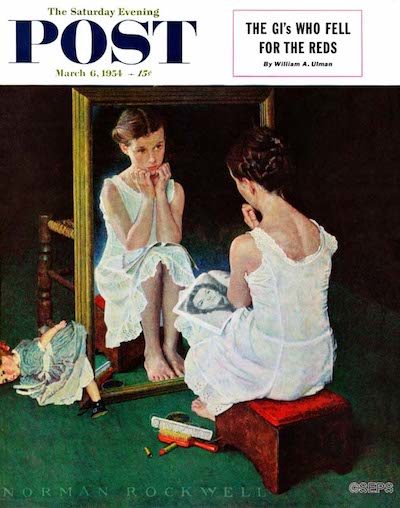
. March 6, 1954. © SEPS
Prom Dress preceeded Rockwell’s ultimate mirror of the transition from childhood, one of his true masterpieces, Girl at Mirror, 1954. The transition into adolescence is a recurring theme in his work; it was a time of heightened sensory awareness and precariousness in his own life. And his paintings reflect that tender moment.
I never had a prom. Losing myself in my grandfather’s painting makes me feel as if I did have one, though. Thanks, Pop.
Warmest wishes,
Abigail
News of the Week: 5 Rockwell Paintings, 1 Howard Johnson’s, and 11 Herbs and Spices
Norman Rockwell on Tour
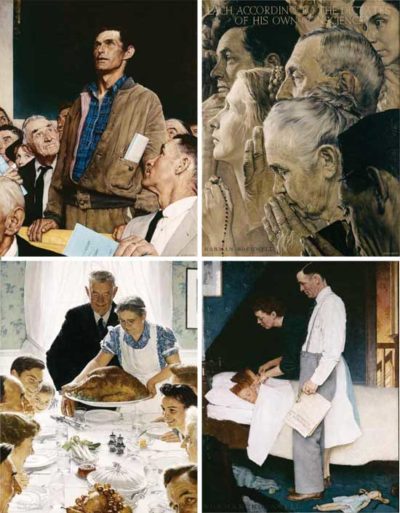
© SEPS.
They’re not the originals, but it’s great to see that quality copies of five classic Norman Rockwell works will be on display at several federal courthouses in Massachusetts this fall.
Copies of “Four Freedoms” and “Golden Rule” will be on display at federal courthouses in Boston, Springfield, and Worcester. The paintings will first be displayed in Boston on September 23, and then in Springfield on October 6 and in Worcester on October 11.
This year marks the 75th anniversary of President Franklin Roosevelt’s “Four Freedoms” speech, which inspired Rockwell to create that series of paintings. In the speech, FDR talked about the freedoms everyone should have: Freedom of Speech, Freedom of Worship, Freedom from Want, and Freedom from Fear.
We should update that list with a fifth: Freedom from the Kardashians.
The Solo Hojo
Back in July of 2015, I told you about the last two remaining Howard Johnson’s. Come next week, there will only be one left.
The Howard Johnson’s in Bangor, Maine, is closing forever next Tuesday. That means that there’s only one Hojo’s left, in Lake George, New York. Let’s hope that somehow, some way, that location is able to stay open forever. I’m sick of iconic things closing or going away or changing.
RIP Gene Wilder, Jeanne Martin, and Marvin Kaplan
To put it bluntly, Gene Wilder was one of the funniest men in the movies. He was in a bunch of classic comedies, including Young Frankenstein, Blazing Saddles, The Producers, and Silver Streak. He also gave one of the all-time great performances in Willy Wonka and the Chocolate Factory, which I think I’ve seen approximately 40 times.
Wilder passed away at the age of 83 of complications from Alzheimer’s. Mel Brooks paid tribute to his friend on Twitter:
Gene Wilder-One of the truly great talents of our time. He blessed every film we did with his magic & he blessed me with his friendship.
— Mel Brooks (@MelBrooks) August 29, 2016
Wilder passed away with his family holding his hand, listening to “Somewhere Over The Rainbow.”
Just a few weeks after her son Ricci died, Jeanne Martin has passed away at the age of 89. She was the ex-wife of Dean Martin (Jerry Lewis was the best man at their 1949 wedding) and had a career as a model.
Marvin Kaplan did a lot of TV shows and movies, and I guess a lot of us will remember him as one of the gas station attendants (along with Arnold Stang) who gets into a big fight with Jonathan Winters in It’s A Mad, Mad, Mad, Mad World. He was also the voice of Choo-Choo on Top Cat and was a regular on the TV series Alice. Other movies he appeared in include Adam’s Rib, The Nutty Professor, and Freaky Friday, and he appeared in TV shows like I Dream of Jeannie, My Three Sons, ER, Becker, and MacGyver.
Kaplan passed away late last week at the age of 89.
11 Herbs and Spices
Was the secret “11 herbs and spices” recipe for Kentucky Fried Chicken just published in The Chicago Tribune?
That’s what people are asking after reporter Jay Jones met with Sanders’ nephew Joe Ledington during a trip to the Harland Sanders Cafe and Museum in Corbin, Kentucky. Ledington showed Jones a family scrapbook that had a piece of paper inside that seems to have the complete recipe.
Ledington later told Jones that he now felt bad about showing the recipe. It’s not in his uncle’s handwriting, but he swears the recipe is authentic because he used to help his uncle mix the spices when he was a kid.
Of course, officials at KFC say the recipe is not authentic. The Chicago Tribune did a taste test with KFC they bought, and here are the results.
Here’s Colonel Sanders on a 1963 episode of What’s My Line? It’s rather confusing because by this time there were already 600 Kentucky Fried Chicken locations. Wasn’t his name and/or appearance known by people in 1963?
Maybe that fame came a few years later.
New Books
In addition to the nonfiction and fiction picks in the new issue of The Saturday Evening Post, here are a few other new books that might be worth your time:
Whistlestop, by John Dickerson
The host of CBS’s Face the Nation has a ridiculously entertaining look at important moments from election years past. The perfect thing to read during this crazy 2016 election, because you’ll learn that some rather interesting things happened in past elections, too.
Best. State. Ever. A Florida Man Defends His Homeland, by Dave Barry
Florida gets a bad rap — often from Dave Barry himself — but in his book he attempts to defend the Sunshine State. (Available September 6.)
She Made Me Laugh: My Friend Nora Ephron, by Richard Cohen
The Washington Post columnist writes a love letter to his close friend. He calls it a “third-person memoir,” and it includes interviews with Tom Hanks, Mike Nichols, Meryl Streep, and many others. (Available September 6.)
The French Chef in America, by Alex Prud’homme
The co-author of the Julia Child biography My Life in France follows up with a sort-of part 2, where he talks about Child’s success on television and how she changed the world of cooking. (Available October 4.)
Young Frankenstein: The Story of the Making of the Film, by Mel Brooks
It’s odd timing, but to celebrate the life of Gene Wilder, you could pick up this book that goes behind the scenes. (Available October 18.)
This Week in History: VJ (Victory Over Japan) Day, 1945
It’s celebrated on August 15 in the United Kingdom, because that was the day of the official surrender by Japan, but it’s officially celebrated in the United States on September 2, the day the surrender agreement was signed.
This Week In History: The Death of Princess Diana, August 31, 1997
The night Princess Diana died I was watching MSNBC. I went to bed but woke up a couple of hours later and decided to turn on the TV again for some reason. That’s when I saw anchor Brian Williams announce her death to viewers.
September is National Rice Month
Like a lot of people, I make a lot of rice in the fall and winter. So I guess it’s good that September kicks things off as National Rice Month.
Here’s a recipe for Chicken Rice Roger, one of the great recipes in my favorite cookbook, Peg Bracken’s The I Hate To Cook Book. And here’s one for Red Rice Stuffing with Dried Fruit. We should include a recipe for classic arancini (or rice balls), and here’s a video where Martha Stewart shows you how to make the perfect white rice. That’s right, PERFECT! Because it’s Martha Stewart.
Next Week’s Holidays and Events
Newspaper Carrier Day (September 4)
It’s celebrated on a Sunday this year, but even if you don’t get a paper on Sunday, make sure you give your carrier a little something extra this week. It will surprise him or her, and you’ll also be supporting print!
Labor Day (September 5)
Was it McGuire or Maguire who came up with the idea for the holiday?
NFL season starts (September 8)
The Carolina Panthers play the Denver Broncos in the first game of the season, which airs on NBC at 8:30 p.m. Here’s the full schedule.
Sign on the Dotted Line
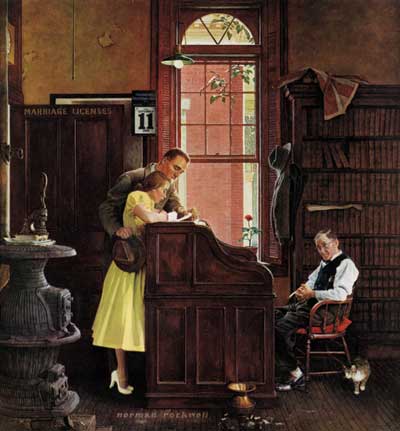
Norman Rockwell
June 11, 1955
Always a stickler for authenticity, Rockwell asked an engaged couple to pose for The Marriage License. He also asked a former town clerk, Jason C. Braman, to pose as the city official. Rockwell knew the old man was still mourning his wife, who’d died just a few months earlier, and thought sitting for the painting might lift Braman’s spirits. Rockwell’s plan worked. When the issue was published and neighbors asked if he was the man on the Post cover, Braman delightedly offered to autograph their copy.
This cover displays Rockwell’s genius for capturing the drama in everyday scenes. He contrasts the dark municipal office and its shelves of dusty books with the woman’s sunny dress and the promise of bright sunlight coming in the open window.
And he used the solitary old clerk to emphasize the hopefulness of the young couple. The effect was so ideal that Rockwell once pointed to the handsome bridegroom and said, “That is what I would have liked to look like if I had had the opportunity.”
New York Street Gets Rockwell Name
Though he is most famous for capturing life in the American Midwest, Norman Rockwell spent much of his on the East Coast, including New York City and nearby New Rochelle before moving to Massachusetts. Rockwell was born in 1894, and as an infant lived at 206 W. 103rd Street near Central Park. One hundred thirty two years later, a sign co-naming the street Norman Rockwell Place will be unveiled thanks to the efforts of a group of New York City high school students.
The students, members of René Mills’ class at Edward A. Reynolds West Side High School, learned Rockwell was born around the corner from their school during a visit to the Norman Rockwell Museum in Stockbridge, Massachusetts, in 2014. On returning, they scoured 103rd Street for a commemorative sign or plaque marking the icon’s presence, only to come up empty-handed. “At that point, we knew we had a mission,” Mills says.
The students formed the Norman Rockwell Place Committee and investigated how to get a secondary street sign. The committee created pamphlets, posters, and T-shirts in an effort to educate the community on the significance of the corner of West 103rd Street and Amsterdam Avenue. After months of work, the committee garnered hundreds of signatures in support of renaming the street.
Two weeks after a New York City Council vote of approval, Mayor Bill de Blasio signed a bill to co-name the corner “Norman Rockwell Place.” The students, who witnessed the signing of the bill on February 25, will see their work come to fruition on Thursday, June 9, when the new sign is unveiled and Norman Rockwell Place becomes official.
As Mills explains, the project grew out of a course study emphasizing local government. “My students were mesmerized by the issues that were presented to the local community board. Getting the Board and the Council’s approval for their proposal was empowering,” she says.
She herself had long been a fan of Rockwell. “Rockwell tells the stories about everyday life as he has exposed the best and worst of our society,” she says. “Rockwell is the visual novelist that moves his audience from frame to frame as they are drawn into the mystique of visual story telling.”
She and her students felt it was important to reclaim the artist as a New Yorker. “I promised my students that if they took this journey with me, it would be bigger than they imagined and their persistence and hard work would be remembered,” Mills says. “Norman Rockwell Place would be part of my students’ legacy.”
Early Rockwell Models
© SEPS
Norman Rockwell did Post covers from 1916 to 1963 — a remarkable 47 years. Who were the folks on his first generation of covers?
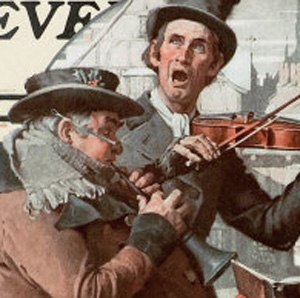
Below are some fun details about two men who transformed into new characters over and over again on the covers of the 1920s: Dave Campion and Pop Fredericks. At right, they appear together as Victorian musicians in the 1923 holiday cover, Christmas Trio. Campion is the taller man on the right, and Fredericks, left.
Dave Campion
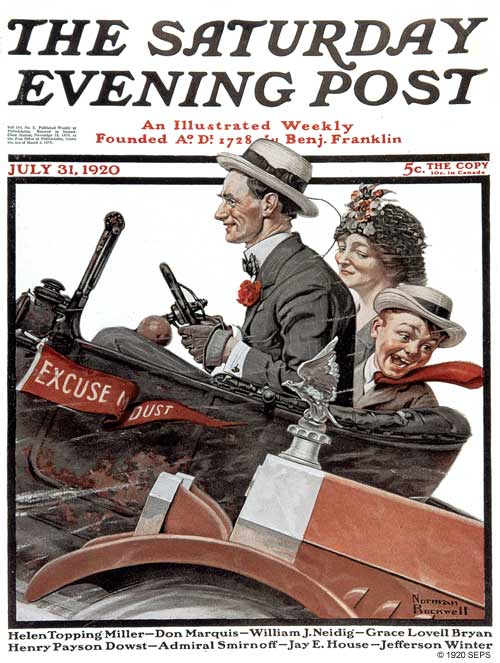
“There was one kind of idea which I didn’t have to struggle over,” Rockwell wrote in My Life as an Illustrator, “the timely idea. In 1920 the whole country was talking about Model T Fords and Henry Ford.”
So, he created the July 1920 cover of the Campion family (below, left) in their rusty Model T, easily passing an expensive Peerless.
Dave Campion, the driver living life in the fast lane (as much as one can at 30 mph), ran a newsstand in New Rochelle, New York — where Rockwell worked and lived when this illustration was created. One can’t help but wonder what it was like for Campion to sell the latest issue of The Saturday Evening Post with himself on the cover!
Norman Rockwell
July 31, 1920
© SEPS
Norman Rockwell
April 20, 1929
© SEPS
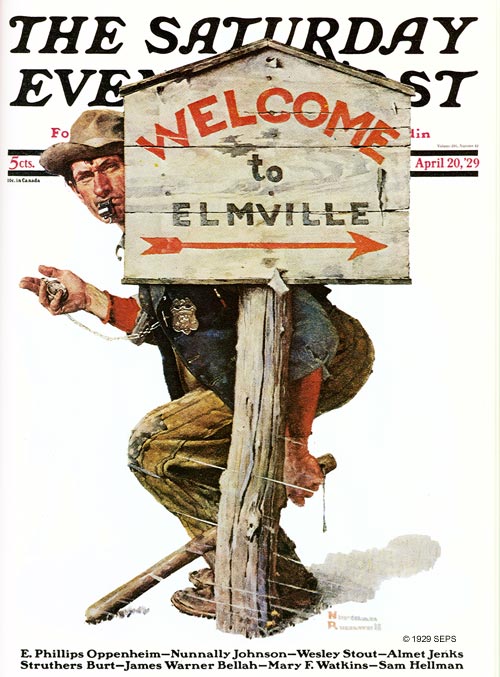
In the top right illustration, Campion, given a slouchy hat and a mean squint, transforms from the amiable dad in 1920’s Excuse My Dust, to the long arm of the law. “Welcome to Elmville,” indeed. (The arm caught Norman Rockwell speeding through Amenia, New York, giving him the idea for this cover. “That was back in the days when towns paid their taxes with speeders’ fines, and the Amenia cop really nailed me — right along the welcome sign!”)
Pop Fredericks
Unlike Campion, who had found his calling selling periodicals and papers, Pop Fredericks was an actor who never quite made it. “Pop had been, as he told it, cheated of fame,” Rockwell wrote. Fredericks was in a play that was just gaining momentum when he was replaced by a better-known actor.
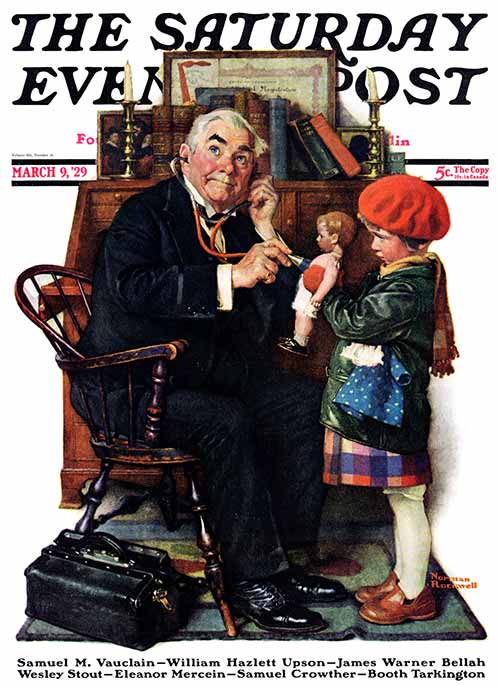
Fredericks’ acting ability allowed him to portray a wide range of personalities, making him a rugged character in one cover (below, left) and a kindly doctor in another (below, right). Like Campion in the covers above, the contrast between the two characters is significant.

Norman Rockwell
March 12, 1927
© SEPS
by Norman Rockwell
March 9, 1929
© SEPS
Though Fredericks never became a renowned actor, he achieved immortality on Post covers: as a seasick ocean voyager, a cellist, a politician, and an obliging physician (above, right) who can’t resist allaying the worries of the little mother. The Doctor and the Doll was an all-time favorite and is one of the most collectible Post covers of all time.
How a Classified Ad Brought Rockwell Two Black Eyes
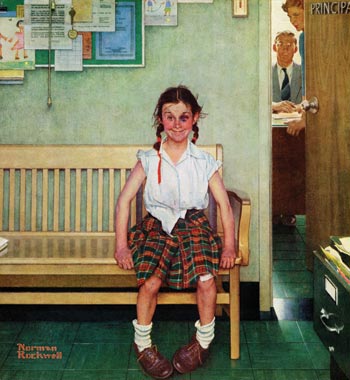
Portraying a boy with a black eye was commonplace enough. Here, Rockwell gives the schoolyard dust-up a then-modern twist by painting a girl combatant who, judging by her grin, was the victor. But as he worked on the cover illustration, Rockwell found himself in a jam because his model was not, in fact, injured. And painting a realistic shiner was challenging, since a truly “black” eye contains multiple colors, none of them black.
Rockwell halted work to visit several hospitals but found no patients in the right condition. An obliging photographer ran an ad in the local paper, announcing a search for a model with a black eye. This created another diversion as the media caught wind of the story, and soon Rockwell was getting offers from across the country. But then, a bit of luck came Rockwell’s way when Tommy Forsberg of Worcester, Massachusetts, fell down the stairs and blackened both his eyes. His father drove him to Rockwell’s studio, where his injury would be immortalized, albeit on a young girl’s face.
Rockwell Rising
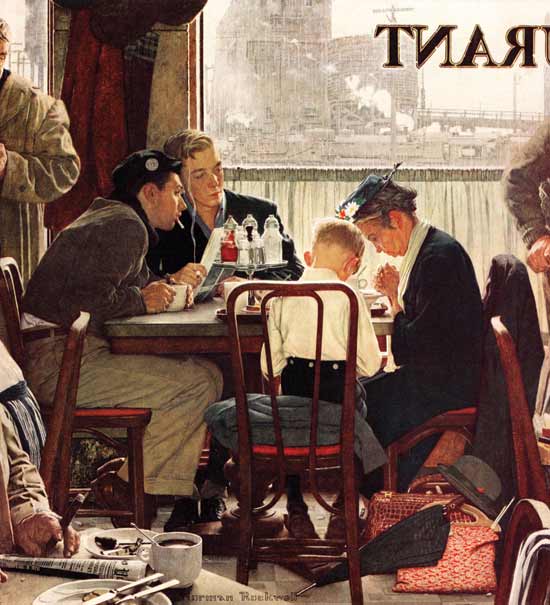
November 24, 1951
© SEPS
Throughout history, most great artists have been storytellers, whether in paintings scratched out on the walls of caves to chronicle the hunt or, later, in lush canvases and intricate frescoes to interpret scenes from the Bible or to record great battles. Norman Rockwell comes from just such a tradition.
Ordinary people doing ordinary things were his subjects for the most part. “The commonplaces of America are to me the richest subjects in art,” Rockwell wrote in 1936. “Boys batting flies on vacant lots; little girls playing jacks on the front steps; old men plodding home at twilight, umbrellas in hand — all of these things arouse feeling in me. Commonplaces never become tiresome. It is we who become tired when we cease to be curious and appreciative.”
The public adored Rockwell from the start, says Laurie Norton Moffatt, director and CEO of the Norman Rockwell Museum. If, in the postwar world of abstract expressionism, folks stared in befuddlement at Ad Reinhardt’s black-on-black canvases or Jackson Pollock’s splatter paintings, Rockwell’s work was a breath of fresh air.
“We know from the fan mail received at The Saturday Evening Post that people were extraordinarily attentive to his work, even to the point of catching him out on details if something was a little off about the picture,” she says. “But most of the letters were accolades of how much they were moved, or touched, by a particular picture.”
Rockwell famously put in long hours, heading off to his studio seven days a week, holidays included. Joseph Csatari, who served for eight years as art director for Rockwell’s Boy Scout paintings, recalls that the artist needed a daily intervention just to pry him away from his easel: “Every day at 11 o’clock, Rockwell’s wife Mary would knock on the studio door to remind him to take a break. ‘If I didn’t,’ she would say, ‘he’d work through dinner.’”
Rockwell’s total production was staggering. In his lifetime, he painted nearly 4,000 images, including 800 magazine covers — 322 for this magazine alone — and ad campaigns for more than 150 companies.
Today his paintings are more popular than ever, commanding eight-figure fees from collectors and drawing crowds to museums. Among his better-known fans are film directors George Lucas and Steven Spielberg. Both speak reverently of the artist’s storytelling skills, likening his paintings to film. “He was able to sum up the story and … understand who the people were, what their motives were, everything in one little frame,” Lucas said in an interview. “I think he’s left a legacy that’ll never be forgotten.”
But for all his popularity, and, in fact, because of it, Rockwell was for most of his lifetime a flop in the eyes of the art world. “His success was his failure,” wrote Arthur Danto in a 1986 review in The New York Times, adding, “He possessed a demonic gift for likenesses, but an appalling lack of taste.”
As Moffatt tells it, he was approached by young art students during a visit to the Art Institute of Chicago in 1949 and asked by one, “You’re Norman Rockwell, right?” Touched with pride at being recognized, he was stung by the comment, “My art professor says you stink!”
Rockwell was well aware that he was out of step with the elites of the art world. “I have always wanted everybody to like my work,” he writes in his autobiography. “I could never be satisfied with just the approval of the critics (and boy, I’ve certainly had to be satisfied without it).”
Understanding the criticism Rockwell endured for much of his career requires some perspective about the history of American art, which went through seismic upheavals during his lifetime. Early in the 20th century, classically trained illustrators were national celebrities and trendsetters — admired and emulated the way sports figures and actors are today. “When you look at the 1920s, illustrators like John Held Jr., who was setting flapper fashions, or his forebears Charles Dana Gibson, who created the Gibson Girl, or J.C. Leyendecker, whose ads for Arrow shirts defined the styles and the fashions of the day — these illustrators defined how people dressed and acted, and even shaped what they should aspire to be,” Moffatt says.
But change was coming. Art historians point to the 1913 Armory show in New York as a critical turning point. Today, it’s hard to imagine the uproar the show caused. Nearly 90,000 people came to see the exhibition, which featured then-unknown-in-America artists such as Georges Braque, Mary Cassatt, Paul Cezanne, Edgar Degas, Pablo Picasso, and many others. The abstraction — Cubism! Fauvism! — was a pie in the face of the classical tradition, and many viewers were outraged.
“For the very first time, American artists were introduced to the breaking down of form, of color, anatomy not being presented realistically,” Moffatt says. “American artists realized they had a choice. Many went to Europe to study these new styles, and you began to have this division. Artists could stay in the narrative tradition, painting pictures that are about a recognizable subject — pictures that involve people or landscape — or you could choose to go into these more abstracted forms of art.”
Rockwell, born in 1894, also caught the modern art fever, if briefly. At 29, already an established artist for the Post, he traveled to Paris to study the latest fads. Right from the beginning, it was not a perfect fit, as he writes in his autobiography. But, on his return, he attempted an abstract cover for the Post that was quickly and mercifully rejected. “I don’t know much about this modern art, but I know it’s not your kind of art,” the famously taciturn editor George Horace Lorimer told him. “Your kind is what you’ve been doing all along.”
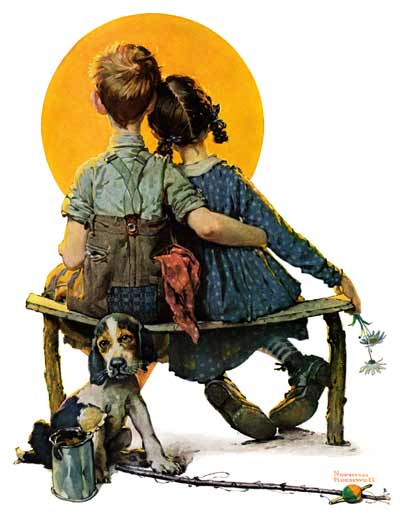
April 24, 1926
© SEPS
Rockwell did revert to form, of course, but throughout his life, he was occasionally troubled that he was an anomaly among the leading artists of his day. “I think any artist who is a creative genius will go through periods of self-doubt,” Moffatt says. “And what comes through in Norman Rockwell’s own autobiography, where he writes about these episodes of depression, is how he always came through them with a burst of creativity where he was painting his absolute best. It’s a measure of his great strength and of his talent and genius.”
That genius must have been evident immediately to Lorimer, who, 100 years ago, bought two of the unknown young artist’s works at first sight. “Even in those early works, Rockwell was already evidencing the deep sense of observation, that keen sense of just how people interact,” Moffatt says. “If you look at the Boy with Baby Carriage, at first it’s all about the humor — the jeering friends running off to play ball while the older brother is stuck babysitting his sister. But as you look more closely, you’re drawn to the detail: the baby bottle in his breast pocket, the bowler hat clipped onto his lapel. I think it is that attention to detail, the little things that spark the humor, and that always take you a little deeper into the picture, that is the hallmark of his great talent.
“So you have an editor who is very skilled and who knows what he likes, who knows what will work for the Post, and he gave Rockwell a tremendous chance, and of course Rockwell never looked back, and he never let Lorimer down.” (For the full story of Rockwell’s thrilling initial encounter with the Post, see “A Fruitful Relationship,” by granddaughter Abigail Rockwell.)
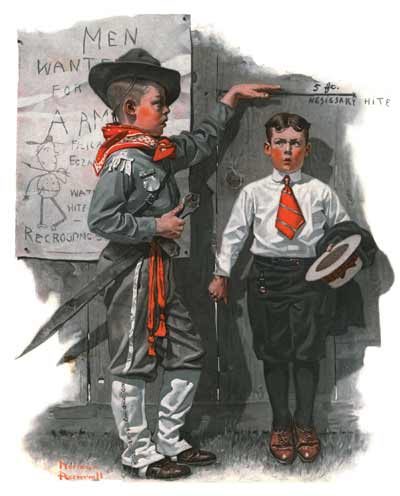
June 16, 1917
© SEPS
There is an additional layer of meaning when you consider the historical backdrop of many of Rockwell’s works. Citing Recruiting Officer, from the June 16, 1917, cover (above), Moffatt notes the obvious storyline — two kids are play-acting as soldiers out in the yard, and one kid isn’t measuring up: “He’s not tall enough to be recruited as a soldier, and the other young man has a wooden sword, and he has this bandana on, and he’s in his scout uniform. What one would have known at that time is that World War I was going on, so Rockwell is incorporating the larger narrative of world events into this narrowly focused microcosm of two kids in the backyard playing. There are so many things to talk about in these pictures beyond the first sort of joke that might stand out to us.”
But, always, the warmth shines through. “It has to be kept in mind that he’s doing all these paintings through the influenza epidemic, through the Great Depression, through the worst wars in the history of the world,” says Pulitzer Prize-winning historian David McCullough. “Yet he maintains a positive theme. Rockwell is like the minister who gives an encouraging sermon every week, and keeps the faith in the American ideal.”
McCullough has a unique perspective on Rockwell, having spent a day with the artist when he was still a student at Yale and contemplating becoming an artist himself.
McCullough painted an illustration that was used for the cover of the program of the Yale-Dartmouth football game. “I was a great admirer of Rockwell, and the drawing — a father and son attending a football game — was very much in the Rockwell spirit.”
A classmate of McCullough’s who lived in the Berkshires near Rockwell arranged for the two to meet. “Rockwell could not have been nicer,” McCullough recalls. “I went up to meet him at his studio, above a store on the main street of the town. He was like a character from his paintings — a small, frail, bent-over man, physically not impressive at all, but his spirit was strong. There was no sense that I was in the presence of some great artistic genius. He struck me as a man who didn’t have much time for ego. He was too busy having the best of life through his work.”
McCullough spent the better part of the day with Rockwell. He watched him paint. Then they went to Rockwell’s home and had lunch, and Rockwell was quite encouraging about the young man’s artwork. “It could not have been a more memorable experience. He was one of my heroes,” McCullough says.
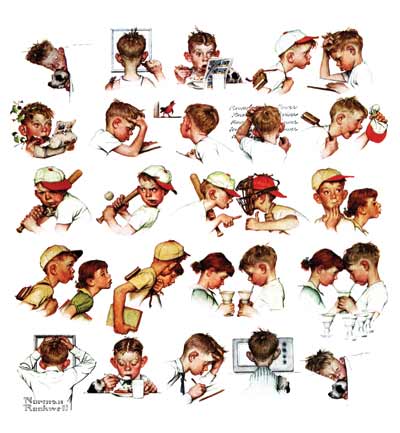
© SEPS
Today, the richness and depth — and yes, the earnest good nature — of Rockwell’s artwork is finally appreciated. (In 2014, Rockwell’s Saying Grace sold for $46 million, setting a record for his work.) But through much of the 20th century, while Rockwell was paid well, the paintings themselves had little or no value — they were merely the medium for delivering his pictures to the printed page. As an example, when the artist donated his canvas of Day in the Life of a Boy to the town’s Community Club for its annual raffle, the work raised a grand total of 50 cents.
Another anecdote that reflects Rockwell’s modesty about his own canvases comes from Csatari: “On one of my early visits to Stockbridge, I took a walk over to the Old Corner House museum to see some of Norman’s paintings while he took his nap. At the museum, I entered a room that held his Four Freedoms. I remember feeling as if I were in church. But in an instant, the reverence was broken. I saw painters on ladders slapping white latex on the ceiling and spattering the paintings below. I was stunned. I hurried back to the studio to tell Norman, who was back at his easel. He took a thoughtful puff of his pipe, then smiled and said, ‘Gee, Joe, maybe they’ll improve ’em.’”
How did Rockwell’s reputation rebound? As early as 1946, the renowned author of art instruction books Arthur Guptill published Norman Rockwell, Illustrator, a book that celebrated his work, notes Moffatt. But it wasn’t until 1968 that there was any serious interest in his original canvases. Rockwell was caught off guard when New York gallery owner Bernie Danenberg called him one afternoon in July 1968 to suggest mounting a show.
“I’m sorry,” Rockwell said, “but I think you have the wrong artist.”
Danenberg insisted he was not mistaken and drove up to Stockbridge the next day with his gallery manager. Arriving in town, they proceeded directly to his studio. Treasures abounded. Danenberg instantly fell for Lift Up Thine Eyes, a painting that depicted city people rushing past a beautiful old Manhattan church, oblivious to its beauty. The art dealer offered to buy the painting on the spot for $2,500. Rockwell at first refused to accept any money for the painting, saying, “I got paid for it once. I don’t need to be paid again.”
Danenberg persisted, and Rockwell ultimately agreed to sell the painting. He also agreed to schedule an exhibition for October of the same year. As art blogger Ann Restak writes, the exhibition marked the first time that Rockwell sold an original illustration as artwork.
There was a second gallery exhibition in 1972 and another traveling exhibition organized by the Brooklyn Museum. So one could regard the early ’70s as something of a turning point for Rockwell. “He went from being an artist on the cover of magazines to an artist who had his paintings on the walls of museums and galleries,” Moffatt says.
Collectors slowly began to take notice. “We see, around 1978, the very first auctions of Rockwell’s work in the major auction houses, such as Sotheby’s and Christie’s,” Moffatt says. “But it was still rare for American illustrators to be sold at art auctions. Honestly, it wasn’t greatly admired by the auctioneer. It would be shown on the back page of the auction catalogue, and sold for very little.”
It wasn’t until 1999, when the Norman Rockwell Museum and the High Museum of Art produced a large-scale exhibition titled Norman Rockwell: Pictures for the American People, that opinion leaders in the insular art world finally came around. The show traveled to seven American cities, ending in New York at the Guggenheim Museum. Now, writes Restak, his work was finally legitimized “in the hallowed halls of a world-class art institution.”
It didn’t hurt that the exhibition catalogue included essays by such authorities as Moffatt; Ned Rifkin, director of the High Museum of Art; and Thomas Hoving, the former director of the Metropolitan Museum of Art. In his essay for the catalogue, Hoving argues that critics must take another look at Rockwell and “place him in his authentic position in art.” He calls Rockwell “one of the most successful visual mass communicators of the century” and points out that “art history, for snobbish reasons, has always been suspicious of artists considered populizers.”
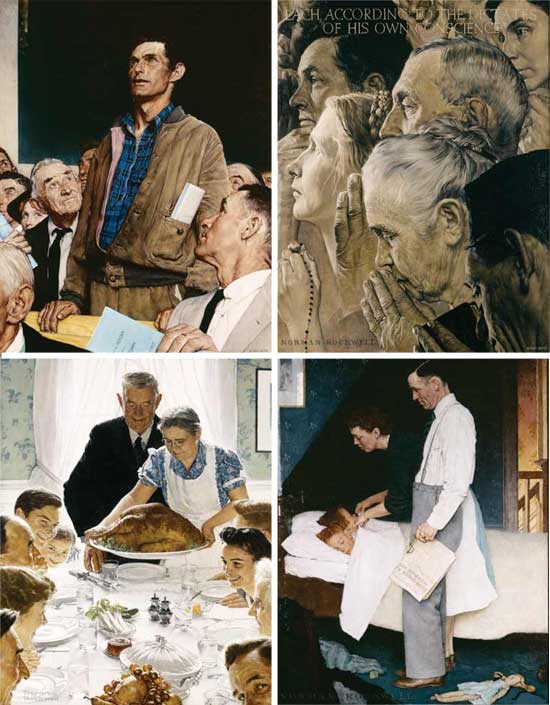
© SEPS.
Admiration for Rockwell has only grown as his paintings are exhibited with more frequency. “The experience of viewing an original Rockwell is very profound,” Moffatt says.
“The more people see Rockwell’s work in the original format, the more they are just wowed by what an extraordinary artist he was. You just can’t deny the artistry, the exquisite detail, and, of course, his keen observation of human nature.”
“He had a tremendous respect for the virtues of mankind,” Spielberg has said. “And there was a real sense of community, of family, and especially of nation.”
“Above all, Norman Rockwell was an extraordinarily kind person, and he genuinely loved people,” Moffatt says. “There’s so much anger in our nation today — and a certain amount of coarseness in the culture overall. But when people look at Rockwell’s work, not only do they respect it and like it, I think maybe they long for those qualities to be present once again. Not to go back in time, but to bring forward some of these guiding principles of how society could be.”
How will Rockwell be regarded 100 years from now? “Unabashedly I would say we’ll remember him the way we remember Rembrandt and Michelangelo,” Moffatt says. “Rockwell’s work will be held up and admired, and hold its own, alongside the greatest painters in the world.”
Click images to enlarge:
June 16, 1917
© SEPS
April 24, 1926
© SEPS
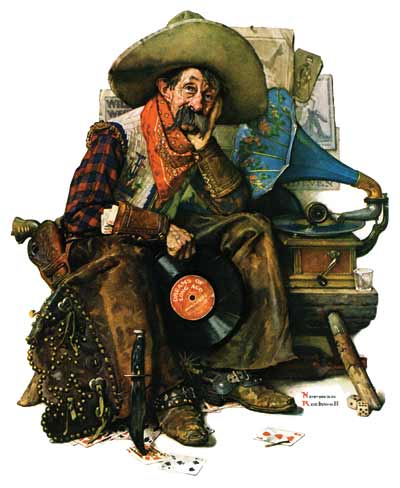
August 13, 1927
© SEPS

March 9, 1929
© SEPS

September 26, 1936
© SEPS
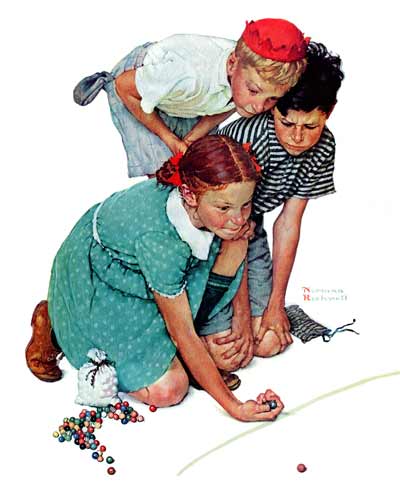
September 2, 1939
© SEPS
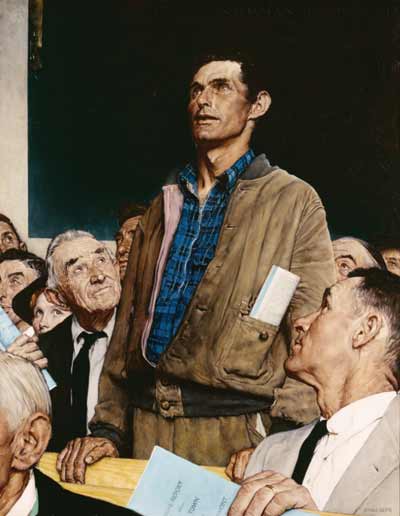
February 20, 1943
© SEPS
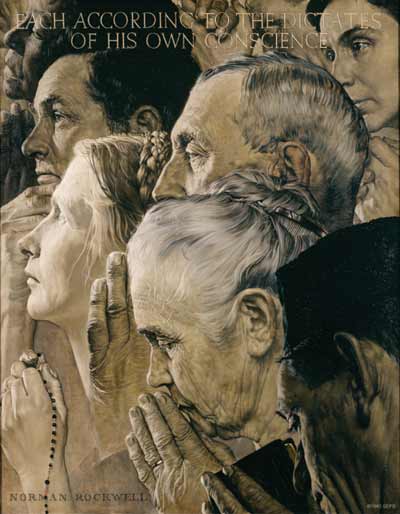
February 27, 1943
© SEPS
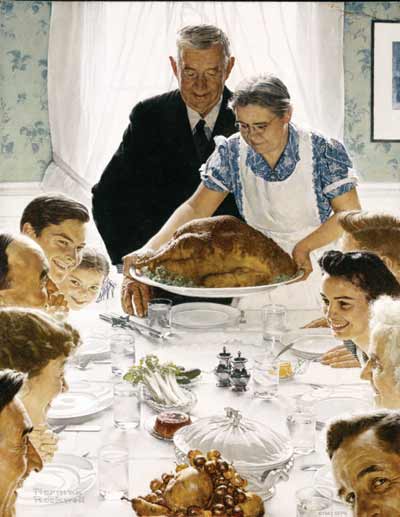
March 6, 1943
© SEPS
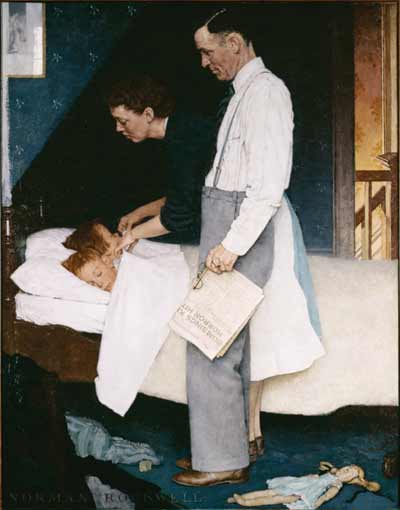
March 13, 1943
© SEPS
November 24, 1951
© SEPS
May 24, 1952
© SEPS
A Tale of Two Streets
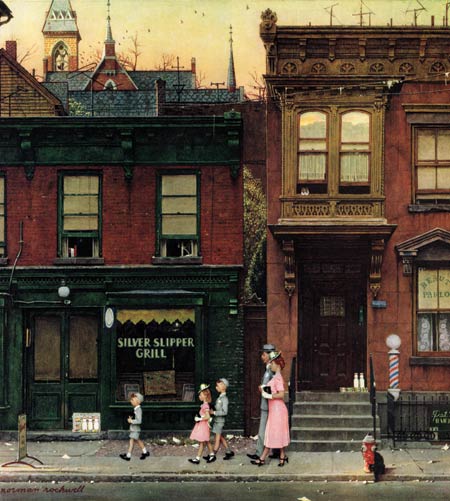
You may not see it, but there’s a 17th-century Dutch painting within the 1953 cover, Walking to Church. Rockwell depicts a family, dressed in their Sunday best, on a city street before the neighbors awaken to take in their milk and newspapers. The scene may seem quiet, but Rockwell showed us, with a line of birds rising in sudden flight from the steeple, that the church bells have begun ringing.
Rockwell’s cover reflected his admiration of View of Houses in Delft, a 1658 painting by Johannes Vermeer that showed a quiet street in the Dutch artist’s hometown. Not only did Rockwell copy Vermeer’s theme, but he also tried to replicate its 21-by-17-inch size. Rockwell’s painting is tiny, for him — just 19 by 25 inches. He wanted to paint it the same size as the Vermeer original, but he couldn’t get a canvas small enough. “Couldn’t paint it better than Vermeer,” he said. “So I painted it bigger.”
Editor’s note: This article has been corrected from the version which appeared in the March/April issue. The article in print was published under the wrong author’s name and stated that Rockwell’s painting was 19 by 18 inches.
Winner Announced: Vote for Your Favorite Rockwell
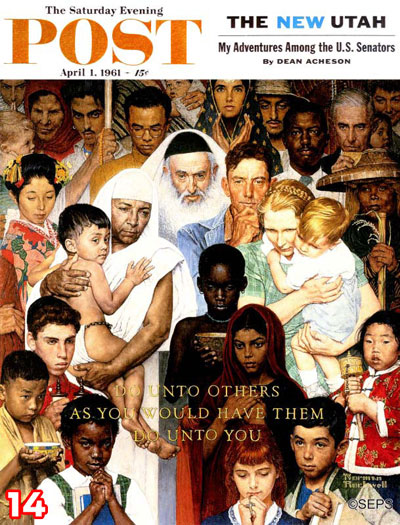
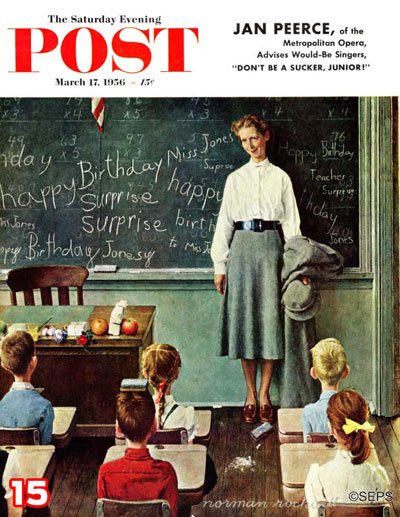
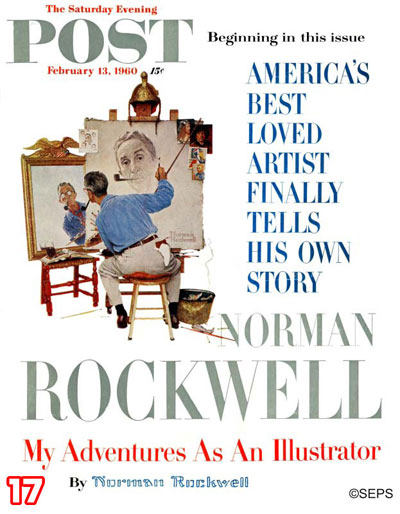
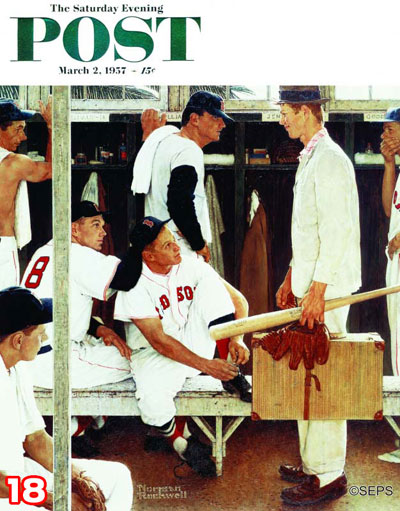
Thanks for playing Rockwell March! The U.S. saw Norman Rockwell’s art on The Saturday Evening Post cover for the first time on May 20, 1916 — almost 100 years ago. To celebrate the upcoming anniversary, we shared 32 of his iconic illustrations on our Rockwell bracket — and asked you to vote for your favorite.
We gathered votes from Facebook, Pinterest, and our website. It was a tough, five-week-long battle, and in the end, Rockwell’s Freedom from Want came out on top! To see the winner close up, just click on the bracket below or scroll down to view each Rockwell contender individually.
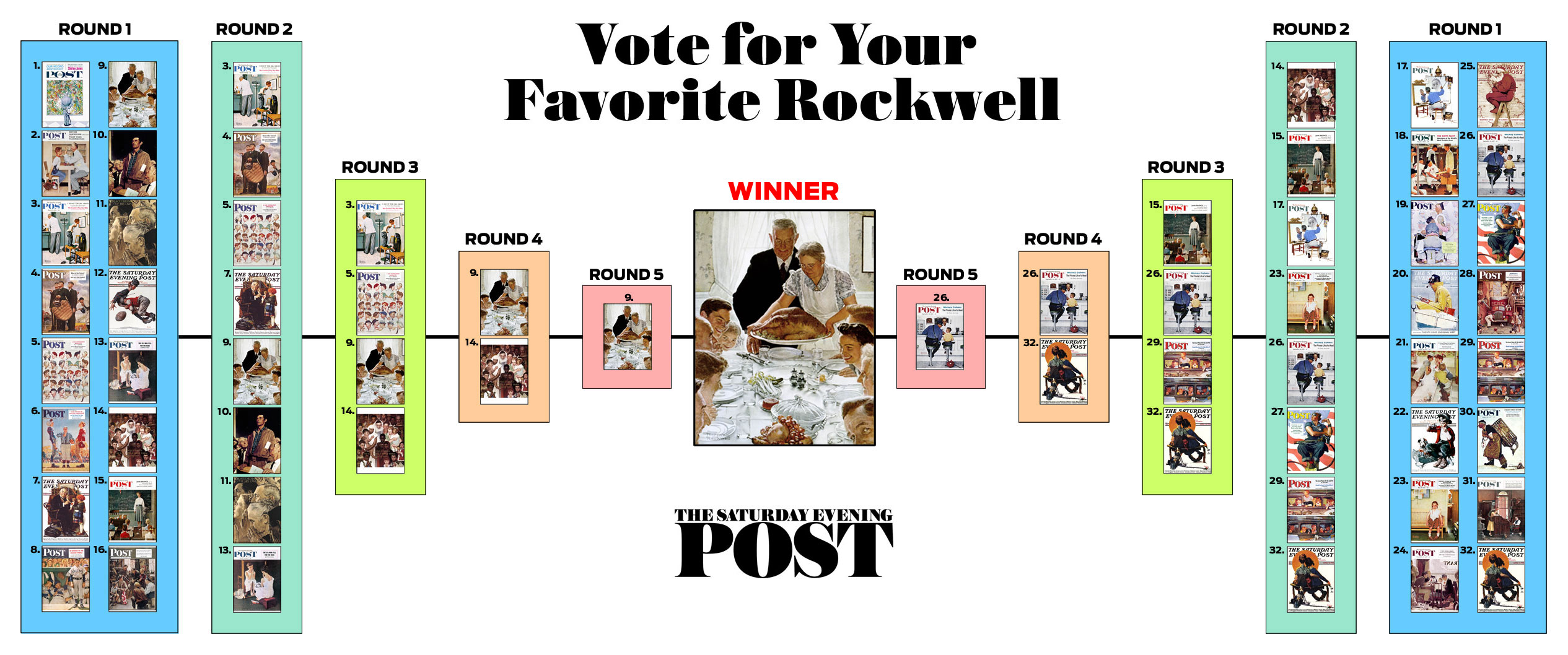
Or scroll down to view each image individually.
Click the numbers below to view the Rockwell contenders up close:
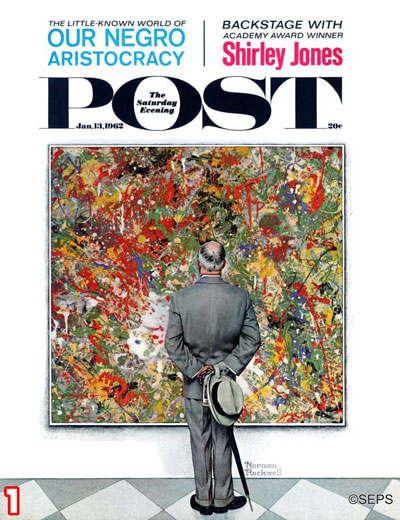
January 13,1962
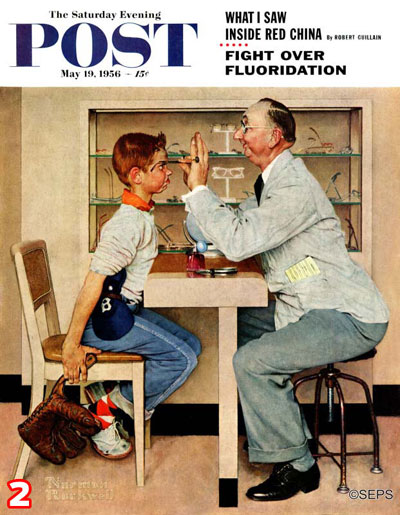
May 19,1956

March 15,1958
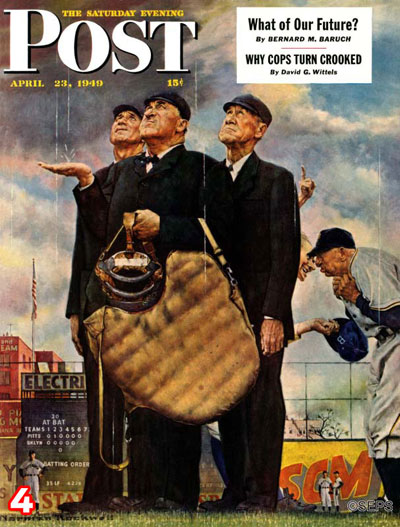
April 23,1949
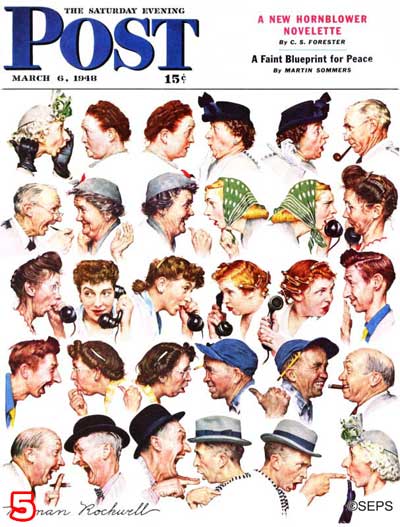
March 6,1948
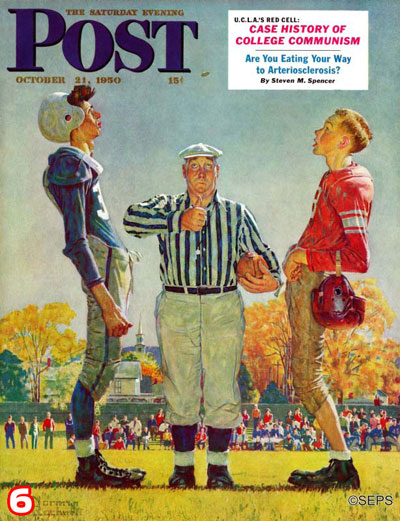
October 21,1950
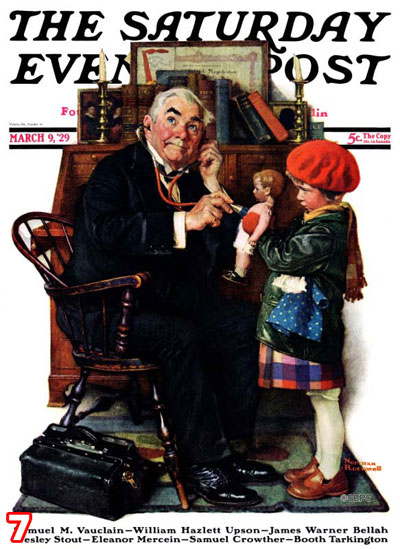
March 9,1929

September 4, 1948

March 6,1943
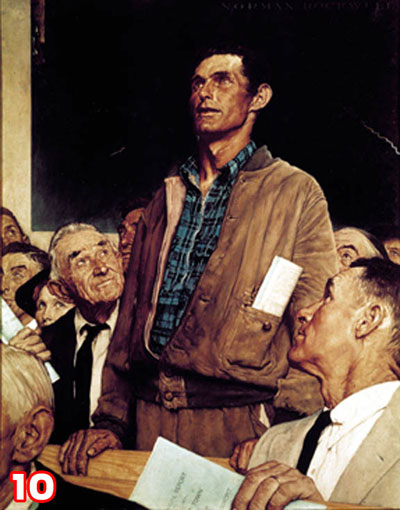
February 21,1943
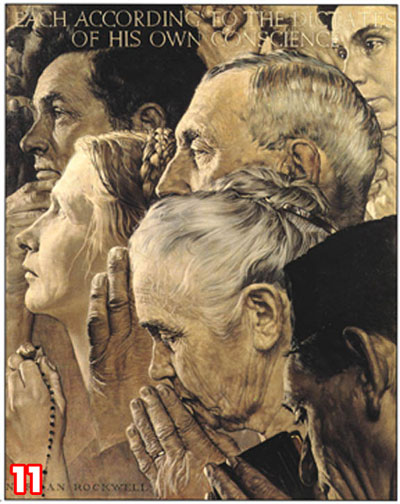
February 27,1943)
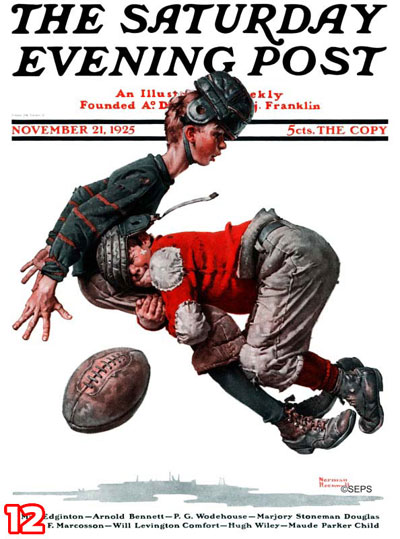
November 21,1925
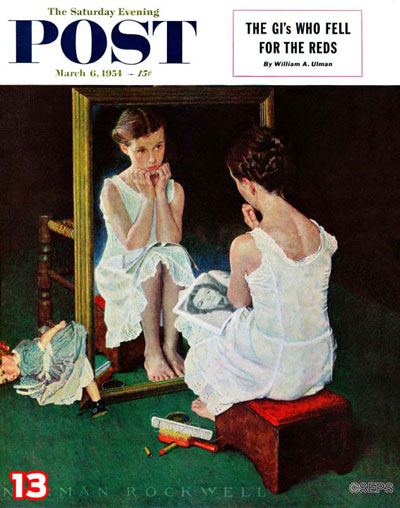
March 6,1954)
April 1,1961)
March 17,1956)

October 13,1945)
February 13,1960)
March 2,1957
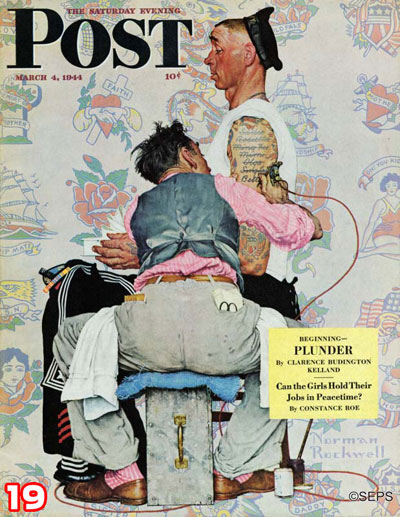
March 4,1944
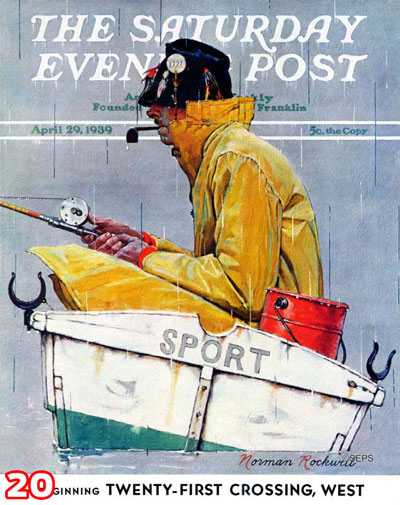
April 29,1939

August 22,1953
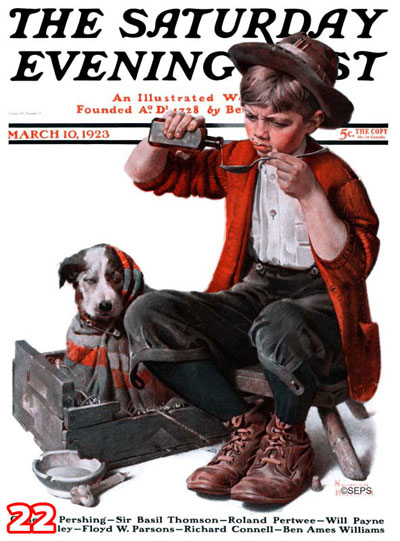
March 10,1923
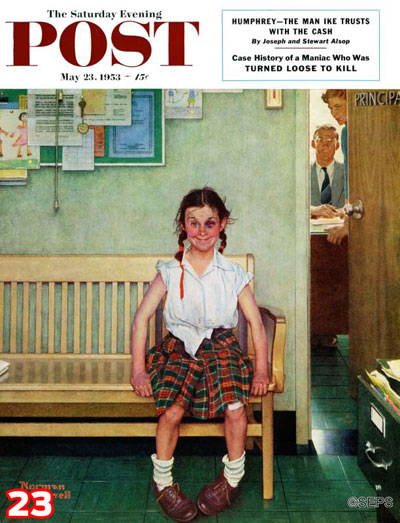
May 23,1953
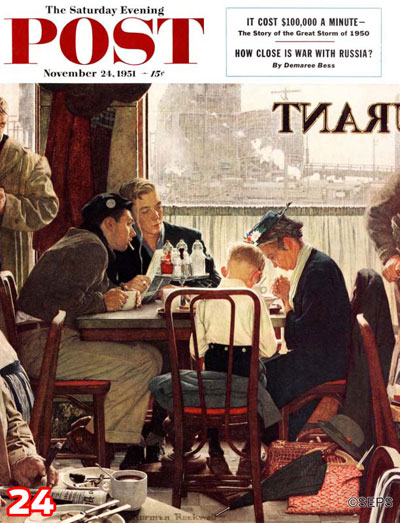
November 24,1951
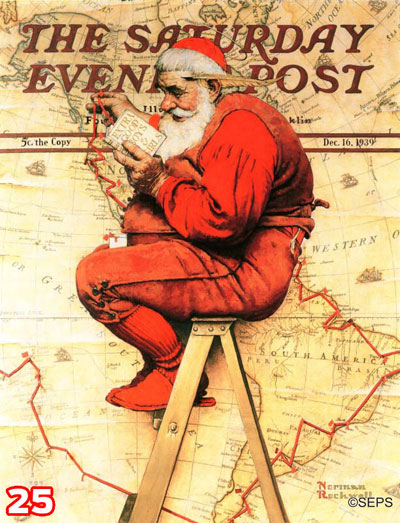
December 16,1939
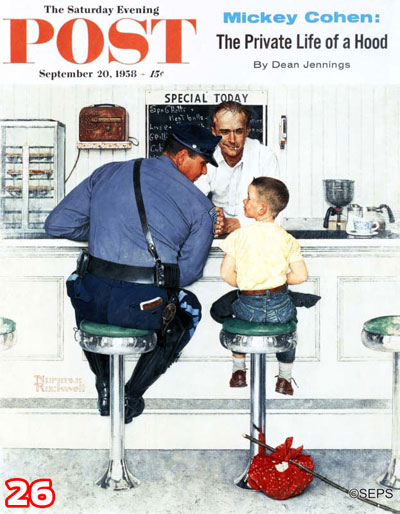
September 20,1958
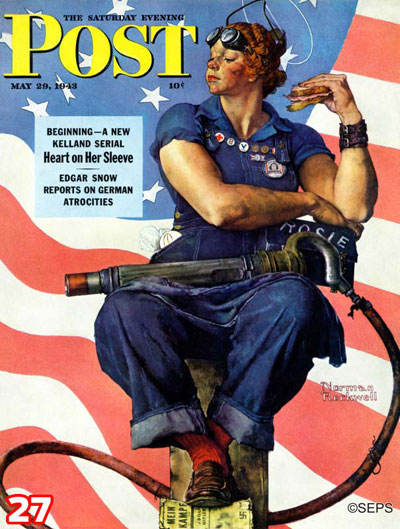
May 29,1943
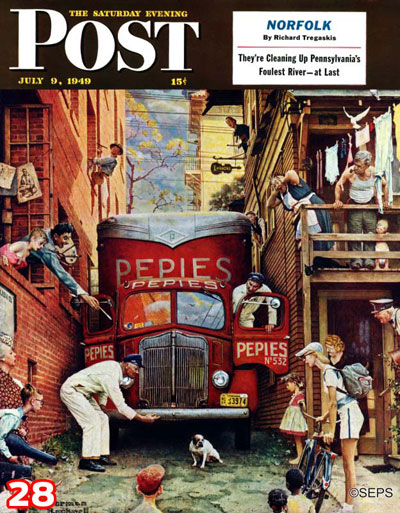
July 9,1949
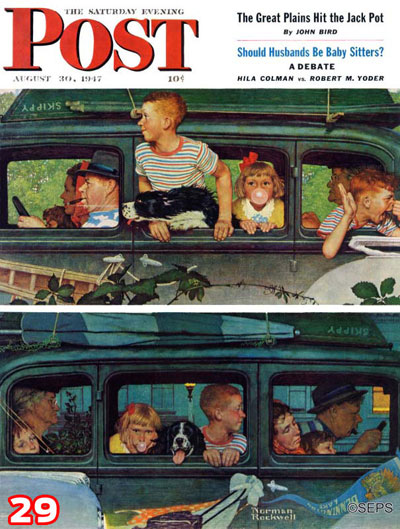
August 30,1947
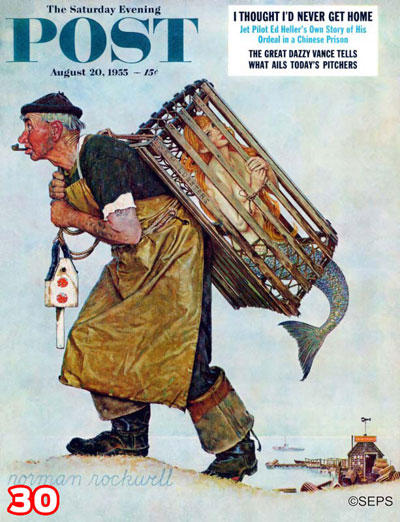
August 20,1955
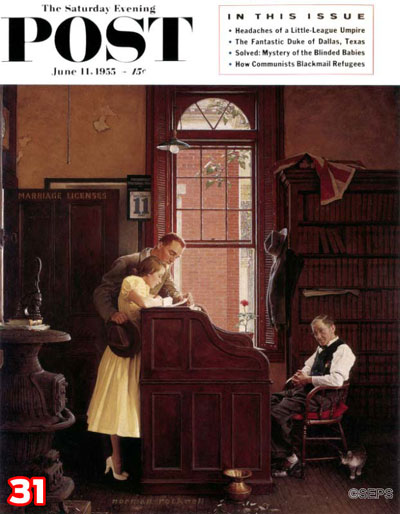
June 11, 1955
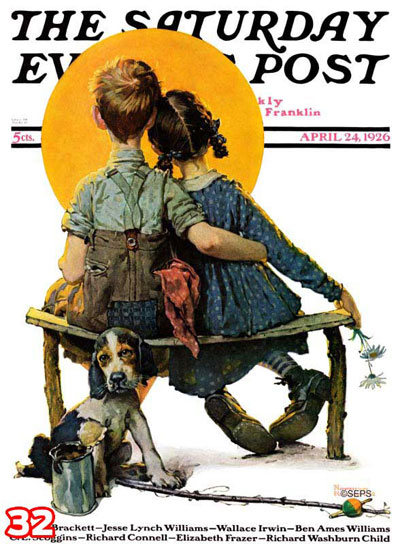
April 24,1926
News of the Week: Rockwell Gets Own Street; McCartney Dissed at Grammys; Inside TMZ
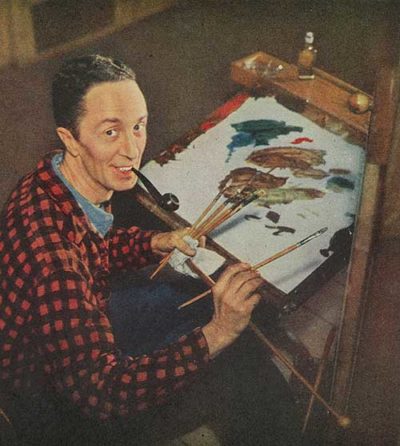
Norman Rockwell the Artist
From February 13, 1943
NYC Street to Be Renamed in Honor of Norman Rockwell
We love the iconic American artist Norman Rockwell here at The Saturday Evening Post, of course. But it turns out that the younger generation loves him too. Thanks to several students at Edward A. Reynolds West Side High School, the southeast corner of Amsterdam Avenue at 103rd Street in New York City is being renamed “Norman Rockwell Place” in honor of Rockwell. The students spent a year on their campaign, doing research, visiting the Rockwell museum in Stockbridge, Massachusetts, and making t-shirts, and they even went around the neighborhood to garner support for the name change.
Paul McCartney Not Allowed into Grammy Party
Let’s say you’re a really famous musician, maybe one of the 4 or 5 most famous musicians in the world. Let’s say you were at the Grammy Awards and you wanted to go to one of the after-parties. Do you think you could get in, or would the bouncer at the front door shoo you away?
That’s what happened to Paul McCartney this week after the Grammy Awards broadcast on CBS. In this video shot by TMZ we see McCartney and Beck being turned away from the Tyga party. Before this, I didn’t know if Tyga was the name of a musician, a band, a company, or a shoe, but they tried to get in and couldn’t. So they went back to their car and drove away.
Speaking of TMZ
Have you ever wondered how the gossip site TMZ always seems to get the scoop on celebrities’ dirty laundry? In this revealing New Yorker article, you’ll find out how they get their information, what they pay for it, and how they sometimes partner with celebrities on certain stories.
Pick Up Organic Carrots, Get a Tattoo
I know it seems like an odd idea, but Whole Foods might be getting into the whole tattooing thing. The grocery chain would partner with third-party vendors to provide tattooing services in their 365 stores, which cater to Millennials.
This could be the start of something. Other chains could get into the act. Going to Dunkin’ Donuts for some coffee? Get your oil changed! Picking up a snow blower at Home Depot? You can get your hair done there, too!
RIP Justice Scalia, George Gaynes, Vanity, Johnny Duncan
I really can’t add anything to the many tributes to Supreme Court Justice Antonin Scalia, who passed away at the age of 79, but for a good summary of his life and what he meant to people, you can read Justice Ginsburg’s touching statement about her friend, a rundown on his legal rulings, and this from The Atlantic on his remarkable life. The New York Times reprints the first mention of Scalia in the paper (when he was 16!), and even Stephen Colbert paid tribute to Scalia on The Late Show.
George Gaynes also passed away this week. He was 98. You might remember him from the TV shows Punky Brewster and The Days and Nights of Mollie Dodd and movies like Tootsie.
You might remember Vanity, aka Denise Matthews, from her work with Prince. She passed away this week too, at the age of 57.
You might not remember the name Johnny Duncan at all, but you’ve probably come across his work. He played Robin in the 1949 Batman movie serial, which TCM sometimes shows. He passed away at the age of 92. Here’s the first episode (and here are the other 14):
And RIP Harper Lee
Friday morning, we lost American novelist Harper Lee at the age of 89. People speak in awe of the tens of millions of copies her To Kill a Mockingbird has sold since it was published in 1960, but more impressive still is the effect the book has had on readers. In a January 2011 Post article called “Does Fiction Matter?” mystery writer Brad Meltzer answered the title’s question with a resounding “Yes” by pointing out a Library of Congress study that said that when asked which books had made a difference in their lives, the only book people cited more often than To Kill a Mockingbird was the Bible.
“Happy Birthday” Lawsuit Settled
I used to joke that you couldn’t sing “Happy Birthday” at a birthday party anymore without paying a royalty to the two sisters who wrote the song and the company that owned the copyright to the lyrics. Turns out that wasn’t true; you only had to pay for a public performance of the song. But no one has to pay now, because a federal judge has ruled that Warner/Chappell Music actually doesn’t own the rights to the lyrics. Under a deal, the record company will return $14 million in fees it had charged, and it will also no longer charge for the song’s use.
Warner/Chappell actually made over $2 million a year from the song. Every time I hear stories like this, I think of this scene from an episode of Sports Night:
National Grapefruit Month
It doesn’t seem right to have February be the month we celebrate the grapefruit, when it’s more likely to be cold and windy and we’re using the snow blower we just bought at Home Depot. But it’s here, and you still have a couple of weeks to celebrate. We know it’s good for your health — though you should make sure it doesn’t interfere with any medications you’re taking — and it’s a lot more flexible when it comes to recipes than I thought.
But Martha Stewart has you covered. (She always has you covered.) Here’s a recipe from Martha for jicama-citrus salad, one for a ginger-grapefruit spritzer, and one for grapefruit with pistachios. And have you ever thought about putting grapefruit in a sandwich? Of course you haven’t. But Martha has!.
Upcoming Events and Anniversaries
Malcolm X killed (February 21, 1965)
The leader appeared on the September 12, 1964, cover of The Saturday Evening Post.
President George Washington born (February 22, 1732)
Washington appeared on the cover of The Saturday Evening Post ten times.
House of Representatives votes to impeach President Johnson (February 24, 1867)
Johnson’s impeachment trial lasted 11 weeks.
Buffalo Bill Cody born (February 26, 1846)
Here’s SEP Archives Director Jeff Nilsson on “America’s First Superstar.”
Henry Wadsworth Longfellow born (February 27, 1807)
The poet’s work appeared many times in The Saturday Evening Post.
Dashed Dream
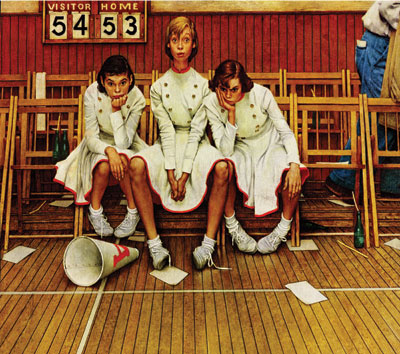
For Norman Rockwell, nothing was more exciting than the drama of everyday events. In “Losing the Game,” he captures a scene that could have taken place in any town USA. The home team lost by one point. Seats are empty. Even the janitor is walking off court. The only ones left are the three stunned, disappointed cheerleaders. In this simple setting, Rockwell demonstrates his mastery of technique and composition. Note how the parallel lines created by the gymnasium’s floor direct attention to the trio of cheerleaders who appear in triangular composition — all drawing viewers into the central scene so everyone can experience the moment. Rockwell once wondered, “How will I be remembered? As a technician or artist? As a humorist or a visionary?” Safe to say all of the above.
Christmas at Pop’s
(Image courtesy the Norman Rockwell Family Agency)
Christmas Day is on December 26. That’s what I thought my whole childhood, and even as an adult I continued to confuse it with the 25th. It’s because every year we went up to Pop’s house in Stockbridge, Massachusetts, the day after Christmas. Christmas at my grandfather Norman Rockwell’s was the highlight of that special season. They were the most magical Christmases of my life.
The memories are accompanied with such a vivid sensory awareness. We’d be greeted by Pop and my step-grandmother, Molly, at the kitchen door. The comforting smells of their cook Virginia’s food would surround and embrace us instantly. I would rush in to see the Christmas tree, running through the pantry, then through the hall with the creaky floorboard under the Arthur Rackham pen and ink, into the living room where I would stand in silence before the tree with its fresh pine scent. My favorite ornament was the little, gold guitar with actual strings and rhinestones, and I would search for it every year. The scent of the crackling fireplace in the library — where the adults would have their whiskey sours and the children would have ginger ale — hung in the air throughout the comfortable colonial house. I loved the after-dinner “job” of putting the candles out with the snuffer and watching the smoke mysteriously drift upwards from the extinguished flame. But what stays with me the most powerfully is the intoxicating scent of Pop’s pipe after he lit it, sitting in his big red armchair to the left of the fireplace. To this day on the rare occasion that I happen upon that scent, I am arrested by it and instantly taken back.
People would send my grandfather gifts every year. I remember winding up a music box in the bottom of a Scotch bottle and being entranced by the tiny Scottish dancer in a kilt turning to the tune of “Loch Lomond.” The Russian nesting dolls in the library were my favorite toy that I would play with faithfully, taking each doll out carefully and putting them together in a perfect lineup.
Norman Rockwell
January 25, 1936
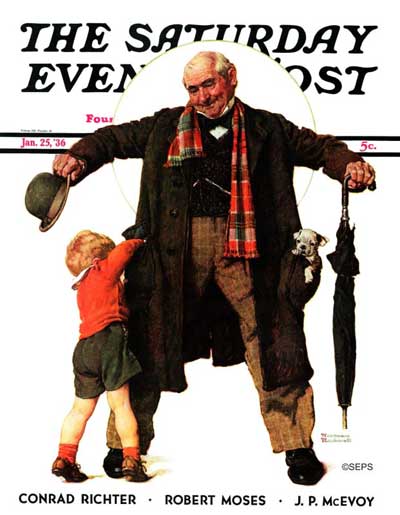
Norman Rockwell’s Christmas paintings are some of his most charming and heartening. His connection to Christmas was deepened in his childhood by his Uncle Gil, an eccentric inventor and scientist. Uncle Gil would bring firecrackers at Christmas to celebrate the Fourth of July, Christmas presents on Easter, and chocolate rabbits on Thanksgiving. The next year he would turn things upside down again and bring chocolate rabbits hidden in his pockets for the children on Christmas. Uncle Gil was a character straight out of Charles Dickens [https://www.saturdayeveningpost.com/2015/12/09/art-entertainment/art-and-artists/rockwells-dickensian-series.html], the great storyteller that had such a profound influence on my grandfather and his work. And I think somehow Uncle Gil became the embodiment of the Christmas spirit and this always stayed with Pop. He painted his memory of Uncle Gil in Little Boy Reaching in Grandfather’s Overcoat for The Saturday Evening Post cover, January 25, 1936. The little boy is my father, Thomas.
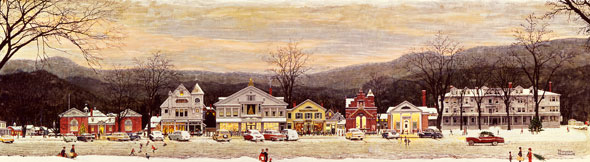
Home for Christmas (or, Stockbridge Main Street at Christmas) was painted for McCall’s December 1967 issue. It is one of my favorites. The main street of Stockbridge today still looks much the same. The little secret of the painting is the house with black shutters on the far right with all the windows illuminated and smoke coming out of its chimney — that was my grandfather’s home, with his barn red studio next to it, where we spent every Thanksgiving and Christmas. I still dream of that house.
It is easy to get lost in the details of this painting. It is full of life, movement and Yuletide festivity: children playing, shoppers with packages rushing home, cars in transit, people going into the library. But it is the less noticeable details that have always captured my interest. Some windows have candles in them, others don’t but instead have their blinds drawn. Some cars are parked correctly; others are a bit askew, presumably because the snow has erased the lines. I love the visible car tracks in the snow and all the different makes and models of automobiles; the newest one of that Christmas looks a bit like the Volkswagen Beetle, the blue car just left of the darkened inn.
The Red Lion Inn was closed at this time because it had fallen into neglect after one owner, Robert Wheeler, had misguidedly attempted to refashion it as a “motor lodge.” His endeavor failed and the inn went dark, intended for demolition in 1968; a gas station was planned in its place. It was saved by the Fitzpatrick family who purchased the inn that same year; they have run it ever since. Stockbridge is a small town of tradition and neighborly kindness and community — it is what Pop loved about it. That, and the wonderful townspeople he found to paint.
My grandfather’s first studio in Stockbridge was in the building with the big plate glass window with the Christmas tree. It was his studio from 1953–1957. He had the picture window installed to get the north light. At the very far left of the painting is The Old Corner House, the original site of the Norman Rockwell Museum, the white colonial with porch windows.
Pop painted the landscape with a delicate, primitive feel, choosing to layer somber transparent tones of grays and browns. The sky is the perfect cold winter sky after the sun has quickly set. All of these bleak colors serve as a contrast to the brilliant yellow light of the bustling town and vibrant Christmas decorations. It is through this important sense of contrast that the meaning of the holiday season is quietly illuminated — finding the light at the peak of the darkest month.
Many holiday blessings to everyone for a wonderful Christmas and Hanukkah! May the light we find in this season carry us through this next year and usher in a time of increased kindness and peace — in spite of everything we are facing around the world right now.
Warmest wishes,
Abigail
P.S. I just gave the Norman Rockwell Museum Archives my finalized, detailed list of the numerous errors and omissions in the recent fraudulent biography of Norman Rockwell, American Mirror, published in 2013. As many of you know, it is because of this biography that I was compelled to start my “Rescuing Norman Rockwell” Facebook page. The extensive list is not just a refutation of falsifications based on my investigation of the primary sources — it presents a true portrait of my grandfather and his life, including many details and memories that I learned from my father, Thomas Rockwell, Pop’s middle son. It will serve as a guide for future Norman Rockwell biographers and scholars. I am happy that this page that started out as a fight to have the truth heard has ended up being a celebration of Norman Rockwell and his work.
Special thanks to Laura Claridge for her comprehensive research in her 2001 biography, Norman Rockwell, A Life. Her biography was a considerable help to me in my investigation.
Rockwell’s Dickensian Series
In 1920, Norman Rockwell approached George Horace Lorimer, the Post editor at the time, with a series of Christmas covers spanning an entire decade. Typically, Lorimer would not have been in favor of such a committed move but the theme of these covers centered on the stories of Charles Dickens. Rockwell happened to know his boss was a huge Dickens fan and even went so far as to dedicate the first picture to Lorimer; a bold and heartfelt move, for sure. Thanked with a handshake from his boss, Rockwell trailed ahead with the green light and brought forth this famous Christmas series.
Merrie Christmas
Norman Rockwell
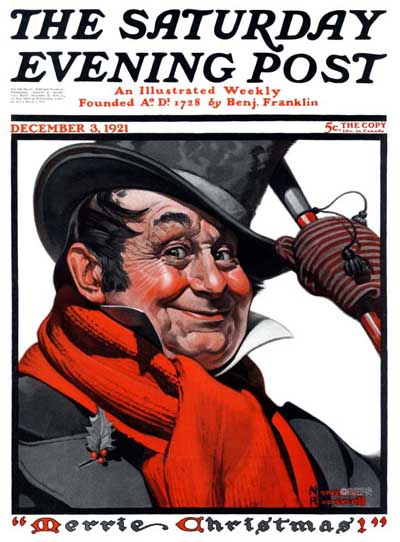
December 3, 1921
Here we have the first picture of the Dickensian series. As previously mentioned, this jocular man wearing a 19th-century hat and holding a cane was dedicated to the Post editor at the time, George Horace Lorimer.
Christmas Trio
Norman Rockwell
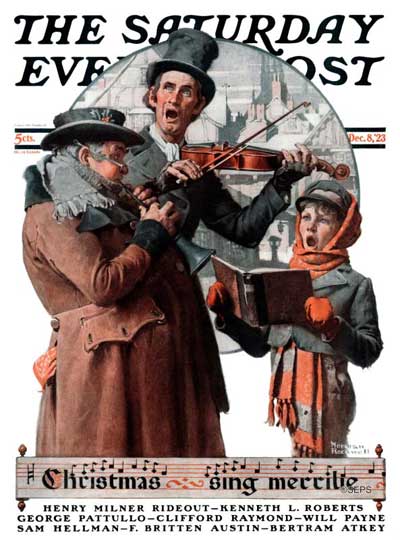
December 8, 1923
Dickens’ portrayal of Victorian society in London captivated Rockwell. He especially admired the street-corner musicians, talented ragamuffins who depended on the kindness of strangers. Interestingly enough though, in spite of how convincing their talent might appear, not one of the models could sing or play!
Couple Dancing Under Mistletoe
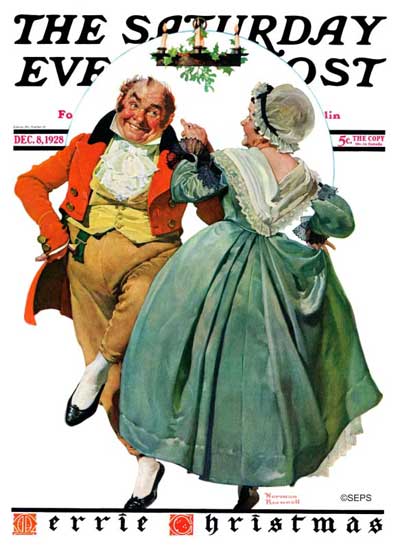
Norman Rockwell
December 8, 1928
The light of Christmas spirit here could enliven even the gloomiest heart. Inspiration for this cover came from the scene in A Christmas Carol when Mr. Fezziwig, the benevolent master of young Ebenezer Scrooge, shows his guests how to dance.
Coachman with Whip
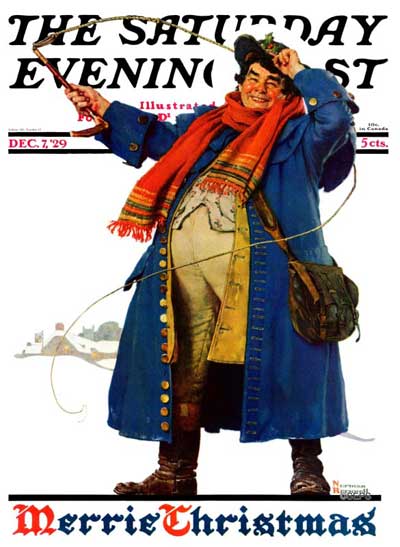
Norman Rockwell
December 7, 1929
Although this joyful taskmaster appears to be without a care in the world, America was heading for troubled times. The stock market crashed on October 29, 1929. Some were unsure if the magazine would survive the downtrodden economy, but Lorimer believed it would. Sure enough, when the issue hit newsstands people lined up to buy it with their precious nickels in hand.
Merrie Christmas—Norman Rockwell
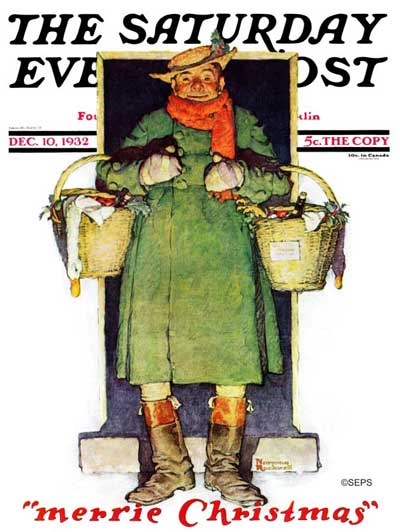
Norman Rockwell
December 10, 1932
Inspired by the generosity of his neighbors after the birth of his son a year prior, Rockwell depicted a Dickensian character cradling two heaping baskets of food. Lorimer signed off on the sketch, undoubtedly moved by the image of plenty as America still faced the turmoil of the Great Depression.
God Bless Us Everyone—Norman Rockwell
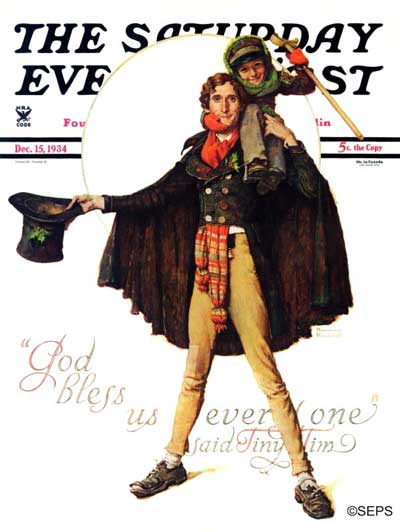
Norman Rockwell
December 15, 1934
Tiny Tim’s feature on the Post hit stands one day before the release date of the movie A Christmas Carol. Although competitors of The Saturday Evening Post had a name for the magazine’s uncanny cover timing — “Post Luck!” — this didn’t happen just by chance. Lorimer caught wind of when the movie would appear on the big screen and contacted Rockwell 11 months before the issue’s publication date to propose this cover.
Under the Mistletoe—Norman Rockwell
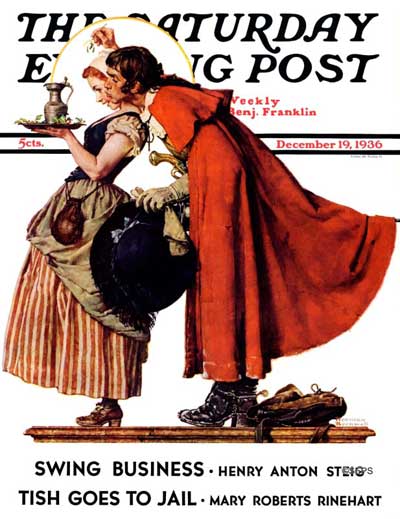
Norman Rockwell
December 19, 1936
Here, the story of a traveling cavalier at a friendly tavern, armed with an even friendlier sprig of mistletoe, unfolds…
Merrie Christmas
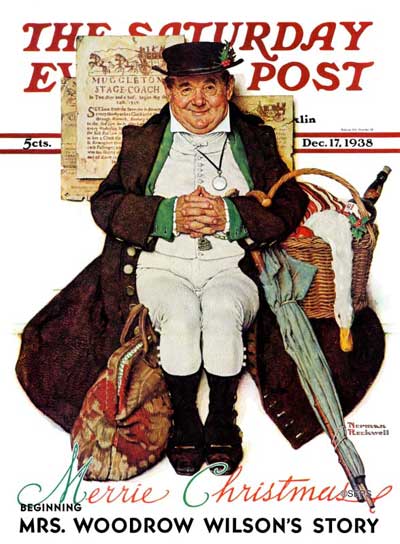
Norman Rockwell
December 17, 1938
Are you beginning to notice a trend in the titles? With instructions from the new Post editor to represent Dickens’ stories literally, Rockwell had to ditch his creative interpretations. This third Merrie Christmas cover depicts Pickwick patiently waiting for the Muggleton Stagecoach.
A Rockwell Thanksgiving Portrait
Norman Rockwell
Life magazine
November 17, 1921
Happiest of Thanksgivings, my friends!
Thanksgiving couldn’t come at a better time this year. It is the perfect moment to gather round, get together in appreciation — of one another and our lives. No matter what is going on in your life — challenging or glorious — there is so much to be grateful for.
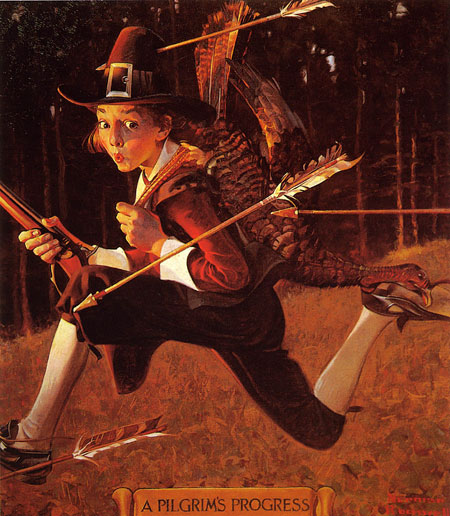
A Pilgrim’s Progress is a painting Norman Rockwell did for Life magazine for its November 17, 1921, cover. His first Post cover was in 1916; in just five short years it is remarkable how much my grandfather improved his technique.
To look at his use of light in this image — that powerful, golden, focused light of the setting sun hitting the pilgrim boy’s face — creating deep shadows, drama, and movement. Compare this boy’s fully realized face to the faces of the three boys in his first Post cover (it was actually only one boy, Billy Payne, who posed for all three).
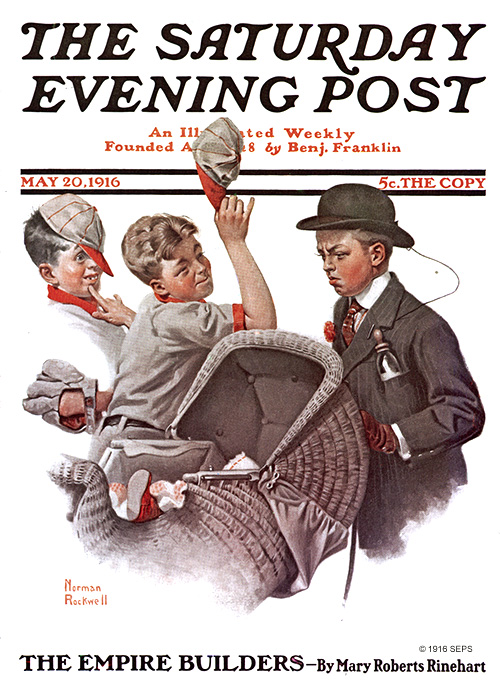
Norman Rockwell
May 20, 1916
The pilgrim’s face is slightly caricatured, but it reveals a marked improvement on his approach to a child’s face. You can feel the bone and muscle structure; see the skin texture and the natural blush of youth.
I can only imagine how Pop captured this image realistically — he must have somehow convinced the model to stand with his legs stretched out on blocks. How many quarters must Pop have had to pay that poor boy to get him to stay in that pose long enough? The extreme clarity of the feathers on the arrows following and surrounding the “poaching” pilgrim provides a playful sense of movement and draws your eye into the picture. The arrows are flying toward the light. The dark woods behind him help to emphasize the importance of the light source and the sense of comedic drama.
My grandfather never rested on his laurels, he always kept looking for ways to improve his technique and step out of his comfort zone. It doesn’t matter what you do — baking, painting, singing, composing, writing, landscaping — it is the intent and craft behind what you do that make it valuable.
One of the most powerful, inexhaustible fuels in this life is appreciation.
Warmest wishes,
Abigail
A Salute to Veterans
Tributes to the military have long been portrayed on covers of The Saturday Evening Post, from situations serious to humorous. In honor of Veterans Day, we would like to share some of our favorites.
The first Post military cover? An action depiction of U.S. soldiers on horseback in the Philippines.
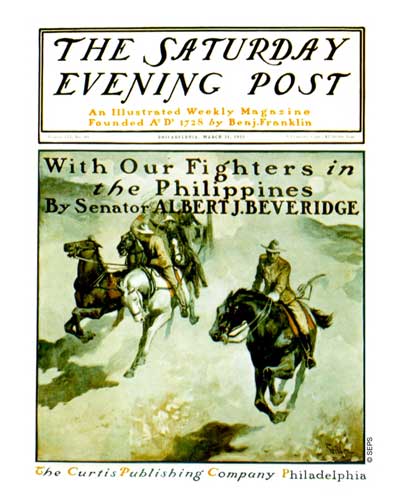
George Gibbs
March 31, 1900
He’s in the Army now. A seldom seen cover from December 1942 by John Atherton shows a faithful dog and a photo. From the uniform, we can guess where its master is. We hope he returns home soon – Spot is itching to go hunting.
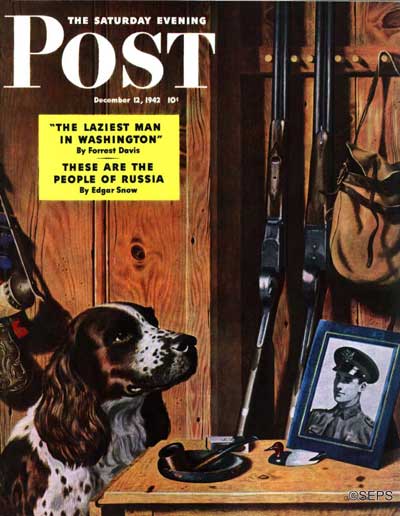
John Atherton
December 12, 1942
The enlisted also included members of the Women’s Army Corps (WAC), as shown in the cover from 1942 by an artist named Gilbert Bundy.
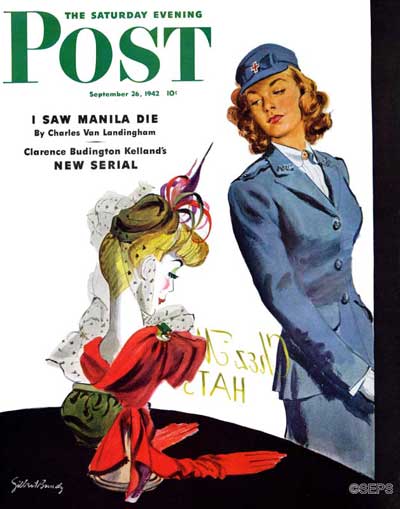
Gilbert Bundy
September 26, 1942
A WWI soldier shares a humble Christmas meal in this endearing 1917 cover by the prolific J.C. Leyendecker.
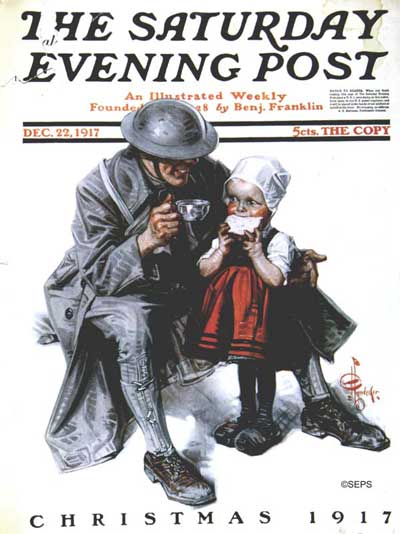
J. C. Leyendecker
December 22, 1917
On the May 14, 1927, cover by E.M. Jackson, this sailor accomplishes an important mission overseas — finding a genuine American hot dog!
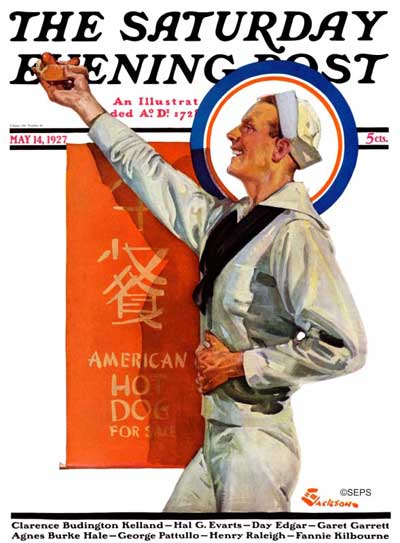
E.M. Jackson
May 14, 1927
Celebrating soldiers, sailors, and marines, the 1937 cover by John Sheridan captures all three with a parade below in their honor.
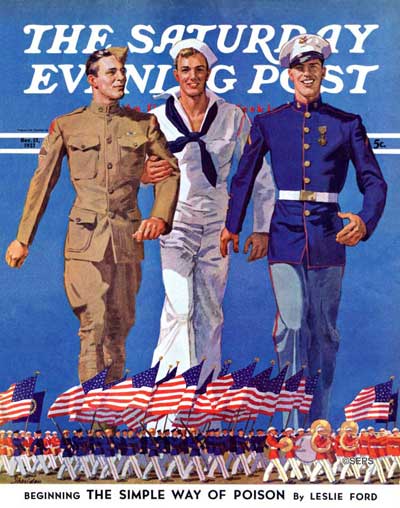
John Sheridan
November 13, 1937
Norman Rockwell honored the military during the WWII years with several covers of the “every soldier” he named Willie Gillis. We’ve shown Willie’s military adventures before, but not this one from 1941. Rockwell’s famous private is home on leave, snuggled under the quilts and enjoying the luxury of sleeping late. The sign above the bed echoes our ardent wish for all our military men and women: Home Sweet Home.
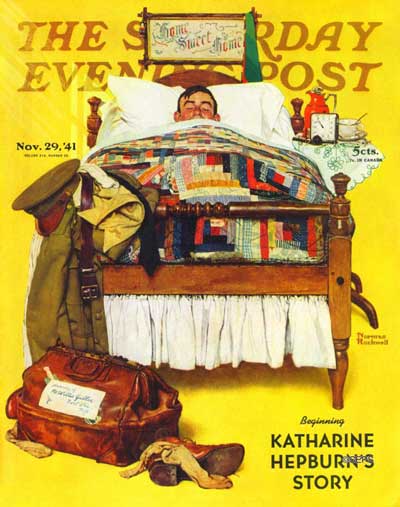
Norman Rockwell
November 29, 1941
After Forest Gump, actor Gary Sinise became an advocate for wounded soldiers. Check out Jeanne Wolf’s interview with Sinise from the September/October 2014 issue here.
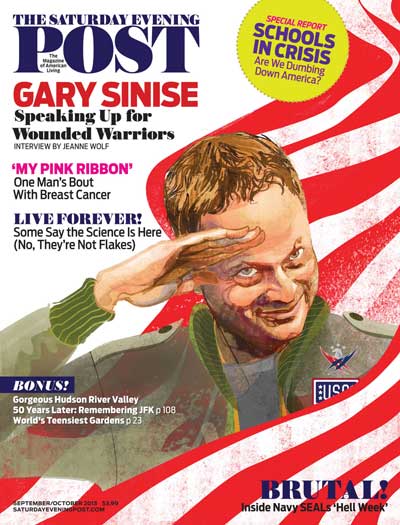
John Jay Cabuay
September/October 2014