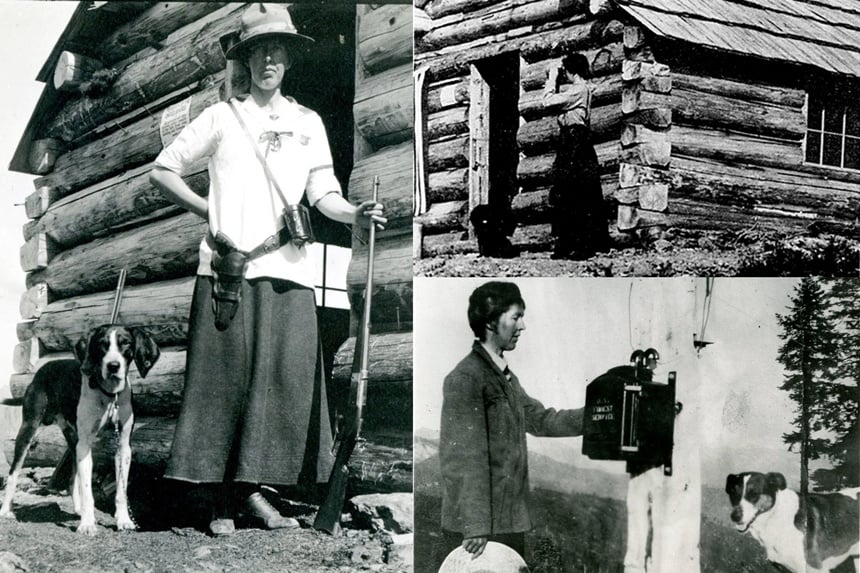
In early May 1913, Assistant Fire Ranger M.H. McCarthy told his boss that he thought he had found a great applicant for the position of fire lookout at Eddy’s Gulch Lookout Station in northern California. In a letter to W.B. Rider, supervisor of the Klamath Forest, McCarthy told his boss, “The novelty of the proposition which has been unloaded on me, and which I am now endeavoring to pass up to you, may perhaps take your breath away, and I hope your heart is strong enough to stand the shock.”
McCarthy believed the best person for the job that summer was a 30-year-old woman named Hallie Morse Daggett. He described her as “an ardent advocate of the Forest Service…devoid of the timidity which is ordinarily associated with her sex as she is not afraid of anything that walks, creeps, or flies.” For the next decade and a half, Daggett would spend months in the Siskiyou Mountains keeping watch in the Eddy’s Gulch Lookout Station.
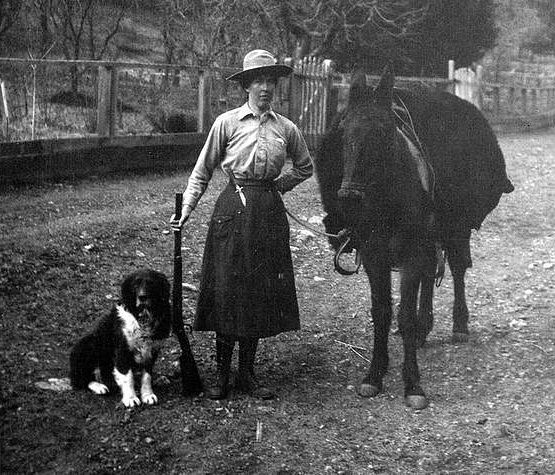
The news of her job appointment spread across the country, such as the announcement in the Maryland Suffrage News informing readers, “It is said Miss Daggett is the first woman in the service. It will be her main duty to watch for forest fires.” In Indiana, The Richmond Palladium and Sun-Telegram posted news of her job, placing it immediately below a help wanted ad for a maid: Daggett would be “situated on a peak of the Salmon Alps, six thousand feet high. Her duty is to keep a lookout for fires and report to the nearest forest station.”
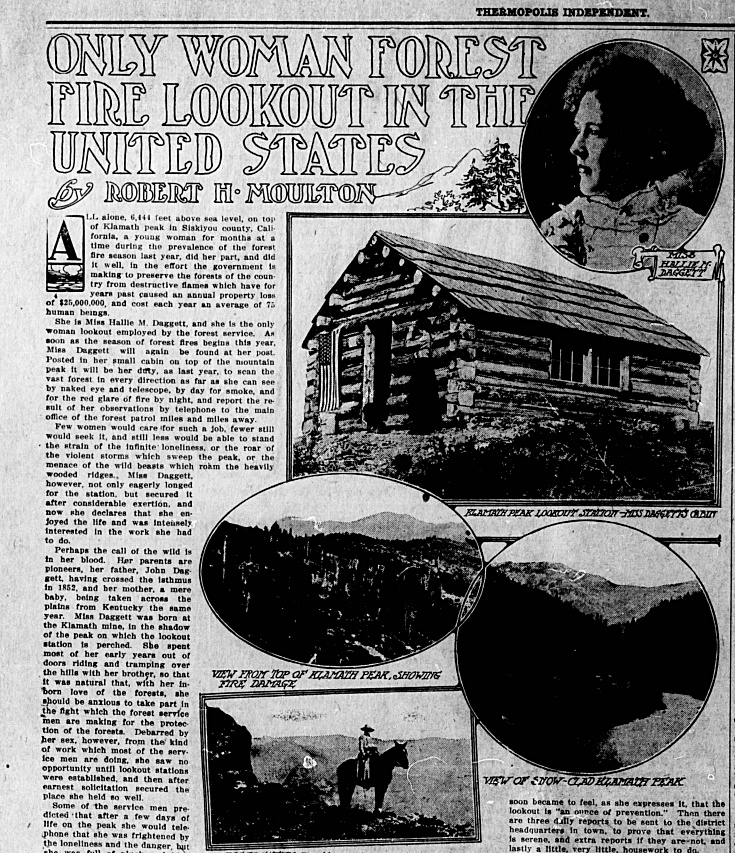
Daggett’s new job fascinated readers. The Thermopolis, Wyoming, Independent ran a feature on her in December 1914, with the headline, “Only Woman Forest Fire Lookout in the United States,” noting that hers was a job that mattered, part of “the effort the government is making to preserve the forests of the country from destructive flames which have for years past caused an annual property loss of $25,000,000, and cost each year an average of 75 human beings.” Even nearly a year after the end of World War I, her work continued to draw interest, as with a piece in the August 14, 1919, issue of The Daily Ardmoreite (Ardmore, Oklahoma). Daggett described her work as “fascinating,” telling reporter Dora Simpkins that she believed she was “doing something for our country.”
Watching for fires was important work, and continued to be in the decades that followed, as the Civilian Conservation Corps built thousands of towers in the 1930s. Some were operated by the Forest Service, the same agency that had hired Daggett, but protecting the nation’s forests fell under a number of different organizations. (Today, the National Interagency Fire Center helps coordinate firefighting responses between the U.S. Forest Service, Bureau of Land Management, Bureau of Indian Affairs, the National Park Service, and others.) As men went off to war in the 1940s, opportunities for women expanded in the Forest Service and other agencies that needed people to staff the towers and take on work men had left behind. Yet even by the middle of the twentieth century, fighting wildfires was not a task deemed suitable for women.
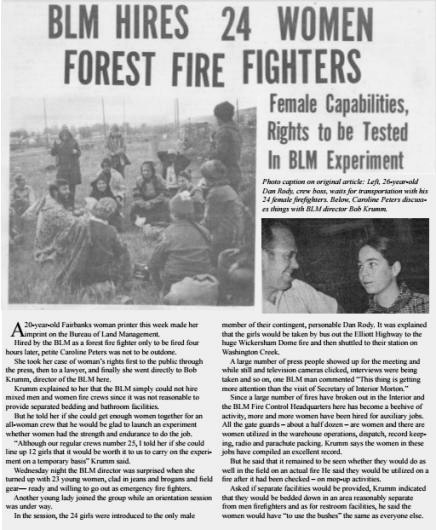
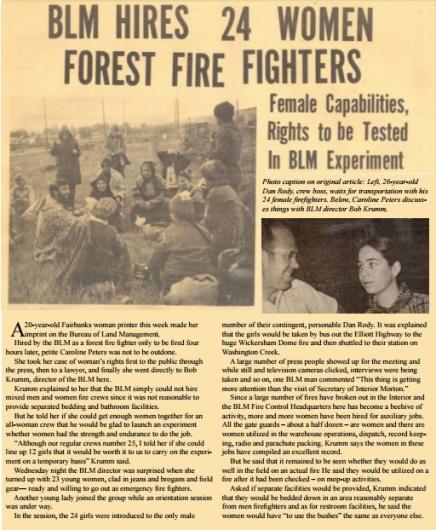
In the summer of 1971, that began to change as women in both Alaska and Montana pushed to take their places as wildfire fighters. In Alaska, the director of the Bureau of Land Management told 20-year-old Caroline Peters that it wouldn’t be possible to have men and women on the same firefighting team. It would just be too much to try to accommodate separate living and bathroom arrangements in the field. However, he was open to the idea of an all-woman team, if enough women could be found: “It would be worth it to us to carry on the experiment on a temporary basis.” The 24 women went on to help fight the Wickersham Dome fire that summer outside of Fairbanks.
At the same time, the U.S. Forest Service in Montana was also giving women the chance to fight wildfires with their new special training program that enrolled 20 women in the summer of 1971. According to the New York Times, the idea had been proposed by a woman on the Forest Service staff a year earlier. The 20 women in the program completed training in the classroom and in the field, and they were ready to go to work that summer.
More women joined the efforts to fight wildfires during the 1970s, including Deanne Shulman. In 1974, Shulman began her work fighting wildfires in California. In 1975 and 1976, she was part of helicopter-based helitack crews fighting fires. Her work was considered strong enough that in 1977 and 1978 she moved to hotshot crews, teams of firefighters who are given the “most challenging terrain and/or priority wildfire incidents throughout the country.” In 1979, Shulman decided to go further: She applied to become a smokejumper, someone who parachutes directly into wildfires to fight them. At that point, no woman had ever served as a smokejumper.
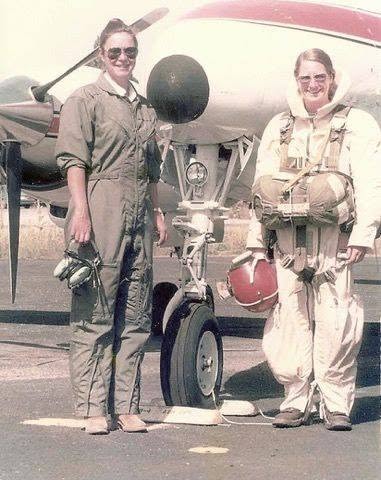
Shulman passed the physical test for smokejumping, but came in a few pounds under the weight requirement, “so they terminated me on my second day. I’d passed the physical fitness test and all that and they just terminated me,” she said. Shulman learned, however, that the weight requirements were not always strictly followed for men, and pursued a grievance process with the Equal Employment Opportunity office. In 1981, Shulman became the first woman smokejumper in the United States.
Today, about 4 percent of smokejumpers are women, as are 12 percent of permanently employed wildland fire fighters hired by the government. That number doesn’t include everyone involved in fighting wildfires. In 2025, about 800 incarcerated firefighters helped put out the wildfires in southern California. The state maintains two camps — the Malibu Fire Camp and Puerta La Cruz Fire Camp — made up entirely of women.
Hallie Daggett stood far above the forest in her lookout tower. Deanne Shulman jumped down into the flames. Summer after summer, American women continue to take our breath away in their work to fight wildfires.
Become a Saturday Evening Post member and enjoy unlimited access. Subscribe now

Comments
Great stuff as always, Tanya!
A woman manning a fire tower has a small but very significant role in Train Dreams (both the novella and the film), and I really enjoyed the chance to think about the broader contexts for her character.
Ben